Tuesday, May 09, 2006

The More Things Change

The value of sustainability depends on what one is sustaining. In earlier posts, I've discussed the role of GOP nepotism in wind-farm siting; the idea of a solar-powered empire; and the outlook for environmentally friendly torture.

All of which ties in, to my mind, with Tom Philpott's article on the latest doings at Archer Daniels Midland:

The ascension to CEO of Patricia Woertz, most recently executive vice president at Chevron, marks the end of a four-decade run at ADM's top by the Andreas family. That venerable clan, whose chicanery runs from a key role in the Watergate scandal to a price-fixing scheme in the 1990s, built ADM into one of the U.S.'s most politically connected corporations. Congressional beneficiaries of ADM's campaign generosity likely need not fear; G. Allen Andreas, who has served as CEO since 1997 (when his uncle and predecessor was convicted of fixing the price of lysine, a corn product used in animal feed), will stay on as chairman of the board of directors....

The move eloquently signals ADM's intention to continue its rush into the auto-fuel market. The company has made billions over the years extracting the Midwest's soil fertility and transforming it into crappy food products like high-fructose corn syrup, buoyed by government commodity policy and the sugar quota. Now it intends to do the same in service of the internal-combustion engine.
Needless to say, Philpott goes on to explain that there's nothing remotely "green" about ADM's ethanol. From cashing in on government subsidies that reward overproduction of corn, to triggering an environmental and economic crisis in Brazil, ADM's approach to biofuels is expensive and dangerous. (A few years ago, the CATO Institute claimed that "every $1 of profits earned by [ADM's] ethanol operation costs taxpayers $30.")

But then, as Dwayne Andreas of ADM once said:
"There isn't one grain of anything in the world that is sold in a free market. Not one! The only place you see a free market is in the speeches of politicians."
Ms. Woertz, unsurprisingly, sees growth potential for ADM:
[W]e see significant trends that allow more protein-intensive diets and so forth in much of the world, particularly Asia. We see a shift in renewable energy supplies being needed.
As with the ostensibly cheap food that factory farms produce, consumers pay for ethanol three times: They pay for subsidies and R&D funding to industry; they pay at the cash register; and they pay for the external costs of any social and environmental problems that arise from unsustainable production techniques (which include, for those who are keeping track, the costs associated with illegal immigration).

Monday, May 08, 2006

A Lethal Coalition


Over at NRO, Kenneth Green argues that climate-change "alarmism" is on the wane. His evidence, not surprisingly, consists of lies and non sequiturs:

Michael Crichton’s State of Fear...has educated millions of readers about climate science. Parody sites such as The Onion and ecoenquirer.com are heaping scorn on scientists who are increasingly sounding like angry authoritarian oracles.
And why not? What are research and data, compared to the scorn of parody sites, and the ravings of a hack novelist? (Just for the record, I searched the Onion's archives for terms like "climate change," "global warming," "atmosphere," "climatologists," and "greenhouse," but I didn't find anything that matches Green's description.)

Green attacks "the positively silly idea of establishing global-weather control by actively managing the atmosphere’s greenhouse-gas emissions." Demonstrating a fearsome grasp of climatological terms and methodology, Green helpfully explains that his ideological opponents comprise a "lethal coalition" of "one-worlders" and other "temperance fiends" who hate "fossil fuels, cars, large houses, urban sprawl, highways, rich people, fat people, industrial economies, airplanes, meat consumption, non-recycled paper, and just about everything else that might make someone smile."

But he sees a silver lining:
One used to hear near unanimity among the scientists beating the drum of climate alarmism. There was, invariably, only one possible course of action supported by “the consensus of scientists”: reducing greenhouse-gas emissions immediately, even if it meant the collapse of national economies. Not any more. On April 18, a group of 90 scientists wrote an open letter to Canada’s prime minister observing that “Advances in climate science . . . have provided more evidence supporting the need for action and development of a strategy for adaptation for projected changes.” The group goes on to emphasize that as “mitigation measures will become effective only after many years . . . adaptive strategies are essential and must begin now.”
This emphasis on "adaptive" response, needless to say, is necessary in part because the industry-funded antics of morally dysfunctional denalists like Green made taking timely action impossible.

More to the point, though, Green is lying consciously and with malice aforethought. Here's what the letter in question actually says:
There is an increasing urgency to act on the threat of climate change. Stopping the growth in atmospheric greenhouse gas concentrations by reducing emissions would also have benefits for air quality, human health and energy security. But since mitigation measures will become effective only after many years, adaptive strategies are essential and need to begin now.
You don't have to be a "one-worlder" to understand that these scientists are saying we should immediately reduce emissions, while preparing for serious problems. The letter shows plainly that the experts whom Green hails as representative of "cracks in the climate coalition" are predicting scenarios he calls "alarmist," and recommending actions he calls "positively silly."

At the risk of being uncivil, what a despicable fucking asshole this guy is.

A Little Light Reading


Subtopia discusses the work of Eyal Weizman, who has written extensively on "military urbanism" in Palestine:

Through his depictions of the verticality and three-dimensional spatiality of a military controlled urban landscape, Weizman also produced an amazingly coherent set of maps of the West Bank in conjunction with B’tselem, the Israeli Information Center for Human Rights in the Occupied Territories, which reveals in a frightening visual display, the invisible geospatial complexity that has shaped an urbanism of the Israel-Palestinian conflict over the last 20 years.
Scientific American discusses new research on the mixture effects of common chemicals:
Biologist Tyrone Hayes and his colleagues at the University of California, Berkeley, have spent the past four years testing four herbicides, two fungicides and three insecticides commonly used in American cornfields. Individually, the chemicals had little effect on developing tadpoles at low concentrations, such as about 0.1 part per billion. But when Hayes exposed them to all nine at the same low level in the laboratory--the lowest level actually found in the field--the future frogs fell prey to endemic infection. Those that survived ended up smaller than their counterparts raised in clean water--despite taking longer to mature into adults.
Echidne locks horns with fundamentalist sexuality:
I understand the fear of rape and sexual violence in general, but I don't understand the fear of sex as such, the fear of sex so strong that it surpasses the fear of death. This idea of sexual license as an apocalypse, the end of everything. What would it actually end? Would there be copulation out in the streets? And if so, how many days would that last? Wouldn't people still need to eat and work and sleep and take care of their children?
Engineer-Poet explains a few things about high gas prices:
Most of this [Wahhabism] was paid for by the Saudi government and private patrons, financed by your spending at the gas pump. Yet when George W. Bush declared that your post-attack role was to go out and spend to prop up the economy, you didn't demand that Detroit help you to cut that monster off at the knees. Instead, you yawned when Congress gave huge tax breaks for any large (and thirsty) vehicle used "in a business"... and then bought plenty of Explorers and Durangos and Escalades and Avalanches yourselves, most of you just to look cool.

You had at least four years and two elections to express your displeasure to those folks you sent to Washington, four years to trade in that guzzling vehicle for something that wouldn't feed that monster in the Middle East, four years to act either collectively as voters or individually as consumers. You blew it, sleepwalking into the crisis.
And last, the Office of Civilian Radioactive Waste Management is pondering "The Monumental Task of Warning Future Generations":
Design ideas for the monuments and markers have been drawn from a broad range of sources: Yucca Mountain’s natural conditions, worldwide archeological studies, materials science, and verbal and symbolic linguistics. The monumental challenge is to address how warnings can be coherently conveyed for thousands of years into the future when human society and languages could change radically.
A monumental task, indeed...especially when one sees how difficult it is to make present generations understand present threats.

Friday, May 05, 2006

Friday Nudibranch Blogging


This is Tritonia diomedea, who, by an amazing coincidence, happens to be in the news today:

"Tritonia is one of the testing grounds for a lot of ideas for how nervous systems work," says Wyeth. "Field work with this organism is helpful because it gives you a good idea of how to set things up in the lab."

[T]hey respond to odors and other sensory cues by initiating beneficial navigational behaviors, including escaping from predators by swimming up into water currents that hurl them (un-sluggishly) end over end downstream and away from harm, as well as crawling aggressively (for slugs) upstream to breed and feed. The observations also correlated with earlier studies suggesting that sea slugs flatten out their bodies to reduce drag when they encounter strong water currents, a behavior that helps them avoid being swept away....

The observations that sea slugs navigate with respect to water flow and direction based on odor and other cues will inspire further studies of this behavior and aid scientists studying the nerve cells involved in navigation, an important problem every animal faces.

Friday Hope Blogging

Derrick Jensen has written a stirring diatribe against hope:

[H]ope is a longing for a future condition over which you have no agency; it means you are essentially powerless....To hope for some result means you have given up any agency concerning it. Many people say they hope the dominant culture stops destroying the world. By saying that, they've assumed that the destruction will continue, at least in the short term, and they've stepped away from their own ability to participate in stopping it.

I do not hope coho salmon survive. I will do whatever it takes to make sure the dominant culture doesn't drive them extinct....When we realize the degree of agency we actually do have, we no longer have to "hope" at all. We simply do the work. We make sure salmon survive. We make sure prairie dogs survive. We make sure grizzlies survive. We do whatever it takes.
I think Jensen is a bit over the top when he argues that hope is inherently an obstacle to action, rather than a too-common substitute for it. And I can't think of any logical or metaphysical reason why hoping for a given result should mean that one has "given up any agency concerning it." Whether you look at this claim semantically or practically, it's pretty goddamn silly.

My view is that Jensen won't actually "do whatever it takes" to make sure coho salmon aren't driven to extinction. For one thing, he can't know which course of action will be successful; he can only hope he chooses the right one.

Further, the fact that Jensen wrote this piece implies that he hopes it will inspire people to take action. But that hope doesn't mean he gave up any agency. On the contrary, I'd imagine he wrote his article as carefully and thoughtfully as he could, in the hope that it would have the greatest possible effect on people. (If he didn't, he should've.)

Communication - writing, in particular - is a good example of how hope and agency are not only not mutually exclusive, but are often shackled together, for better or worse. Few people hope more fervently - or more irrationally - than those who wish to do things with words.

Jensen goes on to say:
I have no patience for those who use our desperate situation as an excuse for inaction. I've learned that if you deprive most of these people of that particular excuse they just find another, then another, then another. The use of this excuse to justify inaction—the use of any excuse to justify inaction—reveals nothing more nor less than an incapacity to love.

[I]f you love, you act to defend your beloved. Of course results matter to you, but they don't determine whether or not you make the effort. You don't simply hope your beloved survives and thrives. You do what it takes. If my love doesn't cause me to protect those I love, it's not love.
Alright, then. You do what it takes. The question is, what does it take?

On that note, let's retreat from cold hard reality, and seek shelter in the world of dreams:
Residents of the province of Quebec (Canada) may no longer smite their dandelions with 2,4-D, the herbicide found in popular lawn and garden products such as Green Cross Killex. The ban results as Quebec enacts the third and final phase of its Pesticides Management Code, which was launched in April 2003. The code is considered the toughest in North America and bans 20 active ingredients found in more than 200 products sold for cosmetic use in lawns and gardens.
Meanwhile, in Massachusetts:
The Natick Conservation Commission voted unanimously last week to deny the state's request to use herbicides to treat the fast-growing Eurasian milfoil that is clogging the lake.
Admittedly, these are small victories. Not as small as this one, though:
A Jupiter man spotted a dead pelican in a Palm Beach pine tree, and a nonprofit seabird rescue organization took flight. "I couldn't believe my eyes," said Dimitri Gregorieff, then a Café L'Europe waiter. "I stood there for a few minutes and said, 'This can't be happening. It's just not right"....

So the one-man Seabird Rescue Foundation volunteer would drive almost daily to marinas and piers and transport injured pelicans to area wildlife hospitals that treat them for free.

"One man is better than nobody," Gregorieff said.
Which is the point of this weekly (sort of) feature. It's not about saving the world; it's about the painfully slow process by which we come to understand that the world needs saving. It's not about documenting technological breakthroughs; it's about documenting individual decisions to do things differently, or - failing that - to try to do things differently.

But enough about that. Here are some magic lantern slides:


I hope you like them.

The Higher Compassion

Fresh from her adoring portrait of death-penalty abolitionist Pope John Paul - in which she bemoaned the "dumbing down" of Catholic precepts - the irrepressible Peggy Noonan lashes out at the jurors who denied her the blood of Zacarias Moussaoui. In doing so, this God-drunk lamb shows off her ability to x-ray the souls of her fellow citizens, and reveals her essentially Nietzschean view of morality:

What we witnessed here was not the higher compassion but a dizzy failure of nerve....How removed from our base passions we've become. Or hope to seem.

It is as if we've become sophisticated beyond our intelligence, savvy beyond wisdom. Some might say we are showing a great and careful generosity, as befits a great nation. But maybe we're just, or also, rolling in our high-mindedness like a puppy in the grass. Maybe we are losing some crude old grit. Maybe it's not good we lose it.
Compare Nietzsche in The Geneology of Morals:
What if a symptom of regression lurked in the “good,” likewise a danger, a seduction, a poison, a narcotic, through which the present lived at the expense of the future? Perhaps more comfortably, less dangerously, but at the same time in a meaner style, more basely?
I must say, Noonan's deconstructive approach to moral excellence has me thinking very seriously about my marital vows. Am I faithful to my wife out of "the higher compassion," or was my unwillingness to get involved with that woman at the sushi restaurant merely a "dizzy failure of nerve"? Am I rolling in my high-mindedness like a puppy in the grass? Do I merely hope to seem removed from my base passions?

How can I prove to myself that my fidelity isn't vanity masquerading as rectitude? Only, I suppose, by consciously wallowing in the "crude old grit" of infidelity.

If anyone's interested in helping me along the Via Dolorosa that leads - I hope! - to Noonanesque spiritual authenticity, I'll be spending the weekend in Room 108 of the El Morocco, in Bakersfield, California. Knock three times. And for God's sake, bring a bottle of something.

Thursday, May 04, 2006

A Plea for Decency


Like all really serious-minded people, I'm disturbed by a new, totally unprecedented lack of civility, integrity, and decency in American political discourse.

There can be no doubt that bloggers are primarily to blame. Thus, if you're a blogger, I implore you to visit Online Blogintegrity. Make sure that you sign its statement of principles, and follow them assiduously in your public and private life.

Remember: Once you've lost your integrity, it can be very expensive to buy it back!

Letting the Market Decide


It seems that a antiseptic agent commonly used in hand soaps and other products survives treatment in sewage plants:

Researchers estimated that more than 70 percent of the triclocarban used by consumers is released to the environment when treated sludge is put on land used, in part, for food production.
In Chemical and Engineering News, a dispassionate advocate of sound science - who just happens to represent the detergent industry - responds to these findings with a fusillade of PR boilerplate:
"This is an important topic, but we need to decide what to be concerned about and what not to," says Hans Sanderson, director of environmental safety at the Soap & Detergent Association. In light of the looming threat of a bird flu pandemic as well as public health risks posed by other infectious diseases, "why remove an extra health protection in consumers' homes?"
A fair question. First, there’s the plain fact that triclocarban is ineffective against viruses, which means it’s useless against avian flu. Second, an FDA panel recently found that there was no benefit to using antibacterial soaps.
Antibacterial soaps don't reduce the risk of illness any better than plain old soap, proclaimed an FDA advisory committee today in a unanimous vote.
After a scientific slapdown of that magnitude, it's hard to see how trying to pass off antibacterial soap as "an extra health protection" against avian flu amounts to anything more than arrogant quackery. The industry doesn't see it that way, though:
Elizabeth Anderson, a lawyer for the Cosmetic, Toiletry and Fragrance Association [said] "We feel strongly that consumers must continue to have the choice to use these products."
Translation: "We don't care what the facts are, and we don't care what the dangers of drug-resistant bacteria may be. If we can keep consumers ignorant, confused, and frightened enough to buy this stuff, we're goddamn well going to do it."

Wednesday, May 03, 2006

What Consumers Want

An editorial in the Detroit News rails against state intervention in setting mileage standards:

The market determines what consumers want, not bureaucrats. Automakers respond to consumer demand, but increasingly can't do that because there are so many political opportunists imposing rules on their business.
Which explains why Detroit churned out an endless supply of SUVs - and why BushCo offered generous tax breaks to SUV buyers - during a period of steadily climbing gas prices and devastating competition from smaller, more efficient foreign brands.

Here's my favorite part of the editorial:
[G]overnment has no business mandating what automakers produce.
All together now: 9/11 changed everything! Energy is a national security issue, if not the national security issue. If our government has a right to torture prisoners in defense of the Homeland, or to tap citizens' phones without a warrant, it certainly has the right to mandate what automakers produce. (If any CEOs complain, you can always accuse them of being soft on terrorism. It's the ultimate argument-settler!)

The problem, of course, is that the federal government is currently run by and for oil companies. Thus, state governments are obliged to take up the regulatory slack.

Now, I think that spouting free-market platitudes to overcompensate for your pathological fear of change is pretty goddamn lame at the best of times. But it's particularly absurd when you're getting your ass handed to you in the marketplace, and are abjectly begging for taxpayer-funded bailouts. While this DN editorialist lashes out at "environmentalist activists," cooler heads note the obvious:
Toyota, Honda, and many European carmakers saw sales grow, while year-to-date sales are down 6.7 percent at GM, 3.9 percent at Ford, and 0.1 percent at Chrysler.
Here's GM's thoughtful, innovative response:
"Given this crucial time in their recovery, they're going with the tried and true - large trucks," says Greg Gardner, an analyst at Harbour Consulting in Troy, Mich.
Ford, meanwhile, recently posted a quarterly loss of over $1 billion, with more losses expected.
Citigroup reiterated a sell rating on the shares. "Ford faces major headwinds in 2006-2008, including North American restructuring, lower financial earnings, and an aging product," according to Citigroup.
As for Chrysler, it's no longer American-owned.

Apparently, these are the sorts of innovations that are threatened by "government meddling": Manufacturing oversized gas-guzzlers whether people want them or not, losing a billion dollars per quarter, and selling off iconic American firms to foreigners.

It'd be a real shame if we gave up any of those winning strategies - to say nothing of the irrefutable philosophical principles behind them - just because of momentary hysteria over skyrocketing gas prices, and a "global war" that's supposed to last for decades.

Deadly Urban Warriors

As BushCo claims its turf in Iraq, a serious threat preoccupies those whose job it is to defend civilization:

The Gangster Disciples, Latin Kings and Vice Lords were born decades ago in Chicago's most violent neighborhoods. Now, their gang graffiti is showing up 6,400 miles away in one of the world's most dangerous neighborhoods -- Iraq. Armored vehicles, concrete barricades and bathroom walls all have served as canvasses for their spray-painted gang art....

Of paramount concern is whether gang-affiliated soldiers' training will make them deadly urban warriors when they return to civilian life and if some are using their access to military equipment to supply gangs at home, said Barfield and other experts....

Barfield said Army recruiters eager to meet their goals have been overlooking applicants' gang tattoos and getting waivers for criminal backgrounds.
And why not? This is very neat economic logic: Send black and Latino criminals to wage war in Iraq, and you dispense with several figures of racial menace at once. Gang members are desperate, angry, violent, and uneducated enough to be ideal recruits for today's volunteer army; to borrow a stock phrase from an intimately related current issue, they do the work that most Americans don't want to do.

But as the war turns sour, we're increasingly prone to worry (an all-consuming habit that is to our culture what prayer was to that of the Puritans). What if these soldiers blame America for what they saw and suffered in Iraq? What if they turn the killing techniques they've learned against us? What if they convert to Islam while they're over there, and form sleeper cells? What if they channel weapons to our enemies?

A black or Latino gang member who gets gunned down in Iraq can safely be designated a hero, and forgotten. The same soldier, if he comes back to America, will be an eternal suspect:
"They're not here for the red, white and blue. They're here for the black and gold," he said, referring to the gang colors of the Latin Kings.
Meanwhile, Shelby Steele frets that "white guilt" has tied our hands when it comes to fighting our enemies. As he sees it, when we gave up "white supremacy as a source of moral authority" (we never really did, of course, but let's pretend), we compromised our ability to mow down "mud people" (like Shelby himself) with the calm detachment proper to the Übermensch.

The fact that feelings of guilt often provide the perfect psychological impetus for "preemptive" violence against the wronged party doesn't seem to have occurred to Steele, even though it explains seemingly disparate GOP policies quite nicely.

There are other gangs in the U.S. military, by the way.
Barfield...has linked white soldiers to racist groups such as the Aryan Nations.
But for some reason, they aren't quite as worrisome as the black and Latino gangs. As always, white criminality and fanaticism is individualized, and seen as an exception. What blacks do, however, reflects badly on all of them; either they're loose cannons themselves, or they're in secret sympathy with the criminals. You just can't trust them...not even when they're fighting to "protect" you.

That said, the way in which gang leaders cynically exploit the human need for a tribalist sense of belonging, in order to seize and claim "turf" that will advance their own economic interests, is certainly reprehensible. God only knows where they got the idea.

Tuesday, May 02, 2006

Dead In Iraq


An artist named Joseph DeLappe has come up with an interesting project:

I enter the online US Army recruiting game, "America's Army", in order to manually type the name, rank and date of death of each service person who has died to date in Iraq. The work is essentially a fleeting, online memorial to those military personnel who have been killed in this ongoing conflict. My actions are also intended as a cautionary gesture.

I enter the game using as my login name, "dead-in-iraq" and proceed to type the names using the game's text messaging system....I stand in position and type until I am killed. Upon being re-incarnated I continue to type.
Just for the record, here's how the U.S. Army describes America's Army:
The game is designed to provide an accurate portrayal of Soldier experiences. The game is an entertaining way for young adults to be educated about the U.S. Army and see some of the career opportunities available to Soldiers in the U.S. Army — all this as a virtual Soldier....

Just as is the case with the Army, the game has a firm grounding in values. The game establishes rules for engagement and imposes significant penalties for violations of these rules.

The Growing Cities of Alberta


Oil sands are to the cornucopian imagination what oxycontin is to Rush Limbaugh. Still, reality has a way of penetrating even the hardiest of self-imposed stupors:

The oil sands' thirst for water is far outstripping Alberta's projections, threatening to drain the Athabasca River as the pace of project development accelerates, a prominent environmental group says in a report issued yesterday....

In situ projects, which use steam to melt bitumen before it is pumped to the surface, used almost three times as much water in 2004 as originally projected. That part of the industry used 27 million cubic metres in 2004, the equivalent of about 72,000 Olympic-sized swimming pools....

"I fear we're going to run out of water before we run out of bitumen in northern Alberta," said Mary Griffiths, senior policy analyst at the Pembina Institute. The environmental group renewed its call for a moratorium on approving any new oil sands projects, and said the industry should start paying for the water it uses.
The implication of that last paragraph (if you read between the lines very, very carefully) is that the industry has been getting its water for free.

Does this mean that the per-barrel cost of processing oil sand is a bit higher than its political boosters claim, even before you factor in external costs? It certainly sounds that way. But I suppose it all depends on how you look at it:
The oil industry, while acknowledging that the concern over water use is growing, says its consumption should not be singled out. Other industries, including agriculture, use significant volumes, as do the growing cities of Alberta.
The most obvious problem with this logic, it seems to me, is that most of "the growing cities of Alberta" are growing primarily because of the boom in oil sands. The other problem is that unlike municipal water, most water used in oil fields doesn't go back into the watershed; instead, it's contaminated and stored in tailings ponds.

You can access the Pembina Institute's full report (or an eight-page summary) here.

A Drug On the Market

An article from the Korea Times discusses problems relating to drug disposal:

When asked about how they deal with such medicines, only 63 pharmacists, 15 percent of the total, said pharmaceutical companies take them back. About 16 percent said they simply dump the medicines with other garbage.

Some 64 percent said they just keep the medicines and wait for decisions from pharmaceutical companies and the Korean Pharmaceutical Association (KPA). Only 1 percent answered they take the medicines to agencies that deal with medical waste.
Part of the problem, apparently, is that pharmaceutical companies are offering drugs in bulk, with scant regard to actual patterns of use:
Pharmaceutical firms sell drugs in large containers, with a canister holding 500 to 1,000 pills. If only two to three patients come to a pharmacy with prescriptions for a particular pill, the pharmacy would use only about a dozen and the remaining hundreds of pills become overdue and useless.
The article goes on to say that at least one Korean river has levels of salicylic acid that are well above allowable U.S. levels. This is a breakdown product of aspirin (and other OTC drugs), and is thus of limited interest when considering the impact of prescription drugs. That said, aspirin's a perfect example of a drug that's routinely sold in bulk containers at "bargain" prices, making it much more likely that consumers won't use it before it expires. (The United States alone produces about 300 aspirin tablets per year for every man, woman, and child in the country.)

It's often claimed that drugs break down quickly in the environment. The problem is, when drugs are constantly in use, they can be replaced as soon as they break down, which may give rise to pseudo-persistence. And while I don't know anything about the testing protocol in Korea, I do know that in the United States, we have a tendency to measure drug levels in water (sort of), while downplaying the presence of less soluble compounds in sludges.

The EPA explains the problems with assessing the ecotoxicity of prescription and OTC drugs:
"Abnormal" behavior can masquerade as seemingly normal deviation within a natural statistical variation. Change can occur so slowly that it appears to result from natural events – with no reason to presume artificial causation. Connections of cause and effect are difficult to draw, in part because of the ambiguous and subjective nature of the effects, but especially when they are convoluted as aggregations of numerous, unrelated interactions.
So much for "informed choice." Speaking of which, Echidne eloquently makes a similar point in her obituary for John Kenneth Galbraith:
[M]athematics is not a religion and the knowledge we get by applying formal modeling is not superior just because it is based on formal modeling. It may be easier to follow and to criticize than a verbal explanation of a phenomenon, largely because the "words" in mathematics have very precise definitions and the "grammar" of the functions is known to all in the fields. But what the "sentences and paragraphs" say still depends on what we assumed at the beginning and on how good our data are, not just on how eloquent the mathematical language might be that we use.

Galbraith understood this. He was looking at features of the economic markets which did not lend themselves to easy mathematical expressions, and not because of faulty or unimportant reasoning, but because the required mathematics did not exist in some obvious form. Galbraith wanted to look at the complicated reality, the big picture, if you like, and the tools to do this were (and still are) limited to thinking and the use of ordinary language.

Friday, April 28, 2006

Friday Nudibranch Blogging


Janolus sp. were cunnyng and wyse,
In the volvell, in the quadrant, and in the astroloby,
To pronostycate truly the chaunce of fortunys dyse;
Som trete of theyr tirikys, some of astrology,
Some pseudo-propheta with ciromancy.

Friday Hope Blogging

This has been a pretty amazing week for advances in energy technology. Via Treehugger:

Prism Solar Technologies in New York has developed a proof-of-concept solar module that uses holograms to concentrate light, possibly cutting the cost of solar modules by as much as 75 percent, making them competitive with electricity generated from fossil fuels.
Meanwhile:
A Texas A&M chemical engineering professor has developed a process to convert biomass to a mixed alcohol fuel that contains more energy than fuel ethanol. He has also developed a compact Brayton-cycle engine (the same thermodynamic cycle employed by jet engines) capable of being powered by any type of fuel—including his MixAlco mixed alcohol fuel.

Prof. Mark Holtzapple projects that his StarRotor engine, which is being developed by a company of the same name, could deliver efficiencies of 49–55% applied in a passenger car—about 2.5 to 3 times more efficient than a conventioanl gasoline engine.
Oak Ridge National Lab announces another method of improving engine efficiency:
"Floating loop is geared toward future developments of hybrid and possibly fuel cell vehicles, which will have high power, high heat producing electronics and motors," says Marlino. "The floating loop will enhance their operation by being able to cool these electronics and motors more efficiently."
Corning has developed a new particulate filter for diesel passenger cars, which should be on sale next year:
Corning Incorporated will begin supplying a new, advanced cordierite (magnesium aluminum silicate—Mg2Al4Si5O18) diesel particulate filter to light-duty diesel vehicle manufacturers....Corning is targeting the DuraTrap AC filters to be the first cordierite filters used in large-scale for diesel passenger cars. They are optimized for use in light-duty diesel vehicles that have new and advanced regeneration systems.
Speaking of particulates, a new Website allows truckers to find truck stops that offer idle-reduction systems:
The TSE map allows the user to drill down on the graphical displays of TSE stations to find information such as location, direction, phone, TSE type, type of communication supported (e.g., wireless Internet), hours and payment types.

Estimates show idle-reduction technologies could reduce diesel fuel use by about 800 million gallons annually, with a potential savings to the trucking industry of $2 billion each year. In addition, idle reduction strategies can reduce NOx emissions by approximately 150,000 tonnes per year and particulate matter emissions by up to 3,000 tonnes per year.
In other news, despite absolutely rabid opposition from corporate lobbyists, Connecticut passed the nation's strongest ban on soda and other high-sugar drinks at public schools.
Only healthy drinks, such as water, milk and 100 percent fruit juice, will be sold in vending machines and school cafeterias starting July 1...."It says you can take on a $1 billion junk-food industry, and you can win," said Senate President Pro Tem Donald Williams, D-Brooklyn, the bill's chief proponent. "We've taken a huge step forward. It sends a powerful message to other states."
And there's some interesting news from the frontiers of biomimesis:
MIT scientists have just learned another lesson from nature. After years of wondering how organisms managed to create self-medications, such as anti-fungal agents, chemists have discovered the simple secret....Chemists would love to have that enzyme's capability so they could efficiently reproduce, or slightly re-engineer, those products, which include antibiotics, anti-tumor agents, and fungicides....

To make halogenated natural products, enzymes catalyze the transformation of a totally unreactive part of a molecule, in this case a methyl group. They break specific chemical bonds and then replace a hydrogen atom with a halide, one of the elements from the column of the periodic table containing chlorine, bromine and iodine. In the lab, that's a very challenging task, but nature accomplishes it almost nonchalantly.
Last, a few online exhibitions for your amusement. Abram Games is one of my favorite graphic designers, so I was pleased to find this online gallery of his work.

Dream Anatomy has been up for a while, but is well worth an extended browse if you haven't already seen it (or even if you have). Be sure to look at the section on Fritz Kahn, entitled "Dreaming the Industrial Body."

For those who can't get enough anatomy, the University of Toronto's Anatomia 1582 - 1867 comprises about 4500 plates. I also enjoyed Place and Space: Cartography of the Physical and the Abstract. But if you're pressed for time, skip it and head directly to Marist College's exhibition of fore-edge paintings.

Thursday, April 27, 2006

Human Filth, and Proud of It!

When we last caught up with the intrepid Captain Ed, he was contorting history and logic to argue that Patrick Henry was a "chickenhawk" who could fairly be viewed as Ed's spiritual godfather.

The laughter died down, eventually. But it's clear that Ed's spinelessness and hypocrisy have been bothering him almost as much as they bother people whose moral compasses work properly.

Now, all that's about to change.

But first, a little background. What you have to understand about Captain Ed is that unlike the soldiers who are fighting and dying in Iraq and Afghanistan, he's got a family. Also, unlike anyone stationed in Iraq or Afghanistan, a member of his family is chronically ill.

As we all know, our volunteer military is brimming over with eager recruits. There are regiments of friendless orphans. There are battalions of test-tube babies. There are platoons of broken men who are courting death in hopes of forgetting that dame in Macao. Throw in the offspring of the overbreeding minorities who crowded Tom DeLay out of Vietnam, and you can see how there'd be no room for El Capitán even if he didn't wet his pants at the thought of personally facing the violence he cheers from the bridge of his imaginary starship.

Not all of us understand this, sad to say, and so we've continued to call him a chickenhawk. Now, though, he's come up with the Final Solution. Like other oppressed minorities, he's chosen to co-opt the pejorative language used against him. Henceforth, when you call Captain Ed a chickenhawk, he'll agree with you:

Frank J of IMAO, Derek Brigham of Freedom Dogs, and I have decided to create -- for real -- the 101st Fighting Keyboardists and adopt the chicken hawk as our mascot. First of all, the term "fighting keyboardist" describes our efforts pretty well, and we think the pseudo-military terminology is pretty danged amusing. Derek himself designed the logo.

And why the chicken hawk? When we looked into it, it turns out that the chicken hawk is a pretty impressive predator. It's the largest of its family. This species vigorously defends its territory, getting even more aggressive when the conditions get harshest. It adapts to all climates. Most impressively, it feeds on chickens, mice, and rats.
"Getting even more aggressive when the conditions get harshest," eh? Sounds pretty impressive, 'til you realize it translates as "The deeper the hole, the faster we dig."

In addition to its connotation of cowardice, "chickenhawk" refers to an older man who preys sexually on young boys. Whatever Ed's predilections may be - and I have no reason to doubt that they're both lawful and honorable - the term does have a certain unhappy resonance for today's GOP.

As for the Chickenhawk logo, it sports an adorably Teutonic black eagle. For those who fondly remember the Wehrmacht, there can be no warmer tribute.

For my part, I'd like to announce that Captain Ed is a blood-drenched, warmongering sewer rat. This, I hasten to add, is a good thing. It's no shame to be figuratively drenched in the blood of Islamofascists (and their children and neighbors), nor is there any shame in agitating (from a position of perfect safety) for a just war. And sewer rats are among the hardiest of beasts; they live by their wits in an implacably hostile environment, and strike terror into the hearts of all who see them.

Where should I mail your t-shirt, Cappy?

Pennies From Heaven

Let joy be unconfined, for Republicans are proposing to send taxpayers a $100 rebate check to help with gas expenses.

Bill Frist says the plan will give "some relief," and that's fairly accurate. At current prices, we're talking about two or three tanks of gas (about a week's supply, for many people).

Where will this money come from? Frist doesn't say, but I note that Congress is talking - very tentatively - about rescinding roughly $2 billion in tax breaks for Big Oil. That'd be enough to pay 200 million Americans ten bucks each, which suggests that someone else will be making up the shortfall. Perhaps I'm being cynical, but my guess is that this "rebate" will entail taking billions and billions of dollars in public money - money intended to pay for everything from port security to public health - and handing it over to the oil companies.

Maybe that's OK, though, because rather than transferring these billions directly from the public coffers to the oil companies, we'd be letting consumers carry the money from their mailboxes to the gas station, and giving 'em a couple of free fill-ups for their trouble (regardless of their income bracket, apparently). It's a great way to keep the public engaged in the democratic process, you must admit.

There's more. (There's always more.) The rebate is linked to - what else? - drilling in ANWR. Frist's vague factsheet on this "relief act" displays two popular forms of Republican pathology: Using incomplete or misleading statistics to argue for short-sighted policies, and blaming Clinton for the sorry state of the country midway through Bush's second term. Frist says that if Clinton hadn't blocked drilling in ANWR a decade ago, "it would now be producing 1 million barrels of oil a day, which would lower gas prices."

There's a certain truthiness to this, though the government's own estimate puts the per-day figure a bit lower. If Frist's number were correct, it'd still cover only 1/20th of current daily U.S. consumption. That isn't likely to lower prices much. Another missing datum is that ANWR would probably be tapped out after about six months (or earlier, if we decide to attack Iran).

Then again, to the sort of people for whom a week or two of "free" gas outweighs such public goods as repairing infrastructure, monitoring avian flu, or protecting a federal wildlife refuge, six months is pretty much an eternity.

Rain Follows the Plow

Popular Mechanics offers a terrific comparison study of alternative fuels, written from a somewhat daring perspective:

In the lab, many gasoline alternatives look good. Out on the road, automotive engineers have a lot of work to do, and energy companies have new infrastructure to build, before very many people can drive off into a petroleum-free future. And, there's the issue of money. Too often, discussions of alternative energy take place in an alternative universe where prices do not matter.
Last I checked, this "alternative universe" is capitalism, where costs matter - or don't matter - depending on their political implications. During America's westward expansion, "experts" explained to prospective homesteaders that there was no reason not to relocate to an arid basin with .05 inches of rainfall per year, because "rain follows the plow." Arguments to the contrary were correct, of course, but they were also pessimistic. And as we all know, it's much better in our culture to be wrong for the right reasons than right for the wrong ones.

But enough about that. Suppose that for some bizarre reason, we wanted to replace oil with ethanol:
One acre of corn can produce 300 gal. of ethanol per growing season. So, in order to replace that 200 billion gal. of petroleum products, American farmers would need to dedicate 675 million acres, or 71 percent of the nation's 938 million acres of farmland, to growing feedstock.
It'd be crazy to do that, of course. Fortunately, there are plenty of poor countries whose existing farms and rainforests could easily be turned over to the production of ethanol for export.

Overall, PM's conclusion is that alternative fuels are a dubious proposition. Thus, they favor about the only thing you can favor: Pursuing as many research and conservation strategies as possible, while hoping desperately that someone comes up with a breakthrough before the more inconvenient effects of peak oil manifest themselves.

As for peak copper, I'm not so worried. I've got a big jar of pennies at home.

On Language As Such and the Language of Man

An interesting article from University of Chicago Hospitals, offered without comment:

Although linguists have argued that certain patterns of language organization are the exclusive province of humans - perhaps the only uniquely human component of language - researchers from the University of Chicago and the University of California San Diego have discovered the same capacity to recognize such patterns and distinguish between them in Sturnus vulgaris, the common European starling....

"Our research is a refutation of the canonical position that what makes human language unique is a singular ability to comprehend these kinds of patterns," said Timothy Gentner, assistant professor of psychology at UCSD and lead author of the study. "If birds can learn these patterning rules, then their use does not explain the uniqueness of human language."

The researchers focused on recursion, or center-embedding, a characteristic found in all human languages. Recursion is one way of creating of new and grammatically correct meanings by inserting words and clauses within sentences -- theoretically, without limit. So, for example, "The bird sang," can become "The bird the cat chased sang"....

To assess the birds' syntactical skills, the research team exploited the diverse sounds in starling songs. They recorded eight different 'rattles' and eight 'warbles' from a single male starling and combined them to construct a total of 16 artificial songs. These songs followed two different grammars, or patterning rules....

The finding that starlings can grasp these grammatical rules shows that other animals share basic levels of pattern recognition with humans. "There might be no single property or processing capacity," the authors write, "that marks the many ways in which the complexity and detail of human language differs from non-human communication systems."

"It may be more useful," they add, "to consider species differences as quantitative rather than qualitative distinctions in cognitive mechanisms."

Tuesday, April 25, 2006

I Meme Mine

My pal Eli tagged me a few days ago with the “five weird habits” meme. Since he gave it to me right before I had to leave town, I’m probably justified in letting it go. And yet…

1. I feel obliged to answer blog memes even when I don’t want to, and have a perfectly good excuse to ignore them.

2. I often stand on the sides of my shoes, with the soles of my feet facing each other. I can’t imagine why. It’s probably not good for my ankles, and it’s definitely not good for my shoes.

3. I tend to bring two books with me anywhere I go, even though I rarely get around to reading either one of them. But I’m always afraid I’ll have time to read and won’t be able to. And I figure that if I bring only one book, I might not be in the mood for it.

4. I go through about fifty toothpicks a day, mainly because I often bite through them without thinking.

5. I sometimes fidget by spinning open scissors on one finger, a few inches from my face.
I’m late enough answering this that I think I can get away without tagging five other people. Right? Right!

Religion and Responsibility

Were I a wiser person, perhaps I'd take Robert M. Jeffers' response to this post as definitive (if not as a good-natured rebuke). But if George W. Bush taught me nothing else, he taught me that compounding one's errors is a surefire path to glory.

Despite the fact that it doesn't actually appear in my earlier post on apocalyptic thinking, I'm going to offer this as my basic stance:

[T]he real problem with apocalyptic thinking - right and left, secular and religious - is that it's an abdication of responsibility...people would rather give up the world than accept responsibility for it.
RMJ quotes Derrida to more or less the same effect:
Religion is responsibility or it is nothing at all. Its history derives its sense entirely from the idea of a passage to responsibility. Such a passage involves traversing or enduring the test by means of which the ethical conscience will be delivered of the demonic, the mystagogic and the enthusiastic, of the initiatory and the esoteric. In the authentic sense of the word, religion comes into being the moment that the experience of responsibility extracts itself from that form of secrecy called demonic mystery.
Which sounds, to my tin ear, as though it involves a Kierkegaardian moment of seeing responsibility as incompatible with wallowing in the aesthetic pleasures of "the mystagogic and enthusiastic."

If so, that's OK by me. And I see no reason to restrict it to the religious imagination. I'd classify the fatalistic faux-detachment typical of a certain secular approach to world catastrophe as "mystagogic and enthusiastic." The same goes for the aesthetic response to what, elsewhere, I've pompously called the Dystopian Sublime. I feel like there's a self-aggrandizing stance here of superior discernment - of connoisseurship of ruin, and competitive consumption of disaster - that treats the result of bad planning decisions (or greed, or evil) as a sort of Duchampian readymade that can be signed by anyone, and offered as a commodity. That's one secular form of "the initiatory and the esoteric," to my mind. There are others.

As for the fundamentalist forms of "demonic mystery," they're obvious enough, I'm sure, not to require discussion.

So far, so good. But Derrida (in discussing Jan Patocka), says religion, properly so called, comes into being when "the ethical conscience" is "delivered of the demonic, the mystagogic and the enthusiastic, of the initiatory and the esoteric." Which perhaps says a great deal, and perhaps not quite enough. At this point, one wants to understand the difference between religion and "the ethical conscience." Or, failing that, the similarity between them.

I'm willing to see notions of right and wrong as metaphysical - how could I not be? - but I feel like I also have to make some sort of distinction between religion - even in Derrida's "authentic" sense - and ethical conscience...partly because this sort of discussion is incoherent to most people without it, and partly because Derrida and Jeffers both recognize (e.g., in the story of Abraham) that faith can "require" a betrayal of worldly ethics (with all the historical trouble that entails). It's reasonable - in a rather bland sort of way - to argue that we're all religious, inasmuch as we heed our consciences even in cases where it's inconvenient or unpleasant to do so. What it's not, necessarily, is illuminating.

Religions in general, and Judeo-Christian religions in particular, are systems that involve a belief in one or more higher powers. To atheists, this belief partakes, if anything does, of "the mystagogic and the enthusiastic, of the initiatory and the esoteric." In rejecting these "demonic" beliefs, while achieving and maintaining a certain level of responsibility towards the Other, could an atheist inadvertantly reach some sort of apotheosis? In other words, religion may be responsibility, but does this mean that responsibility is religion?

I doubt that in asking this question, I've done much more than reveal my own shallowness. But as someone who deeply resents the "greedy reductionist" attempt to co-opt every form of human experience (and to legitimate itself with forms of argument and evidence that it sneers at in other contexts), I don't want to turn around and do something similar to atheists, by treating their ethical convictions as evidence of God's tender mercies.

And yet...what other language than the religious do we have to express the idea of responsibility, in its fullest sense? Beats me.

A Lot of Inspiration

Over at Phi Beta Cons, a gaggle of third-string conservative buffoons continues to lock horns with the "crisis" in higher education. On this fine sparkling morning, George Leef applauds Larry Summers for "saying no" to a Harvard course in Latino Studies. Why is this worthy of admiration (beyond the fact that it's yet another miracle worked by this Christlike martyr)? Perhaps because unlike Neoplatonism, fracture mechanics or the polyphonic motets of Lassus, Latino Studies are of no conceivable interest to anyone but nonwhites and their pathetic courtiers.

But Summers can't be everywhere at once, sad to say. Leef notes that the University of North Carolina does have a minor in Latino Studies...only they call it "Latina/o Studies." More proof that political correctness is running amok! Are we to tolerate such crimes against typographical norms, simply in order to recognize the distinction between men and women in a language with gendered nouns?

Leef has a number of complaints with "Latina/o Studies." This one is particularly revealing:

Whatever generalizations a student might draw from having taken courses in the Latina/o minor are apt to be inapplicable to many individual Latinos they might encounter.
Because after all, that's the purpose of courses like these, isn't it? To help white students make pat, facile generalizations and apply them to an entire culture? I must say, that's exactly the sort of nonsense I'd expect from the sort of patchouli-drenched, queer-coddling Marxists who teach at colleges.

I also like being lectured about higher education by someone who uses "they" to refer to "a student." If William F. Buckley Jr. saw this, he'd be spinning in his grave, if he were dead.

The subtext of all this, of course, is that college students are mere vessels to be filled with whatever flavor of Kool-Aid the teacher prefers. To be a vessel for the theories of F.A. Hayek is to be educated; to be a vessel for "Latino Studies" is to be indoctrinated. As usual, the same lack of character that makes the average conservative a hapless toady to authority makes him or her unable to imagine that other people aren't hapless toadies to authority.

But perhaps I'm being too theoretical here. The teachers I know may secretly long to indoctrinate their students, but most of them would settle for getting students to read assigned books and turn in homework. Or at the very least, to stop talking on cell phones during class. Even if participating in the Revolution earned students an automatic A+, I fear the barricades might be substantially underpersonned.

Meanwhile, Carol Iannone, stylishly decked out in a black ski mask and a camouflage jumpsuit, with her Kalishnikov slung over one shoulder, reads her manifesto to the world:
I would also want an acknowledgement that men and women are different.
Something tells me that this "acknowledgement" of difference doesn't include making any distinction between Latinos and Latinas. But perhaps I'm making an unfair assumption about Iannone, based on nothing more concrete than the hardwired irrationalism of her sex.

Iannone has other earnest (if ungrammatical) ideas for fixing higher education:
I think a return to single sex dorms might be considered. I think a kind of coarsening toward the opposite sex occurs with that, making women too available and too ordinary....If you look back on old college rules, or just see some old movies, you get a lot of inspiration.
Old movies, eh? Fair enough. Is Rope old enough? Or should we go all the way back to Horsefeathers?

And really...old movies give Iannone "a lot of inspiration" to do what, exactly? To write ahistorical, semiliterate gibberish on NRO? To prattle irresponsibly about the need to keep women from seeming "too ordinary," while wondering why on earth those pesky feminists would have concerns about issues of agency and representation?

Never mind that the punitive morality of these movies was, as often as not, the spoonful of medicine that helped the sugar of exploitative onscreen sexuality go down. To know-nothing hysterics like Iannone, yesterday's cynical, market-based pandering to hypocrisy is today's dewy-eyed innocence.

Iannone also wants to see an end to "interracial antagonism" at American colleges. It just may be that old college rules, and old movies, have a solution for that postmodern woe, too...if only we have the courage to heed them. Where's Larry Summers when you need him?

Friday, April 21, 2006

Friday Nudibranch Blogging


Here's Hypselodoris maculosa...."sweetly Wounding, ardently Unchaste," and wantonly displaying "Elaboration of dress, varicolored Striping, glittering Refinement, multi-hued Coloration, silken Subtlety, scarlet Delicacy, purple Splendor, ruddy Pride."

Friday Hope Blogging

Treehugger discusses hot rock energy:

The concept is simple really. Pump water down into the Earth’s core, so it can be super heated by contact with those hot rocks, returning to the surface as steam, which in turn drive turbines to create energy. The water is basically in a close [sic] loop, so after spinning said turbines it’s sent off down into the bowels once more.
In reality, it's a good deal simpler than that, in that no one's actually going to be pumping water "into the earth's core." Here's how it really works.

I've never been a big fan of biodiesel, but this is pretty goddamn interesting:
A tiny chemical reactor that can convert vegetable oil directly into biodiesel could help farmers turn some of their crops into homegrown fuel to operate agricultural equipment instead of relying on costly imported oil...."Distributed energy production means you can use local resources - farmers can produce all the energy they need from what they grow on their own farms," Jovanovic said.
I'm a bit skeptical about that last statement. For one thing, I wonder what amount of acreage would have to be turned over to biodiesel production. Still, it's an amazing device, assuming it's for real. Almost as amazing as solar-powered retinal implants.

In tangentially related news, UK researchers seem to have come up with a biologically based hydrogen fuel cell:
A hydrogen fuel cell that uses enzymes instead of expensive metal catalysts to drive chemical reactions has been developed by UK researchers. Enzyme-powered fuel cells could be smaller, simpler and cheaper to make than conventional ones, the researchers claim. They have already powered a digital watch using their invention.
A new bioplastic seems like it would be a good substitute for Styrofoam clamshell-style packaging in fast-food restaurants:
Yesterday, the first factory dedicated to manufacturing EarthShell´s biodegradable packaging products opened in Missouri....EarthShell is a proprietary composite made from natural limestone and starch from potatoes, wheat or corn. The new packaging poses substantially fewer risks to wildlife than polystyrene foam packaging because it biodegradable when exposed to moisture in nature, physically disintegrates in water when crushed or broken, and can be composted in a commercial facility. EarthShell dinnerware is now being sold in Schnuck Markets in the Midwest and Smart & Final stores on the West Coast and will soon be available in other areas.
Speaking of water and wildlife, Alabama and Mississippi will soon have a bit more of both, and it's not because they're building new golf courses:
An unprecedented marsh gardening project, spanning two states and utilizing the talents of many agencies, is ready to begin this spring.  Headed by Dr. Just Cebrian, Senior Marine Scientist at the Dauphin Island Sea Lab, this ambitious “greening of the estuaries” seeks to establish new, or rehabilitate existing, marsh sites.
Meanwhile, up in Oregon, a group of conservatives is agitating for the creation of a protected wilderness area in the Rogue River-Siskiyou National Forest:
"It's unusual to have a bunch of Republicans behind this kind of proposal. What that should tell you is we want this place to stay like it is because that's what's best for our community."

The supporters are generally hunting and fishing enthusiasts who say the proposed Copper-Salmon wilderness area centers on protecting recreational opportunities. "This is to ensure that our children will be able to catch salmon and steelhead and hunt in the area," said Mike Beagle, an Eagle Point Republican who is field coordinator for Trout Unlimited in Oregon and Washington.
Once you get past the shrill rhetoric of these fanatics, it's really a pretty remarkable idea! I’m surprised no one else has thought of it.

Here's another odd way of protecting wood:
Wood for outdoor decks and playground equipment is infused with amorphous glass that turns off bugs without harming them—or the environment.

Wood treated by an innovative and environmentally friendly process called TimberSil will soon be available to builders and consumers for decks, docks, fences, and children’s playground equipment. TimberSil, based on a sodium silicate formula, protects wood in a radically different way than competing products by eliminating the toxic and corrosive side effects associated with conventional arsenic- and copper-based treatments. The new product promises to be gentler to the environment than products based on pesticides.
Last, some heartening news on the antibiotic properties of wallaby milk:
[T]he mother's milk contains a molecule that is 100 times more effective against Gram-negative bacteria such as E. coli than the most potent form of penicillin. The molecule, called AGG01, also kills four types of Gram-positive bacteria and one type of fungus. The work was presented at the US Biotechnology Industry Organization 2006 meeting in Chicago last week.
There you have it. With that out of the way, you have the whole weekend to treat your eyes to this lovely online edition of The Grammar of Ornament (the only single-volume book I've ever spent more than $400 on), and your ears to the mundane marvels of the Phonography Archive.

Nuke-Loving Theocrats

Over at the Weekly Standard, Reuel Marc Gerecht cautions us about the evils of "nuke-loving theocrats."

Glad we don't have any of those 'round these parts. Really glad.


From Pogo by Walt Kelley, 1952.

Surprised By Roy

Back in the seventies and eighties, I used to listen rather queasily to Roy Masters' call-in show. A former stage hypnotist turned cult leader, he's a raving misogynist whose obsessive loathing of human sexuality in general, and female sexuality in particular, makes his figurative offspring Dr. Laura sound like Rusty Warren.

Like the Preacher in Night of the Hunter, Masters and the Almighty worked out a religion betwixt themselves, and Masters has no patience with anyone who can't keep up from day to day with its seemingly improvised tenets. His "faith" is vaguely Eastern, with a syncretic overlay of hard-right pseudo-Judaism. In a sense, he's something of a throwback to theosophists like C.W. Leadbeater - whose idea of "prophylactic masturbation" he's occasionally espoused - with the empire-building pedagogical inclinations of a Norman McLaren. Most of the time, he sounds like Rex Harrison channelling the Reverend Moon.

Masters founded Talk Radio Network, which syndicates Michael Savage and Laura Ingraham. But until today, I was unaware of his interesting ties to WorldNetDaily:

The most direct connection between WorldNetDaily and Masters is David Kupelian, WND's vice president and managing editor. In the early 1990s, Kupelian was managing editor of a Masters-published magazine called New Dimensions. The magazine's tagline was "The Psychology Behind the News," but it appears to have been merely a conservative-oriented magazine taking on such issues as opposing abortion and gun control and supporting convicted Israeli spy Jonathan Pollard....

Masters sold New Dimensions in April 1992 to a group headed by Lee Bellinger, longtime publisher of the right-wing, national security-oriented newsletter American Sentinel. Joseph Farah served for a time as its editor-in-chief, a tenure that apparently started after the sale....

Masters also was a part owner of the company that syndicated graveyard-shift radio conspiracy promoter Art Bell; Kupelian served as editor of Bell's newsletter for two years.
Kupelein, appropriately enough, is the author of a book called The Marketing of Evil. On the occasion of its publication, Michelle Malkin said, "Now watch the cockroaches run for cover." Apropos of which:
[D]espite this intertwining of Masters' and WND's interests, Masters is mentioned only three times in WorldNetDaily articles....[T]he links between WND and Masters seem a little too numerous to be coincidental. Is it a business relationship? Are WND bigwigs Masters' followers? Perhaps it's time for WND to start talking about it.

Thursday, April 20, 2006

Nice Dream

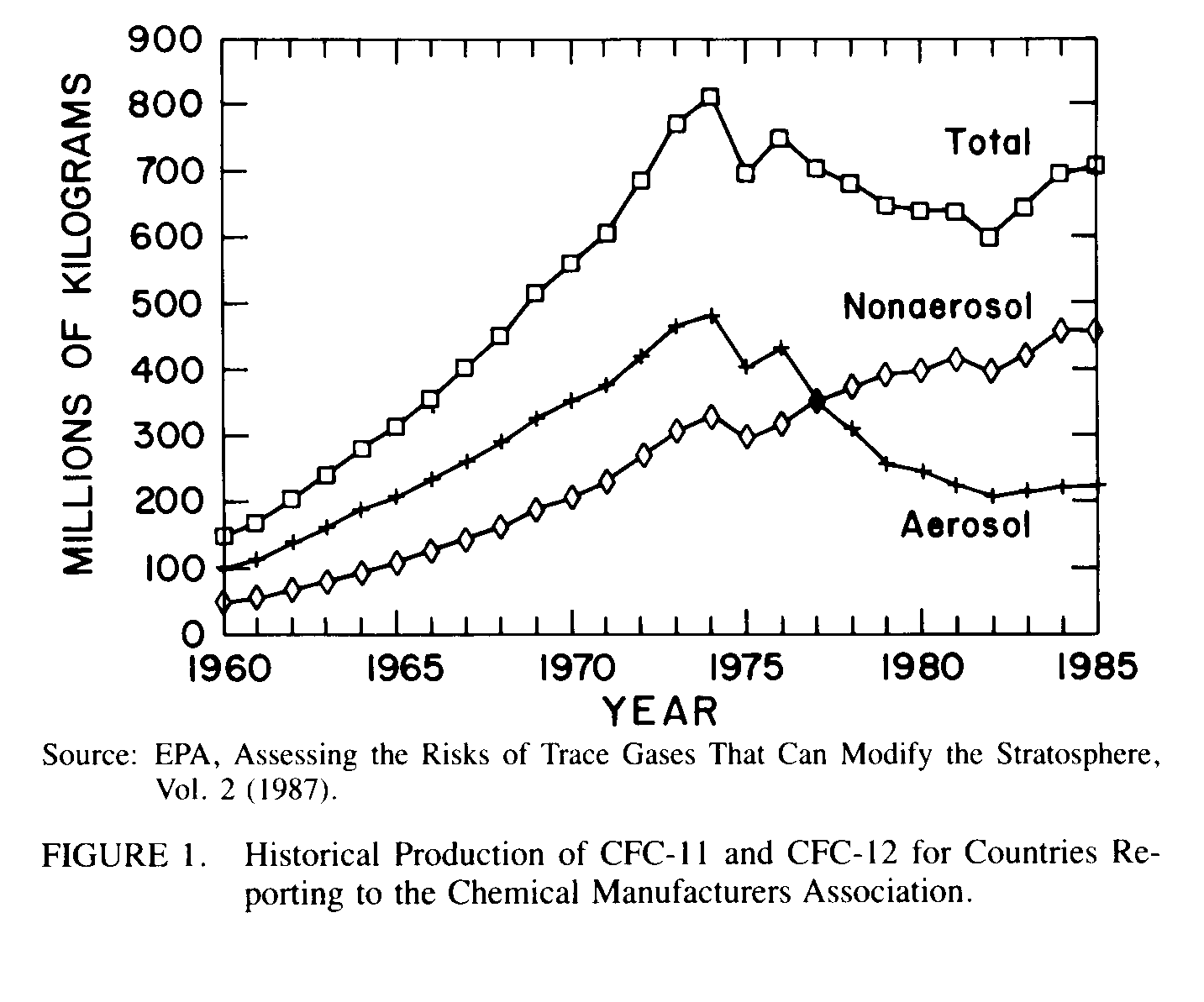
Patt Morrison has written a bizarre account of the history of chlorofluorocarbon (CFC) regulation.

ONCE , IT ACTUALLY worked. About 30 years ago, science pointed its solvent-stained finger at something that humans were doing wrong, something that would kill us if we kept it up. And the politicians listened and said: Whoa — let's stop doing that.

It's 1973. A pair of UC Irvine scientists discover that the chemicals putting the spritz into deodorant and hairspray and the chill into air conditioning are chewing away the pancake-thin ozone layer that protects the planet from radiation. A year later they publish their findings. A year after that, Oregon bans the stuff, then the rest of the nation and Canada follow suit.

Bada boom, bada bing. Chlorofluorocarbons, RIP.
This is absolutely insane. The ban Morrison's talking about only applied to CFCs in "nonessential" aerosols (sales of which had already plummeted in response to news stories about ozone depletion). It didn't apply to CFC refrigerants or solvents, the use of which increased steadily throughout the decade and well into the Reagan years. Widespread calls for total phaseout didn't happen 'til the mid-1980s, and even then the goal was an eventual 50-percent reduction of five CFCs (from the much higher 1986 levels).

Morrison tries to present this as an exemple of politicians listening to scientists and taking their advice, instead of treating their findings as "opinion." But the nationwide ban on CFC propellants went into effect in 1978, when Carter was in office, and it was limited to propellants largely because of the lobbying efforts of the chemical industry. DuPont official Raymond L. McCarthy argued:
All we have are assumptions. Without experimental evidence, it would be an injustice if a few claims--which even the critics agree are hypotheses--were to be the basis of regulatory or consumer reaction.
CFC regulation effectively ended during the Reagan years; disgraced EPA chief Anne Gorsuch said in 1981 that the link between CFCs and ozone was "highly controversial." DuPont, the largest producer of CFCs, immediately discontinued research into alternatives. And Reagan's Interior Secretary Donald Paul Hodel was famously reported as saying that the best response to ozone depletion was to wear a hat and sunglasses.

There's also a plausible argument that the Montreal Protocol was successful only after DuPont had positioned itself to profit handsomely from the new regulations; the company itself acknowledges that after a certain point, adaptation was in its best interests, though it had previously been staunchly in the denialist camp.

All things considered, Morrison's picture of CFC regulation is a wee bit rosier than the facts justify.

Not Ready to Come Out

SPLC reports that anti-immigration activist Laine Lawless has been consorting with neo-Nazis. Early in April, she sent a confidential e-mail to Mark Martin, "SS commander" of the Ohio National Socialist Movement, which read:

"Maybe some of your warriors for the race would be the kind of people willing to implement some of these ideas," Lawless wrote. "I’m not ready to come out on this. ... Please don’t use my name. THANKS."
Her suggestions are charming, on the whole. My favorite is "Discourage Spanish-speaking children from going to school. Be creative."

In her e-mail, she acknowledges the illegality of her suggested tactics. Six days after sending the e-mail, she held a press conference in Tucson, where she said:
"As always, Border Guardians remains committed to only lawful actions to combat illegal immigration," she said. "We are committed to practice only peaceful, lawful action in defense of our country."
In other immigration news, the Chicago Tribune offers this interesting factoid:
A new Gallup poll...finds that most Americans favor making illegal immigration a crime.

Wednesday, April 19, 2006

Something Hidden


Once again, Jonah Goldberg wanders the scenic byways of ignorance, and sends us a postcard reading "Wish you were here!"

[E]ven generally, events which reflect badly on Bush also tend to result in hikes in gas prices. Katrina, for example, pushed Bush's numbers down and gas prices up.
Alright, then. A enormous hurricane slams into the omphalos of American oil and gas production, causing the evacuation of oil platforms, the closing of pipelines, and the shutting down of refineries. The price of gas goes up.

Meanwhile, Bush lolls around strumming a guitar, and canoodling with John McCain, while American men, women, and children drown in the streets of New Orleans. His poll numbers go down.

And now, all these months later, Goldberg puts on his thinking cap and tries to puzzle things out:
Maybe there's something "hidden" in oil prices which illuminates Bush's fortunes more than mere prices at the gas pump.
I cheerfully admit that I don’t think much of the collective brainpower over at the Corner. But some of the regulars must be embarrassed by Goldberg’s comically earnest blithering.

Let's give Jonah credit where it's due, though; every once in a while, he knocks it right out of the park:
[W]e do know there is some correlation between chaos in the Mideast and oil prices.

The Future of the Past


There's something about unused land that seems to provoke an existential horror in certain types of people, as surely as it provokes spiritual or quasi-spiritual rapture in others. The Arizona Strip, which comprises five million desolate acres above the Grand Canyon, is one of the most undeveloped pieces of land left in the country. Now, the BLM is putting finishing touches on a four-year plan that would open it to virtually every sort of activity imaginable, from uranium mining, to cattle grazing, to oil and gas drilling, to virtually unrestricted off-road vehicle use.

Once again, as Marilynne Robinson observes, "we assert the sovereign privilege of destroying what we would go to any lengths to defend." A dirty bomb exploded in St. George, Utah would justify thermonuclear retaliation against the Middle Eastern country of one's choice. An equivalent amount of fallout in St. George, Utah is sound defense policy.

There are lots of problems with the BLM's scheme, but let's focus on one: the lack of archaeological and paleontological research in this region.

According to an article in the latest edition of Issues in Science and Technology, published by the National Academies and the University of Texas at Dallas, only 6% of the BLM's 260 million acres in the West have been surveyed for cultural resources. About 263,000 cultural sites have been found, according to the article, but archeologists estimate there are likely to be 4.5 million sites on BLM holdings....More than 97% of the land within the monuments has not been surveyed for archeological or paleontological sites, and according to a scientific study conducted last summer, 63% of the sites in Grand Canyon-Parashant are vulnerable to damage by off-road vehicle routes, as are nearly half the sites in the more remote Vermilion Cliffs monument.

"These archeological sites are a nonrenewable resource. Once they are gone, they are gone forever, " said Peter Bungart, a Flagstaff-based archeologist who conducted last year's monument surveys. "The silent history that's on that landscape is important, unless you argue that history is not important."
The Bush Administration would never argue that history is unimportant. On the contrary, they understand that it's far too important to be left to chance.

But the sort of history lying dormant in the Arizona Strip isn't worth revising or rewriting. There's nothing worth co-opting for ideological advantage, so there's nothing worth saving. (Some archaeological research may even be a threat to the New Age that authoritarianism invariably proclaims. According to the fascinating book Archaeology Under Dictatorship, Stalin actually murdered or enslaved 85% of Russian archaeologists in the early 1930s.)

The BLM assures us that neither mining nor ORVs nor grazing will harm the area in any really meaningful way. Their own site on Arizona Strip petroglyphs, however, tells a somewhat different story:
Please remember to leave only footprints, leave all artifacts in place and report any vandalism you witness....Remember - This site is yours to share and appreciate, but once it's gone, it's gone forever.
It's interesting to think about the point at which "reporting vandalism" stops being good citizenship, and starts being America-hating extremism.

Tuesday, April 18, 2006

Like Cures Like

Back in 2002, the gibbering husks at Forbes Magazine were breathlessly excited about a Post-Saddam Premium: The invasion would send oil prices plummeting, which would deal a staggering blow to the anti-American fiends at OPEC, while heralding a bright new day for you and me and the man in the next street. And, of course, oil revenue would pay for the invasion and reconstruction (which Forbes cheerfully estimated would cost about $50 billion).

By 2004, Forbes had changed its tune, somewhat. The cover story on its October 18 issue was "Why $45 Oil is Good for You."

By that measure, things are getting better all the time. The price of oil has tripled since 2002.

Steve Forbes himself spent late 2005 touting $35 oil by early 2006. However, that prediction was at odds with Forbes' private advice to investors in September of 2005:

Oil and natural gas are on their way to significantly higher levels. I expect to see crude move to $65.00 this summer and to $76.00 by early next year.
Now, Steve Forbes is arguing that attacking Iran will bring oil prices down.
[W]hen we have the confrontation, which we will have, we can really deal with that crisis. Then the price of oil will come down.
Forbes' brand of Paracelsian economics has that magnetic allure common to all the hermetic arts. But speaking as a guy who bought shares of Adventus and Metacomments when prices were ridiculously low, I'd say bet the farm on oil prices going up before, during, and after an attack on Iran.

The Credibility of Our Civilization


Here's Mark Steyn on de-nuking Iran:

The cost of de-nuking Iran will be high now but significantly higher with every year it’s postponed. The lesson of the Danish cartoons is the clearest reminder that what is at stake here is the credibility of our civilization.
Granted, Steyn has a cruel tendency to overwork the hamster that turns the little wheel in his head. But the idea that the Danish cartoon controversy was some epochal turning-point in world affairs - and is now central to the question of whether, or how, to deal with Iran - is as giddy and desperate a proposition as I've ever seen advanced by this bizarre man.

Steyn goes on to warn that our time will be defined by whether or not we "denuclearize" Iran by attacking it pre-emptively. This is yet another example of how vital false dichotomies are to the Right's rhetorical strategies. It's also a good example of how the chain of causality magically ends the moment a bloodthirsty hysteric like Steyn gets his heart's desire.

The notion that our era might be defined not by "de-nuking" Iran, but by some gruesome and perfectly predictable consequence of George W. Bush's ostensible attempt to do so, would never occur to Steyn in a million years. Where sane people imagine a discredited, unpopular, bankrupt, and incompetent administration attacking a third country while botching the occupation of two others, Steyn imagines boundless fields of glory. A scenario in which BushCo makes things much, much worse - either through incompetence or malevolence - is simply not possible, for no other reason than that Steyn doesn't have the brains or honesty to imagine it happening (even as it is happening in Iraq).

While wallowing in his usual election-forfeiting incivility, Thersites notes a similarly unhinged obsession with cartoons within the hallowed precincts of Chez Maglalang. This "controversary" is so daft and inconsequential that I can only assume it was her way of preparing her squadron of flying monkeys for more important work.

UPDATE: Welcome, Pharyngula readers! Please ignore the cobwebs, and the pile of dirty dishes in the sink. I've been a rather slovenly housekeeper of late...

Monday, April 17, 2006

Earth Is No Resting-Place


Robert M. Jeffers quotes Derrida: "My death; is it possible?" He goes on to discuss certain manifestations of the denial of death, and makes this eloquent point:

It is a function of money, and of the illusion that money and power can be used to work our will irrevocably on the world.
Meanwhile, Cervantes discusses "secular apocalyptics," and makes this eloquent point:
One starts to suspect that, at least in the case of many people, these are expressions not of fears, but of wishes. Certainly that is true in the case of the Christian millenialists, but is the psychology of the secular apocalyptics similar? Do they yearn for a better world on the other side of the Great Dying?
My argument would be that for the most part, the psychology is not merely similar, but virtually identical, and that this equivalence between secular and religious psychology is more the rule than the exception. (I suppose one could argue over which viewpoint involves a greater betrayal of reason. But that would mean assuming that reason per se is something that ought not to be betrayed, which is a superstition I try my best to avoid.)

Walter Benjamin, as he watched the rise of the political movement that would eventually drive him to suicide, said of contemporary society:
Its self-alienation has reached the point where it can experience its own annihilation as a supreme aesthetic pleasure.
But of course, this "supreme aesthetic pleasure" presupposes a self that lives through it. Which suggests that the motive force here is not self-alienation so much as world-alienation.

Then again, is there necessarily a difference? In Dialectic of Enlightenment, Adorno and Horkheimer write:
The compulsively projecting self can project nothing except its own unhappiness....For the ego, sinking into the meaningless abyss of itself, objects become allegories of ruin, which harbor the meaning of its own downfall.
A somewhat quaint formulation, I'm afraid. And yet it's hard to avoid the suspicion that the world is less the cause of our misery, than a convenient scapegoat for it. If so, it's no wonder some people gloat over the idea of its doom. It's the ultimate form of what AA calls "pulling a geographic"...the notion that everything will be fine if you just go somewhere else.

On the other hand, if you've given up on utopia, you can always glamorize dystopia. Don't chemical ponds have a certain beauty, after all, when seen from a God's-eye view?

Apocalypse appeals to human beings in a way that - to take the most charitable view - is inexpressible enough to make most people who speak of it seem...well, kind of vapid. On the secular side, the problem may be that apocalyptic thinking often exalts the self while pretending to cast it away in favor of "objectivity." Or maybe it's because striking a pose of aestheticized equanimity towards one's own death is so much easier if, as Tom Lehrer sang, "We will all go together when we go." That way, at least, the emotional discomfort of being survived doesn't arise. When it comes to extinction, apparently, there's strength in numbers.

Things are no better on the theological side, of course. The religious incoherence (and materialist vulgarity) of the Jew-annihilating Darbyist apocalypse goes beyond vapidity, and proceeds directly to evil.

At any rate, when contemplating the end-times through the eyes of secular or religious eschatophiles, I'm struck less by awe or humility than by the eerily similar forms that human vanity and human misery take on both sides of this supposedly profound philosophical divide, as they seek to "work their will irrevocably upon the world."

(The photo above is from Sean O'Boyle's Modern Ruins).

The Happiest Panopticon On Earth


A British amusement park is demonstrating the admirable flexibility of late capitalist culture, by turning authoritarian surveillance into a marketing opportunity.

Visitors to Alton Towers could soon be tagged and tracked by cameras in a new system to video their entire day that could also tighten security. The Staffordshire theme park will offer entrants wrist bands containing tiny Radio Frequency Identification chips.

Guests would be watched as they use the park and will be filmed on rides, which the creators say would also cut crime. At the end of the day they would then be given the option to buy the footage in a personalised DVD.
This is an altogether wonderful idea: Increasing surveillance, while commodifying it.

Of course, the scheme isn't compulsory; the pathologically negligent, for instance, are perfectly free to endanger their children by opting out:
Liz Greenwood, from Alton Towers, said the security aspect was secondary as the wristbands would not be compulsory.

"If people don't want to take part that is their choice," she said.

"Only the people who opt into the scheme will be filmed so if a child is lost, for instance, the system will only track the child if his/her parents have opted in."

Friday, April 07, 2006

Friday Nudibranch Blogging: Nim and Jen Edition


Here's a candid snapshot of Polycera faroensis in a frolicsome mood, in honor of this happy news.

Judging from the deadly insults I'm receiving in some corners, I shouldn't even bother mentioning this...but I'm finally done with the awful job I've been doing, and will be back on Monday.

I hate to let Diane down...so in lieu of Friday Hope Blogging, I'll mention that deglycyrrhizinated licorice does seem to help with acid reflux.

Other than that, I'm just glad I took a few days off during a week when absolutely nothing happened, anywhere.