Showing posts with label peak oil. Show all posts

Thursday, March 26, 2009

Problematizing Progress


Brendan O'Neill argues that we should sooner strangle an infant in its cradle than nurse unacted desires:

If you want proof of the miserabilist, misanthropic outlook of contemporary western society, look no further than the curmudgeonly reaction to the launch of "the People's Car" in India yesterday.

The Nano, developed by Tata Motors and costing a mere 100,000 rupees (around £1,200), will make the dream of car travel a reality for tens of thousands of Indians. Yet its launch was greeted by a collective groan from western observers, concerned that if the developing world plays "catch up" with us – what used to be known as "global equality" – the planet will fry in a hellfire of greedy car-drivers' making.
This collective groan is an ugly symptom of "eco-imperialism," which is much like classic imperialism, except that instead of traveling overseas to beat or starve foreign populations into submission, you sit at home and fret over the environmental impact of cheap consumer goods. As such, it's one of the most fearsome weapons in the armamentarium of liberal fascism, and can't be criticized harshly enough.
We have become incapable of judging new developments and breakthroughs by any criteria other than their projected carbon emissions. The fact that the Nano will increase many Indians' mobility, their choices, their personal freedom to travel where they want and when they want – a freedom many in the west have enjoyed for decades – is simply overlooked....

Immeasurable benefits to humanity have been usurped by pseudo-measurable levels of planetary destruction.
By which O'Neill means that these benefits would be usurped, if eco-imperialism actually got its way, for once. But fortunately, no one with any real power seriously believes in the miserabilists' pseudo-measurements of atmospheric CO2, polar ice, animal populations, rainfall, glacier loss, ocean acidification, and related phantasmagoria.

It's easy enough to point out that O'Neill is a flaming asshole. But if we were to concentrate solely on that fact, we might overlook the really interesting aspects of his argument. "Western environmentalists" are worried about the Nano; that's a given. Does this mean that Indian environmentalists and scientists aren't worried? Of course not: environmentalists and climatologists all around the world are brooding over "pseudo-measurable levels of planetary destruction" even as we speak, instead of banishing dull care by riding an ATV through a protected wilderness area. That's what makes 'em miserabilists, regardless of race, color, caste, or creed.

But if O'Neill acknowledged this little detail, he'd have to forego the pleasure of turning what little remains of white liberal guilt against itself, by invoking the horrors of imperialism as an argument for free-market dogmatism. He understands that Westerners are a bit more sensitive than they used to be about dictating terms to the Wogs, and so he figures he can score a few points by painting the IPCC as a new East India Company. Of course, this theory requires us to view Indian culture as monolithic, scientifically backwards, and implacably self-centered...but what matter the victims if the gesture be beautiful?

No one "overlooks" the benefits of the Nano. The people who are worried about it, here and in India, simply see the negatives as outweighing the positives. By contrast, O'Neill and his ilk refuse to concede that any meaningful negatives exist (hence all the talk of "pseudo-measurement"). This tactic is not just necessary, but enjoyable, because once the science is out of the way, there's all the time in the world to dream up neoliberal just-so stories:
In the past it was argued that the developing world was poor because there simply wasn't enough to go around or because Indians and Africans hadn't quite got the hang of this capitalism thing.

Today, the key cultural justification for continuing inequality is the idea that if the south becomes like us – with just as many cars, factories, roads, homes – then the planet will perish.
It's fascinating how many young journalistic firebrands have adapted the language and tone of radical critique to the purpose of blessing things as they are. O'Neill expects us to feel pious outrage at Western arrogance, while suggesting that development in India must follow the Western model or be damned, and that anyone who worries about the consequences is a fraud or a terminal mope, and that India doesn't have competent scientists, diversity of opinion, and a strong and courageous environmental movement. When it comes to purging ourselves of Western arrogance, like apparently cures like.

The funny thing is, O'Neill doesn't seem to believe this gibberish himself. No sooner does he accuse the West of scheming to maintain global inequality than he backpedals, and claims that the real concern is that we're allowing our silly Western guilt to interfere with the Hindoos' progress towards Civilization. This is known as "problematising progress." No, really!
This is a moral righteousness built on privilege rather than principle. The anti-Nano brigade, and all of the rest who problematise progress in the developing world, know the destructiveness of everything but the value of nothing. Just because we have become uncertain about technological progress, guilt-ridden about our luxuries, and cavalier about the feeling of freedom brought about by car travel, that doesn't mean Indians should stay put in their rickshaws.
Of course, it doesn't mean they have to buy a Nano, either. There are other possible vehicles, and wiser forms of progress, and Indian experts who can tell you all about them. (And of course, there are also Western countries that could be setting a good example by cutting their own emissions and working seriously to create a low-carbon economy.) But O'Neill seems to be problematizing every single one of these options except the Nano, for no better reason than that the Nano exists here and now, and environmentalists and climate scientists have dared to measure its carbon emissions instead of hailing it as the salvation of the downtrodden.

So once again, freedom boils down to scrambling to buy what the market offers, instead of demanding what it doesn't, or creating a solution oneself or with one's neighbors. Achieving "global equality" turns out to be a matter of individual access to adequate cash or credit, just as our best and brightest always suspected. And anyone who proposes that there are greater goals or more pressing duties than consumer choice is an Enemy of the People.

This would be a colossally dismal view of human possibilities even if there truly were nothing more to climate change than pseudo-measurements and eco-imperialism. Since O'Neill's theory also happens to be deadly lunacy, it's not hard to understand why he finds his dreary faux-radical boosterism running afoul of "miserabilists."

(Photo: "Roads in India are already congested with traffic." Reuters/Krishnendu Halde.)

Thursday, February 19, 2009

Dirty Oil


Joseph Romm is upset because Obama has suggested that technological progress could make it possible to process Canada's tar sands safely.

I distrust Obama on this issue, too. It's nothing personal, though. I'd distrust any president's willingness to come down on the sensible side of a question like this. It's not really in the job description, as things currently stand, and there are enormous structural obstacles to doing the right thing even -- or especially -- if you decide to take a stab at it.

At the same time, I get a little tired of the liberal pretense that solving problems like the tar sands industry is a simple matter of "speaking truth to power."

If Obama would announce that tar sands are unhealthy for children and other living things, the theory goes, the companies exploiting them would withdraw in shame and be forced to seek honest work in the solar industry. The idea that diplomacy is a necessary and delicate affair remains an alien concept in some circles, and sometimes I wonder if a certain number of people on the left haven't internalized and adapted to the conservative axiom that when the USA talks, them furriners had better listen up, or else.

I'm not accusing Romm of that attitude, I hasten to add. But unlike him, I think that what's important in Obama's remarks is not what he said about some vague, dreamworld future in which tar sands are no longer an economic and environmental and moral disaster, but what he said about the present:

Obama declined to call the oil sands "dirty oil" in a White House interview yesterday with Peter Mansbridge of the Canadian Broadcasting Corp., but acknowledged that the process "creates a big carbon footprint."

"So the dilemma that Canada faces, the United States faces, and China and the entire world faces is: How do we obtain the energy that we need to grow our economies in a way that is not rapidly accelerating climate change?"
Granting that Obama could secretly be planning to switch the entire country over to tar sands by 2010, a more reasonable interpretation is that he's trying diplomatically to acknowledge the theoretical economic value of tar sands, while pointing out that current extraction methods are unacceptable. It's hard to imagine what more he could say on his first official visit up north.

On second thought, it's not hard at all, because he actually did go quite a bit beyond the call of duty:
"I think, to the extent that Canada and the United States can collaborate on ways that we can sequester carbon, capture greenhouse gases before they're emitted into the atmosphere, that's going to be good for everybody," Obama added. "Because if we don't, then we're going to have a ceiling at some point in terms of our ability to expand our economies...."
Perhaps I'm crazy, but it sounds as though Obama is saying that if we can't figure out how to extract this fuel safely, we're going to have to do without it.

It's quite possible that he doesn't mean it. But regardless, when you consider the dictates of diplomatic language and the strong gravitational pull of business as usual, that's a pretty staggering thing even to suggest. And it encourages me to believe that whether Obama is willing or able or allowed to tackle this problem, he does at least understand it. That may not be enough, but it's more than we've had in a long, long while.

In other news, tar sands really are horrific, just in case you didn't know.

UPDATE: I probably should've made it clear that I'm basing this argument on the assumption that there will be no technological fix for tar sands in my lifetime, and we'll be left with the choice of using them anyway, or leaving them in the ground. I tend to doubt that we'll make the right choice. But I'm also not absolutely positive we won't, which kind of surprises me.

(Photo by Peter Esseck.)

Thursday, January 29, 2009

Detroit's Welfare


The Times-Herald of Port Huron, MI is worried about the environment:

President Barack Obama carries the hopes of many Americans -- many who rightly believe his administration has a responsibility to reduce air pollution and set a national course toward a healthier environment.

There should be no dispute about the importance of that goal.
Having ruled out any possibility of disputing this, we can all agree that as important as a healthier environment may be, it's not nearly as important as kowtowing to the dead-enders who control what's left of our auto industry:
Obama's decision opens the way for the Golden State to set its own standards -- and at least 14 other states that adopted California's. Despite the euphoria many environmentalists might feel, the prospect is another challenge to the nation's embattled auto industry.
"Embattled" is one way of putting it. "Shortsighted," "arrogant," "corrupt," and "stupid" are other words that spring to mind. Particularly given what comes next:
Stronger emissions and fuel-efficiency standards...cannot come at the risk of the nation's weakened auto industry.

For now, new federal regulations must be considered in accordance with Detroit's welfare.
So there's no disputing the importance of cleaner air, but Detroit gets the final say on when and if we can have it. Seems to me I've been hearing that refrain for several decades now. Perhaps its basic assumptions are as flawed as the business model that led to the recent "need" for a massive bailout (or "Detroit's welfare," if you prefer).

That bailout, by the way, is not a reward for mismanagement, by any means. Nor does it amount to throwing money down a well. In fact, it's a cruel, cruel burden that Detroit bears only with the greatest difficulty:
Chrysler LLC and General Motors are fighting for their lives. The automakers are struggling to meet a number of stringent restructuring demands in accordance with the billion [???] dollars in emergency loans the Bush administration approved in December.
In other words, the "hardship" of restructuring gives the auto industry the moral authority to veto clean-air regulations in 15 or more states.

Once you've accepted this, you can pat yourself on the back for your patriotism and your understanding of the Free Market.

Tuesday, August 12, 2008

Freedom Machines


It's no use talking to Ernest Istook about donkey carts, or velocipedes, or ornithopters. The plain fact is, he's simply wild about automobiles! He likes them so much that he refers to them, rather tautologically, as "great American Freedom machines."

Consider the evidence: As long as you've got enough money to fill your tank, you can use your car to travel from the place where you live to the place where you work. If that's not freedom, what is?

And that's just the tip of the iceberg. In some states, you can also drive your car to a late-term abortion appointment, or a same-sex marriage ceremony (though you filthy perverts may rest assured that Mr. Istook and his colleagues are working on these problems as we speak).

Also, unlike mass transit, transportation by car is not subsidized by taxpayers (so long as you ignore the cost of oil and gas subsidies, and building freeways through residential areas, and treating pavement runoff laden with automotive fluids and heavy metals, and sacrificing parks and agricultural land, and protecting oil tankers and infrastructure, and air pollution, and congestion and crashes, and the billions of dollars that driver fees and taxes fail to cover in any given year).

In NYC, meanwhile, plans are being made to screen every vehicle Freedom machine that visits the island for radioactivity.

The proposal — called Operation Sentinel — relies on integrating layers of technologies, some that are still being perfected. It calls for photographing, and scanning the license plates of, cars and trucks at all bridges and tunnels and using sensors to detect the presence of radioactivity.
A while back, I suggested that purposefully triggering urban radiation sensors would be a cheap and easy way of causing chaos. That was idle speculation, of course, and there's no reason to believe that our pitiless enemies are capable of coming up with a tactic like that (not without dedicating an hour or two to working out the logistics, anyway).

Which is just as well, because if Noah Shachtman is to be believed, the current system is very sensitive indeed:
I spent some time with an NYPD unit, armed with these sensors. Just about anything would set them off -- like a patient getting chemotherapy, for example.
Even assuming they manage to reduce the false alarms to a bare minimum, it sounds as though this extraordinarily data-hungry Emancipation Contraption will cause more problems than it solves:
Data on each vehicle — its time-stamped image, license plate imprint and radiological signature — would be sent to a command center in Lower Manhattan, where it would be indexed and stored for at least a month as part of a broad security plan that emphasizes protecting the city’s financial district, the spokesman, Paul J. Browne, said.
In other news, we need better icebreakers (or Exalted Yankee Liberty Devices, as I prefer to call them) if we're going to keep the goddamn Russkies away from the North Pole:
Russia -- which last year planted a titanium flag under the North Pole, claiming 460,000 square miles of Arctic waters -- "has 20 icebreakers in its fleet, seven of them nuclear powered, including the largest ice-breaking vessel in the world," Homeland Security Today observes. Of the Coast Guard’s three polar icebreakers, two have outlived their originally designed service lives of 30 years.

The third sets sail this week, Reuters notes, "to determine the extent of the continental shelf north of Alaska and map the ocean floor, data that could be used for oil and natural gas exploration." And maybe claim some turf for America, too.
(Illustration at top by Bruce McCall.)

Thursday, July 24, 2008

Geopolitical Problems


The New York Times reports on the US Geological Survey's estimate of Arctic oil resources:

At today’s consumption rate of 86 million barrels a day, the potential oil in the Arctic could meet global demand for almost three years.
The article goes on to say that this potential windfall comprises "13 percent of the world's total undiscovered oil." Happy days are here again!

And they're here to stay:
Dr Peter McCabe, from the CSIRO, says predictions of a peak oil phenomenon date back to the 1920s but are no more relevant today than they were then.

He claims it's geopolitical problems in oil-producing countries such as Nigeria and Venezuela that's pushing up oil prices, rather than dwindling supply.
He's right, of course. We all remember the radical Enviropacifislamofemifascists who seized Kuwait's Burgan field, and have refused to let anyone get at a drop of it until Phil Donahue is restored to his rightful place on MSNBC.

Meanwhile, China's Daqing field remains firmly in the clawlike hand of Fu Manchu, despite the best efforts of Nayland Smith and the intrepid Dr. Petrie. And in Mexico, production at the Cantarell field remains lower than average, due to an ongoing struggle between wrestling women and an Aztec mummy.

Similar situations obtain at Ghawar, where sectarian conflict over whether Certs is a breath mint or a candy mint has almost entirely shut down operations, and at Samatlor, where Dostoevskian nihilist intellectuals have been waging a decades-long battle against Tolstoyan prophets of worldly renunciation.

In other news, John McCain has postponed his plan to praise the safety of offshore drilling from atop an oil rig off the coast of Louisiana, due to circumstances beyond his control:
The campaign blamed Hurricane Dolly, which had just crossed the Texas coast with winds reported at 100 miles per hour, or 160 kilometers per hour. It did not mention that an oil tanker had just collided with a barge near New Orleans, shutting down 29 miles of the Mississippi River and sending hundreds of thousands of gallons of heavy fuel oil into the water.

Wednesday, July 02, 2008

Pull the Pin and Roll


I've daydreamed for years about doing away with interstate trucking, on the grounds that it's stupid, wasteful, dangerous, exploitative, polluting, and a waste of time for all concerned.

Sure, "Convoy" was a great song, and the most cogent defense of libertarianism ever written. And the obscene messages scrawled by truckers in roadside toilet stalls provide the lonely traveler with plenty of food for thought. I also understand that once a sufficient number of maudlin songs have been written about a dull and dangerous job, it becomes a Proud Way of Life that must not be allowed to perish from the earth.

On the other hand, our heroic truckers could simply switch over to workin' on the railroad, all the live-long day. That was a proud way of life before anyone ever heard of 18-wheelers, as you can tell from the vast number of folk songs about being scalded to death by steam, or lying crushed beneath the boiler with your white-haired mother praying by your side.

If truckers became railroad workers, they'd still get to marvel at the beauty of God's own earth while eating three-day-old scrambled eggs, they'd still get to have anonymous sex with transients, and they'd still have the opportunity to go out in a blaze of glory, with nothing to regret but those two last drinks they wanted to try. And they could boast, with Jimmie Rodgers, that they'll eat their breakfast here and their dinner in New Orleans, and get them a mama they ain't never seen.

Best of all, they'd no longer have to suffer indignities like this.

Admittedly, I'm thinking with my heart rather than my head, as leftist sissy-boys so often do. Fortunately, a new study offers a more toughminded rationale for replacing trucks with trains:

Because one intermodal train can take nearly 300 trucks off our highways, shifting freight from trucks to trains reduces competition between commuters, drivers and freight traffic for space on the road," said Wendell Cox, author of the study and principal of Demographia, a market research and urban policy consultancy.

The study claims that if 25% of the volume moved by trucks was moved to rail transport by the year 2026, each American commuter could save, on average, $985 -- and 41 hours of time in their car -- a year. The survey also estimates that each year, a commuter could save 79 gallons of fuel and reduce air pollution by 920,000 tons."
You can find an interesting proposal for making a gradual switch from trucks to trains here; it also discusses the possibility of reducing air freight. Seems reasonable to me, for what little that's worth.

(Illustration at top by David Oram.)

Thursday, June 26, 2008

Ice Cream or Oil?


CNBC has posted a helpful slideshow that helps concerned consumers to become better informed -- in a certain sense -- about the price of oil. Its title is revealing: "More Expensive by the Barrel: Ice Cream or Oil?"

As you click through the slides, you learn that Coca-Cola is currently a bit less expensive than light sweet crude, while Perrier comes in at a shocking $300 per barrel.

"Who would have thought water would burn a hole in your pocket?" the caption asks...a sobering question indeed, for those whose vehicles are powered by imported soda water.

Still, it's nothing compared to the horror of the Starbucks latte, at $954.24 per barrel. If our society used these lattes to manufacture and distribute and sell oil, instead of the other way around, we'd really have something to complain about.

And get this: Those hippies Ben and Jerry are always talking about saving the planet...but their ice cream costs $1609 per barrel! Typical liberals, eh? It turns out that perfume is much more expensive than oil, too. You have to admit, it kind of puts things in perspective.

In a better world, a slideshow like this one might ask readers to think about oil's role in creating and transporting and setting the prices of the nonessential goods to which it's being compared. It might even manage to discuss interesting issues like external costs and goverment subsidies. But things being as they are, the slideshow is simply a propaganda piece for Big Oil, and it absolutely drips with contempt for its readers.

It also fails to acknowledge the "mileage" you get from a barrel of, say, Tabasco sauce. Sure, it costs $6155...but that adds up to about 2,789 bottles, which I'd say is an ample, if not generous, supply for most households. I love Tabasco and use it in almost everything I cook; even so, I doubt I've gone through 20 bottles of it in my entire life.

By contrast, $6155 will get you about 1,540 gallons of gasoline at current prices. That's 110 full tanks if you've got a 14-gallon tank, or roughly a year's supply if you're filling up twice a week, as so many drivers do. Perhaps this would be a better basis for comparison, since more Americans buy gasoline by the gallon than crude oil by the barrel?

Then again, doing it that way wouldn't be nearly as much fun. You know what else costs more than oil? Chateau Mouton-Rothschild 1945. So quit complaining, ya goddamn schmendriks, and fill 'er up!

Incidentally, the figures in this slideshow come from John S. Herold, Inc., whose "client base is comprised of virtually every major oil company."

(Photo by Steve Brandon, from his set Nepean, Ottawa suburb of infinite excitement!)

Wednesday, May 21, 2008

The Road to Hell


If you don't have enough money to fill your gas tank, you might want to consider selling Neil Reynolds the Brooklyn Bridge:

The average public transit bus in the U.S. uses 4,365 British thermal units, a measure of energy, per passenger mile and emits 0.71 pounds of carbon dioxide. The average car uses 3,445 BTUs per passenger mile and emits 0.54 pounds of CO{-2}. Whether you seek to conserve energy or to reduce greenhouse gas emissions, your public policy decision here appears remarkably obvious. Get people off buses and get them into cars.
Reynolds got these numbers from that cornucopian goofball Randal O'Toole, whom he claims has "impeccable environmental credentials." What this means in layperson's terms is that O'Toole is the senior economist at the Thoreau Institute, a Scaife-funded pro-automobile thinktank that he created and heads (which should definitely not be confused with the Thoreau Institute that actually has something to do with Thoreau).

To be fair, naming a pro-sprawl thinktank after Thoreau isn't O'Toole's only impeccable environmental accomplishment. He also rides a bicycle, like all good-hearted people. Perhaps that's why he "has been described as the next Jane Jacobs," presumably by people who thought Bush was the next FDR.

Before we get to the numbers cited above, which you've probably already recognized as flawed, let's have a look at O'Toole's shocking theory that "on the basis of every billion passenger miles...light-rail [public transit] kills three times as many people as cars on urban freeways."

That Reynolds is impressed with this claim is a bad sign, since pretty much anyone can see that there's something weird about limiting auto fatality statistics to "urban freeways," especially when the DoT statistics show automobiles killing more people than all other forms of transit combined in every year since 1960.

O'Toole might argue that limiting his statistics to urban freeways makes sense, if he's comparing autos to commuter trains. Except that plenty of commuters don't drive on freeways, or work in urban areas. Plus, urban freeway commutes tend to be congested; it's hard to get in a fatal accident when you're traveling at 25 mph. It's also possible that O'Toole favors this comparison because light rail takes a higher toll on pedestrians than freeways do.

But who knows? It's not my job to dredge up O'Toole's stats, or figure out his definition of "urban." Ideally, that'd be Reynolds' obligation. I do think it's fair to say that O'Toole's claim is meaningless without these data.

Anyway, back to the bus and car comparison. The first problem with O'Toole's argument, as Reynolds states it, is that "public transit" isn't defined. This is important because there's a huge difference in utilization rates between city and interurban buses, and utilization is crucial to efficiency. Second, O'Toole is perversely using overall underutilization of mass transit (which, I'm willing to bet, includes off-peak hours) as an argument for not riding buses during hours when ridership is at its peak. If you want to increase overall efficiency, it'd be better to use small shuttles during off-peak hours -- and to reroute lines to avoid hills, left turns, idling, and so forth, a la UPS -- than to cut service to people who need it.

Third, you don't usually see people calculating transit efficiency in terms of BTUs, because it begs the question of how the energy is generated. Buses and light rail are often electric, so the BTUs in question can be generated partly or entirely by renewable and low-emissions sources.

Since O'Toole complains that buses aren't as fuel-efficient as they could be, you'd think the logical solution would be to improve them, as so many cities and manufacturers are attempting to do. But O'Toole sees absolutely no need for this, as long as cars and gas are available to those of us who can afford them:
People respond to high fuel prices by buying more efficient cars - and then driving more.
If only every problem were that simple!

Which reminds me...when I was about four, I saw a picture of a starving African family squatting on a bare expanse of parched dirt. It disturbed me, so I asked my parents why these silly people didn't just go to a motel.

Imagine my surprise when they told me.

Tuesday, May 13, 2008

Stopping Everything


When your circular path deepens into a trench, you know you're making real progress.

Kevin Hassett of the American Enterprise Institute explains that there are people out there who actually want to put an end to this sort of progress, just when the trench is getting comfortably deep. And it's all for the sake of the polar bear, a vicious and thankfully farflung monster that'd just as soon rip your throat open as look at you.

Remember when the snail darter brought Western Civilization to its knees by temporarily blocking the ill-conceived and unnecessary Tellico Dam? Well, if polar bears are declared an endangered species, you could be fined or imprisoned simply for starting your car. Anything that could conceivably contribute to global warming will be made illegal, up to and possibly including breathing. Life as we know it will simply end.

Don't drink that bottle of drain opener just yet, though. First, let's consider whether the polar bear is actually in trouble. Granted, they need ice, and plenty of it (at least according to biologists, whom you have to admit are not exactly neutral, given that their opinions diverge on occasion from the commonsense beliefs of the average citizen).

But whether the ice is melting, or will melt, is less pertinent than the fact that no one actually knows how many polar bears there are: some say the number is going down, while others say it's going up:

For example, University of Pennsylvania Professor J. Scott Armstrong told Science Daily that "the polar bear populations have been increasing rapidly in recent decades due to hunting restrictions."

Others, such as biologists Ian Stirling and Andrew Derocher, see troubling signs of decline in specific subpopulations that live in regions more affected by ice melts.
They can't both be right...unless polar bears are somehow threatened by loss of habitat while rebounding from overhunting. Without getting into scholastic niceties like these, let's all just agree to agree that no one has any idea what's going on with polar bears, and that any claim to the contrary is a vain and sinful departure from the doctrine of learned ignorance.
The truth is, as noted by my American Enterprise Institute colleague Kenneth Green in a recent article, "Is the Polar Bear Endangered, or Just Conveniently Charismatic?" we just don't have the data to assess what is happening.
That being the case, you must assume that everything is just ducky, much as you would if you wanted to write a large check, but had no idea how much money was in your bank account.

The alternative to carefree optimism is too terrible to contemplate, so let's go right ahead and contemplate it:
The snail darter almost killed a dam. The polar bear could, in theory, stop everything.
Everything! In theory, yeah, granted. But still...everything! No matter what sort of Ivory Tower you inhabit, you have to sit up and take notice when everything stops. No man is an island!

Picture a world, not far from today, in which everything has stopped. It's dark. It's cold. There's no food. No one can travel except on foot or on a "bicycle," but no one travels in any case because there's nowhere to go in a world that has stopped. Is that really what you want? When your child comes to you in tears, begging to be allowed to chew for a time on your belt, will you truly be comforted by the thought that on some ice floe thousands of miles away, a polar bear is biting the head off a baby seal?

Short of everything stopping, Hassett also worries that ruling in favor of polar bears might "heighten pressure on the United States to adopt a carbon tax or a cap-and-trade emissions program," which could inconvenience the companies that fund his thinktank. Plus, it could stop or slow oil exploration in the Arctic, which "is the only thing standing between us and $200-a-barrel oil." It stands between us and $200-a-barrel oil temporarily, if at all, but what of it? Life itself is temporary; it's a vapor that appeareth for a little time, and vanisheth away.

Enough philosophizing, though. Let's get back to the facts:
Many biologists think global warming is a serious threat to the polar bear. If that leads to the polar bear being listed as threatened this week, then the world you live in will have fundamentally changed.
Here's hoping, pal.

Hassett, by the way, is apparently an adviser on economic policy for John McCain. I'm old-fashioned enough to believe that the paper that printed this drivel should've said as much.

(Photo by PhotoGraham.)

Thursday, November 29, 2007

Really Good Things


A cryptoclimatological discoverist from the Kansas state legislature expounds on the Great Chain of Being:

A state legislator Wednesday criticized rejection of two coal-fired power plants in western Kansas, saying carbon dioxide emissions were good for crops.

“One of the really good things about CO2 is that plants perform better under stress (drought, etc.) with increased levels of CO2,” Rep. Larry Powell, R-Garden City, said in a letter disseminated to the media.
Ideally, CO2 will increase agricultural yield, which'll increase earth's carrying capacity, which'll increase earth's population, which'll increase CO2 emissions, which'll increase agricultural yield. World without end, amen!

Powell's information comes from a report by Craig and Keith Idso, who've been singing this tune for many years now (with a little help from ExxonMobil and the rabidly pro-coal Western Fuels Association).

All their huffing and puffing will come to nothing, though. Coal is the fuel of the past; the fuel of the future is low-grade synthetic crude extracted from oil shale with "portable" nuclear reactors that may or may not actually work:
Though it would produce 27 megawatts worth of thermal energy, Hyperion doesn’t like to think of its product as a “reactor.” It’s self-contained, involves no moving parts and, therefore, doesn’t require a human operator....

“The lab is doing a lot of work on oil shales and oil sands, but there’s no way to get power to those facilities,” Blackwell says. “So, this nuclear battery would be brought in and that would provide the power to run a small city of industrial use.”
Oil shale extraction is thirsty work. But since increasing CO2 emissions will make crops more drought resistant, it seems logical that this'll free up water for the oil shale boom.

All things considered, I'm feeling cautiously optimistic.

(Photo: Mid-day dust storm in Garden City, Kansas, 1935.)

Thursday, September 13, 2007

Growth at the Edges


An article in the LA Times (via Atrios) hints at the connection between the subprime housing market and suburban sprawl:

Most communities are seeing price declines, and the downtrend is strongest in outlying suburban areas such as in Riverside County, where affordable homes attracted droves of first-time buyers -- many of whom could not qualify for traditional fixed-rated mortgages.
It's interesting to compare this sober post mortem with the LAT's giddy boosterism for the housing boom in Antelope Valley, which ran four pages without mentioning groundwater.

In Atlanta, meanwhile, commutes are getting longer:
"I think what it means is that Atlanta continues to grow," Pisarski said. "And it continues to grow at the edges, and I think this is kind of an indication of the way the world's going to continue to function in the future."
As it was in the beginning, is now, and ever shall be.

This growth "at the edges" often makes it unfeasible for children to walk or bike to school, which increases traffic congestion and pollution, while making children more prone to obesity:
"Forty years ago, half of all students walked or bicycled to school. Today, fewer than 15 percent travel on their own steam. One-quarter take buses, and about 60 percent are transported in private automobiles, usually driven by a parent or, sometimes, a teenager."
I can't help wondering to what extent this cheap imitation of the American Dream is fueled by subprime auto loans, as well as subprime mortgages.

On the bright side, there's plenty of room for growth in Tippecanoe County, Indiana, where parking spaces outnumber drivers 3 to 1:
"Tippecanoe County parking lots turn out about 1,000 pounds of heavy metal runoff annually, said Purdue professor Bernard Engel, who used a computer model to estimate changes in water-borne runoff caused by land-use changes.
Some people have suggested smart growth - or even no growth - as a solution to problems like these. But Wendell Cox worries that such policies constitute "land rationing":
Smart growth seeks to control suburbanization (pejoratively called "urban sprawl") and has been pursued principally by liberals committed to the current orthodoxy of urban planning. The problem with smart growth is that it takes away opportunity through land rationing and other overly restrictive strategies that increase housing prices."
Or to put it another way, the problem with restricting growth is that it restricts growth.

If only everything else were that simple.

(Photo at top by Steve Smith.)

Wednesday, August 29, 2007

Petro-Nationalism


Kazakhstan has temporarily suspended work in the dangerous and difficult Kashagan oil field:

The day's wrangling added yet another layer of complexity to Kashagan, a field that shows the increasingly hostile environment encountered by Western energy companies in pursuit of crude. With the era of easy oil long gone and international demand climbing to new heights, the majors are focusing on increasingly remote and hazardous corners of the globe.
The Wall Street Journal describes shutting down Kashagan as an act of "petro-nationalism"; the Kazakh government begs to differ:
"When costs increase by 5%, by 10%, that's one thing," Kazakh Prime Minister Karim Masimov said in an interview earlier this month. Projected costs over the 40-year life of the project, he said, had increased to $136 billion from $57 billion. "When they rise by two and a half times, either the planning was wrong, or the execution is wrong, or it was deliberate."
These complaints are allegedly symptomatic of "rising assertiveness" on the part of countries like Kazakhstan. Make of that what you will.

Some of the cost overruns were due to the construction of artificial islands:
Eni started building islands. It dumped more than four million tons of rock on the seabed, secured it with steel piles and covered it with concrete slabs. Gradually, pontoonlike modules and helipads were added. The larger of the two islands, D, was surrounded by reeflike barriers to protect against ice.
Previous problems and overruns have already delayed oil production until at least 2010. But Eni executives insist that it'll be worth the wait:
Company officials have revised upwards their estimates for peak production, to 1.5 million barrels a day from 1.2 million barrels. "The more we look at Kashagan, the more we realize that this is a super supergiant," said Mr. Scaroni. "This is a field that's going to last until 2039."
World without end, amen! I believe I'll fill up my tank with premium for a change, just to celebrate.

Petro-nationalism is also rearing its ugly head in Africa:
Governments in Algeria, Chad and Equatorial Guinea have rewritten contracts or oil laws to advance national interests.
And as Adam Smith said, "when we prefer ourselves so shamefully and so blindly to others, we become the proper objects of resentment, abhorrence, and execration."

In other energy news, the UK intends to adapt salt caves for natural-gas storage, just in case global warming doesn't live up to its promise:
A recent report suggested demand for gas in the UK could exceed supply by up to 20 per cent by 2015 on the coldest days of the year in a cold winter, although a warming climate would be likely to mitigate this.
Here's hoping, eh?

(Illustration via Phil Hart.)

Friday, July 20, 2007

Water, Water Everywhere


The debate over ethanol crops in Iowa offers some useful insights into the cornucopian imagination.

Certain people - let's call 'em "terrorists" - are arguing that because expanding ethanol crops will consume billions of gallons of water, the amount of water available in Iowa's aquifers has some bearing on whether the project is viable. Basically, they're attempting to balance supply with demand, and coming up short. Therefore, they see conservation - including mandatory water recycling - as a necessity.

Other people - we'll call them "realists" - point out that these policies might prevent them from doing something they really, really want to do:

Such mandates could damage Iowa's growing renewable fuels industry, they said.
In other words, making an elementary concession to reality could stunt the growth of an industry based on fantasy. Never mind the polite concessions regulators are already making to the fiction that ethanol is economically viable whether there's an inexhaustible supply of water or not; we must cast away all doubt, or be revealed as enemies of Progress.

And what exactly is "water shortage" supposed to mean, anyway? The stuff falls from the sky daily in the rainforest, thunders by the cubic mile over Niagara Falls every week, and is a copious byproduct of melting ice. What with the progress being made on desalinization, we may even be able to harvest the tears of the poor. For now, though, the market decrees that these options are less economical than pumping out aquifers that supply roughly 80 percent of Iowans with their drinking water:
For $25, the Iowa Department of Natural Resources grants a 10-year license for [ethanol] plants to pump as much water as they need from the ground.
This system works, obviously, and will continue to work until someone can prove that it doesn't:
State Sen. David Johnson, the top-ranking Republican on the Senate Agriculture Committee, said he will not support regulations on how ethanol facilities use water until he sees proof that Iowa's aquifers are in trouble.
As for me, I refuse to stop writing checks until I see evidence that I'm overdrawn. In fact, I'm going to write a check for two dollars this very morning, in order to buy Sen. Johnson a copy of Iowa's Groundwater Basics: A Geological Guide to the Occurrence, Use, and Vulnerability of Iowa's Aquifers, which was published by the Iowa Department of Natural Resources, and includes this passage:
Where numerous wells withdraw large quantities of water over time...regional declines in water levels may occur. In Iowa, the most widespread of these declines has occurred in the extensive Cambrian-Ordovician aquifer. Regional water levels have dropped about 100 feet in this aquifer since use began in the late 1800s, with the greatest lowering of water-levels near major pumping centers. Other declines of a more local nature have occurred, such as those in the Cedar Rapids and Iowa City areas where the Silurian aquifer is heavily used.
In related news, ever-expanding ethanol crops in the vicinity of Chesapeake Bay are expected to poison it with agricultural runoff:
The study forecasted that farmers in the bay watershed area will field more than half a million acres of corn over the next five years, reports The Washington Post. Corn fields usually produce more polluted runoff than other crops, creating a problem for the bay.

“It’s going in the opposite direction from where we want to go,” Jim Pease, a Virginia Tech professor and one of the study’s authors, told the newspaper.
It seems logical that increased runoff from the ethanol boom could pose a problem for Iowa's groundwater, too.

But I suppose we'd better wait until we see evidence. We wouldn't want to be irresponsible.

(Photo: Coffee Cup Watertower at Stanton, Iowa. Via Roadside America.)

Wednesday, May 30, 2007

The Shales and Husks of Men


There’s some interesting speculation about the effect of California’s pending greenhouse-gas legislation on Canada's disastrous tar sands industry:

[T]he California plan includes a formula that stipulates all greenhouse gas emissions during the life cycle of a fuel will be taken into account. In effect, not only does the crude oil product from the tar sands fail to meet the fuel quality standards of the California plan, but the greenhouse gas emissions that are generated to produce the crude would be more than sufficient to disqualify imports.
Sounds good to me! One can only hope the same calculations will be applied to American shale oil, which is once again being touted as our salvation:
Colorado and Utah have as much oil as Saudi Arabia, Iran, Iraq, Venezuela, Nigeria, Kuwait, Libya, Angola, Algeria, Indonesia, Qatar and the United Arab Emirates combined.

That's not science fiction. Trapped in limestone up to 200 feet thick in the two Rocky Mountain states is enough so-called shale oil to rival OPEC and supply the U.S. for a century.
This is journalism of a very high order indeed. You might as well say that cold fusion isn’t science fiction, because it’ll solve all our energy problems forever, just as soon as we figure it out.

To be fair, shale-oil extraction is a good deal further along than cold fusion:
"The breakthrough is that now the oil companies have a way of getting this oil out of the ground without the massive energy and manpower costs that killed these projects in the 1970s," said Pete Stark, an analyst at IHS Inc., an Englewood, Colo., research firm.
Indeed, the energy costs are negligible, as this description shows:
In the high desert near Rifle, Colo., Shell engineers are burying hundreds of steel rods 2,000 feet underground that will heat the shale to 700 degrees Fahrenheit, a temperature at which Teflon melts.

The heat will be applied for the next four years….
In other words, it’ll use less energy in four years than Al Gore’s gloomy fortress atop Death Mountain uses in the average month. Or about the same amount, once you factor in the energy cost of creating an underground ice wall.

Take that, doomsayers!

The AZ Star (second link, above) article notes a couple of other interesting approaches to the shale oil problem; I’ll let you explore those for yourselves.

In unrelated news, please be advised that “some of the nation's largest farming operations are paying rock-bottom rates for the electricity they use to pump federally subsidized water to their fields.”

(Illustration at top: "Night shift in the oil shale processing plant" by Peeter Somelar, 1977.)

Tuesday, March 27, 2007

Oil and Water


The Colorado River is expected to provide less water in years to come:

Flows into Lake Powell are projected at 59 percent of normal this year, and the Bureau of Reclamation could very likely begin operating its reservoirs under critical drought conditions by the end of the year, he said.
Meanwhile, Colorado and Nebraska continue to bicker over water rights:
Nebraska has been using more than its legal share of the Republican [River]'s water. Underground water pumped by farmers is partly blamed for the problem. The state must reduce its consumption of the river water or face possible legal or financial penalties.
In Arizona, booming development is putting a strain on private wells:
[R]esidents who have wells and live next to large developments may find their wells too shallow to draw water when those developments start to fill with people.
And in California, a battle is looming over control of groundwater:
[T]he state is under increasing pressure to quickly develop new sources of water. Climate changes brought on by global warming threaten to disrupt water supplies and increase the risk of floods. Reservoirs, if approved, would take years to build and fill. At the same time, California continues to grow.
In other words, it’s business as usual in the desert West. However, the article on the Colorado’s dwindling flows makes an important point:
Royal Dutch Shell and other companies researching oil shale here have not divulged how much water in situ oil shale extraction will consume.

“There’s a misconception that it’s (oil shale development) all going to be new water, it’s really not,” Kuhn said. “Oil companies have existing valid water rights.” Some of those companies have water rights dating from the 1950s or 1960s....During a water shortage, water consumptive oil shale extraction could deny Gunnison Basin or San Juan Basin or other water users their water rights if they date from 1970s or 1980s, he said.
How much water are we talking about? A lot:
The United States Geological Survey has predicted that 1.5 to 1.8 trillion barrels of recoverable oil can be developed from oil shale in Wyoming, Utah and Colorado. The U.S. Water Resources Council estimates that three barrels of water will be needed for one barrel of oil produced from oil shale.
The USGS figure is probably a tiny bit inflated, given that the Energy Information Administration recently estimated the total US supply of shale oil at about 1.2 trillion barrels, and no reasonable person – so far as I know – would dream of claiming that all of it is extractable (or that its energy density is comparable to that of real oil). Regardless, the (optimistic) 3:1 water-to-oil ratio bodes ill for those states “blessed” with shale oil deposits, and those adjoining them.

This story - about the Interior Department’s secret plan to destroy the wildly popular Endangered Species Act - probably has nothing whatsoever to do with shale oil development:
The proposed changes limit the number of species that can be protected and curtail the acres of wildlife habitat to be preserved. It shifts authority to enforce the act from the federal government to the states, and it dilutes legal barriers that protect habitat from sprawl, logging or mining.
In unrelated news, the Pope has made an shocking announcement:
Hell is a place where sinners really do burn in an everlasting fire, and not just a religious symbol designed to galvanise the faithful, the Pope said.
(Photo: "Uinta Basin Drill Pads" by Lin Alder.)

Tuesday, July 11, 2006

What Industry Does Best


Fort McMurray, Alberta faces problems from the exponential growth of the Athabasca oil sands project:

"Fort Mac" already has a shortfall of nearly 3,000 homes, 17 police officers and two public schools. Its assault rate is nearly twice the provincial average; its drug offences are triple.

Population continues to grow at about 10 per cent a year....The city needs a new water treatment plant, police station, recreation centre and fire hall. One report estimates the area will need $1.2 billion in infrastructure to accommodate growth - costs that continually inflate because of the overheated economy that makes them necessary in the first place.
There's talk of having the oil sand extraction industry chip in towards these costs; after all, they benefit directly from the local labor boom, and the infrastructure that supports it. Needless to say, though, they see matters somewhat differently:
[Suncor spokeswoman Darcie] Park said Suncor is cautious about demands that it directly fund municipal infrastructure, even if it's partly their employees causing the increased demand.

"Industry should do what industry does best, which is to work to responsibly develop the resource," she said. "Governments should do what they do best, which is to identify needs for public funding and provide the funding."
Or to put it another way, "the social responsibility of business is to increase its profits, and feeding parasitically off municipal taxes is as good a way as any."

Meanwhile, at the Alang shipbreaking yards in India, workers earn $2.40 per day to take oil tankers apart by hand:
Cheap labor is crucial to sustaining an 8 percent economic growth rate, the fastest behind China among Asia's major economies....
The work is extremely dangerous, and almost totally unregulated. On the other hand, it's work:
"I've got no other choice but to suffer through this,'' says Kumar, wearing a thin cotton shirt and pants perforated with tiny holes from sparks that fly off the metal he cuts.


Nothing good lasts forever, though:
Shipbreaking is in decline worldwide as surging freight rates prompt shipping companies to delay replacing vessels. About 70 oil tankers totaling 3.5 million deadweight tons are scheduled to be scrapped this year, down 52 percent from 2004, according to London-based Drewry Shipping Consultants Ltd.
Delaying the replacement of aging oil tankers is more than a little risky, of course. But what are you gonna do?

Personally, I'm hoping that Alberta will raise enough public funding for infrastructure improvements that Suncor will be able to produce enough shale oil to lower fuel prices enough to make it cost-effective to send aging oil tankers to Indian shipbreakers, thereby reducing the likelihood of catastrophic oil spills.

It seems as reasonable as anything else.

(Photo by Edward Burtynsky.)

Wednesday, June 07, 2006

Opportunities and Challenges


Canada's National Energy Board has taken a cold hard look at oil sands in a new report called Canada’s Oil Sands—Opportunities and Challenges to 2015: An Update.

The opportunity is easy enough to explain. Output could reach three million barrels per day by 2015. That sounds like a lot, until you realize that the USA currently imports about ten million gallons barrels of oil per day. How much oil China will want circa 2015 is an interesting question to ponder. Still, this would represent a 40% increase in oil production. That's a lot of money...on paper, at least.

What are the challenges? Oh, nothing very much. Rising costs for steel, cement, industrial equipment, and natural gas. Increased emission of greenhouse gases. A lack of skilled labor. Social disruption and collapsing infrastructure in towns near the oil fields. (The opportunity cost of squandering money, labor, and resources on oil sands isn't addressed...too hard to figure out, probably.)

As I've mentioned elsewhere, there's also the minor issue of water:

Both mining and in situ operations use large volumes of water for extracting bitumen from the oil sands. Between 2 to 4.5 barrels of water are withdrawn, primarily from the Athabasca River, to produce each barrel of synthetic crude oil (SCO) in a mining operation. Currently, approved oil sands mining projects are licensed to divert 370 million cubic metres (2.3 billion barrels) of freshwater per year from the Athabasca River.

Planned oil sands mines would push the cumulative withdrawal to 529 million cubic meters (3.3 billion barrels) per year. Despite some recycling, almost all of the water withdrawn for oil sands operations ends up in tailings ponds. Stakeholders agree that the Athabasca River does not have sufficient flows to support the needs of all planned oil sands mining operations.
On the bright side, Canada's melting glaciers - including the Athabasca Glacier - could provide a bit of extra water in the short term (and perhaps some valuable uranium, too). And one must also consider the cultural advantages.

My carefully considered guess is that they'll decide the opportunities outweigh the challenges. Apropos of which, this quote from Theodor Adorno:
The obviousness of disaster becomes an asset to its apologists - what everyone knows no one need say - and under cover of silence is allowed to proceed unopposed. Assent is given to what has been drummed into people's heads by philosophy of every hue: that whatever has the persistent momentum of existence on its side is thereby proved right.
(Photo by Edward Burtynsky.)

Wednesday, May 10, 2006

A Medicine for Melancholy

China wants to build 48 new airports. Fortunately, the good folks at Raytheon are proposing to make shale-oil recovery cost-effective and environmentally safe, apparently by using some form of death-ray:

"Raytheon is an expert in RF technology," said Lee Silvestre, director of Mission Innovation at Raytheon IDS. "What makes this effort a breakthrough is that similar RF technology that we have been applying in core defense products -- radars for tracking and guidance systems -- has demonstrated applications in the energy crisis."
Whatever Raytheon's scheme is, it was probably foreshadowed in The Comic Book Periodic Table of the Elements.


Even with Raytheon on your team, you can't be absolutely sure that your short-sighted, midbogglingly stupid decisions will lead to an optimal outcome for you and your cronies. That's why the SurvivaBall is vital to your contingency planning:
Fred Wolf and a colleague at Halliburton demonstrated yesterday at the Catastrophic Loss conference in Florida three SurvivaBall mockups, and described how the inflatable units will sustainably protect managers from natural or cultural disturbances of any intensity or duration. The devices will include sophisticated communications systems, nutrient gathering capacities, onboard medical facilities, and a defense infrastructure to ensure that the corporate mission will not go unfulfilled even when most human life is rendered impossible by catastrophes or the consequent epidemics and armed conflicts.


If you're a Titan of Industry - like the ones who are lobbying to end buyer incentives for hybrid cars - you'll definitely want American taxpayers to buy you enough SurvivaBalls for the non-expendable personnel on your org chart! Especially since Project BioShield isn't working out too well:
The new developments are merely the latest problems in a program that was supposed to showcase the Bush administration's commitment to developing a broad national defense against bioterror attacks...but lately members from both parties have criticized the government's handling of it and demanded more progress. The anthrax program is by far the biggest contract awarded under BioShield to date.
If you can't afford a SurvivaBall, don't despair. The Inflatable Breasts Dress is better than nothing:
With large inflated breasts, she felt like she had a protective zone.
UPDATE: Just in case I've confused anyone, please note that at least one thing described in this post is a joke.

Tuesday, May 02, 2006

The Growing Cities of Alberta


Oil sands are to the cornucopian imagination what oxycontin is to Rush Limbaugh. Still, reality has a way of penetrating even the hardiest of self-imposed stupors:

The oil sands' thirst for water is far outstripping Alberta's projections, threatening to drain the Athabasca River as the pace of project development accelerates, a prominent environmental group says in a report issued yesterday....

In situ projects, which use steam to melt bitumen before it is pumped to the surface, used almost three times as much water in 2004 as originally projected. That part of the industry used 27 million cubic metres in 2004, the equivalent of about 72,000 Olympic-sized swimming pools....

"I fear we're going to run out of water before we run out of bitumen in northern Alberta," said Mary Griffiths, senior policy analyst at the Pembina Institute. The environmental group renewed its call for a moratorium on approving any new oil sands projects, and said the industry should start paying for the water it uses.
The implication of that last paragraph (if you read between the lines very, very carefully) is that the industry has been getting its water for free.

Does this mean that the per-barrel cost of processing oil sand is a bit higher than its political boosters claim, even before you factor in external costs? It certainly sounds that way. But I suppose it all depends on how you look at it:
The oil industry, while acknowledging that the concern over water use is growing, says its consumption should not be singled out. Other industries, including agriculture, use significant volumes, as do the growing cities of Alberta.
The most obvious problem with this logic, it seems to me, is that most of "the growing cities of Alberta" are growing primarily because of the boom in oil sands. The other problem is that unlike municipal water, most water used in oil fields doesn't go back into the watershed; instead, it's contaminated and stored in tailings ponds.

You can access the Pembina Institute's full report (or an eight-page summary) here.

Tuesday, October 25, 2005

Gentlemen, Starch Your Engines!


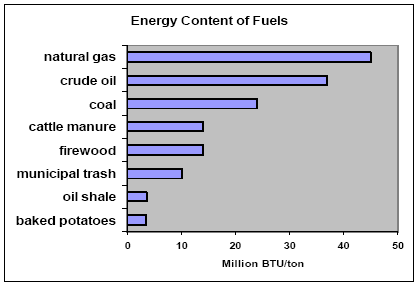
This helpful chart comes from Policy Pete by way of Mobjectivist.

We often hear that oil shale is tantalizingly close to being economically feasible. The carefree utopia that awaits us when we develop our potato reserves is less often discussed. In both cases, water intensity is a serious issue. Potatoes typically require about 20 inches of water per season, while oil-shale processing requires three to five barrels of water to produce one barrel of oil. On the bright side, few or no pesticides are used in the production of shale oil, whereas in 1996, 1,275,000 pounds of pesticides were applied to potatoes in Idaho's Red River Valley alone.

Then again, potato power would almost certainly involve less air pollution than traditional oil-shale processing; in theory, Estonia's oil-shale problems are far worse than ours would be, but we have to consider the possibility that the "urgent need" for shale oil will be used as a justification for ignoring or overturning applicable air-quality regulations.

When you consider Shell's exciting new in situ process - which is supposed to represent an improvement over the traditional methods - potatoes almost start to look attractive:

The company proposes to electrically heat a 1,000 foot-thick section of the Green River Formation to 700 degrees Fahrenheit, then keep it that hot for three years....Imagine a ten-acre production plot, 2,000 feet on a side. Inside that area, the company would drill up to 200 closely spaced wells. After those wells are lined with steel casing, 1,000 foot-long electric heaters would be inserted in preparation for the "bake"....

Although Shell's method avoids many of the negative impacts of mining oil shale, it requires a mind-boggling amount of electricity. To produce 100,000 barrels a day would require raising the temperature of 700,000,000,000 pounds of shale by 700 degrees F. How much power would be needed? A gigabunch — in rough numbers, about $500,000,000 per year. The least expensive source for electricity is a coal-fired power plant. How much coal, how many power plants? To produce 100,000 barrels per day, the RAND Corporation recently estimated that Shell will need to construct the largest power plant in Colorado history, large enough to serve a city of 500,000. This power plant, costing about $3 billion, would consume five million tons of coal each year, producing ten million tons of greenhouse gases, some of which would still be in the atmosphere a century from now. To double production, you’d need two power plants. One million barrels a day would require ten new power plants, five new coal mines.
Absolutely nightmarish, if true. But to Orrin Hatch, it's a beautiful dream:
"Utah has more recoverable oil in oil sands than the entire U.S. reserve," Hatch said. "That's a significant number, but it is overshadowed by the fact that the largest recoverable hydrocarbon resource in the world rests within the borders of Utah, Colorado, and Wyoming in the form of oil shale."
To the pure in heart, all things are pure. Hatch tends to use Alberta's tar sands as proof that Utah's oil shale is viable, despite the fact that they're different things and require different types of processing (oil shale development is worse, though tar sands are ghastly in their own right). This is typical; enthusiasm for oil shale seems most intense among cornucopian wingnuts who prefer weird analogies and sentimental flights of fancy to inconvenient facts. Instapundit is, as usual, a good example:
Long term strategic plan for the United States: Get the price of oil up high enough that oil shale competes with Middle East oil. Then put Middle East oil producers out of business, or just let them run out of oil. Oil-funded islamoterror then goes out of business, too, and the Middle East goes back to being an unimportant backwater.
Indeed. What could be easier, save for pwning those Red Chinese l4m3rz with our m4d cold-fusion sk1llz? Insty's brilliant strategy reminds me of Monty Python's instructions on how to rid the world of disease:
Well, first of all become a doctor and discover a marvellous cure for something, and then, when the medical profession really starts to take notice of you, you can jolly well tell them what to do and make sure they get everything right so there'll never be any diseases ever again.
Arguments like Instapundit's are simply an application of slope-browed belligerence to the problems of the moment. And I mean "of the moment" very literally, given that the situations he expects oil shale to remedy may have changed dramatically by the time oil shale is even remotely viable. (Besides which, the terrorist-funding Saudis have diversified their investments nicely. I suspect they'll land on their feet, if not ours.)

I seem to have digressed somewhat, so let's get back to those potatoes for a moment. It'd be crazy to assume that potato power could keep us in the style to which we're accustomed, let alone allow for the growth demanded by our increasingly cancerous civilization. But for some reason, it's considered rational - in some circles - to stake our future on the even more intractable, unfeasible, and uneconomical problem of oil shale. That'd be sad, if we were courting nothing more uncomfortable than disappointed expectations. But given the amount of subsidies we're likely to hand out, and the environmental damage we're likely to do, and the time we're likely to waste, quite a bit more hangs in the balance.