Showing posts with label denial industry. Show all posts

Wednesday, May 19, 2010

De Rerum Natura


The Washington Times hammers yet another final nail into Algore's piano-sized coffin:

The alarmists must imagine that 50 years before the birth of Christ, men like Julius Caesar spent their summers strolling the streets of Rome wearing sweaters to guard against catching a chill - instead of abandoning the sweltering capital in favor of temperate seaside villas. A study published in the March 8 edition of the Proceedings of the National Academy of Science casts further doubt on the warmist premise by concluding that the sun beat down more harshly on the Caesars than it did on anyone else in the past 2,000 years.
Not only that, but Lucretius was whining about hot weather centuries ago!
The following easily could be a passage from [Gore's] book "Earth in the Balance" describing the consequence of failure to act on climate change: "Either the scorching sun burns up your fields, or sudden rains or frosts destroy your harvests, or a violent wind carries away all before it." Inconveniently for Mr. Gore, the Roman poet Lucretius expressed those sentiments around 50 B.C. That's because weather back then was just as hot - or hotter - and as extreme as it is today.
See what they did there? The Goracle's movie had the word "inconvenient" in its title, but now it turns out that he's the one who has to face the inconvenient truth that Lucretius' description of extreme weather sounds just like his, but predates it. Which means we can arguably add plagiarism to his list of crimes. Sux2bu, fatty!
Other studies from around the world confirm the existence of Roman and Medieval warming periods, where no source of "greenhouse gases" existed aside from the horses and cows of the time.
I suppose the warmistas think Roman warming was caused by Nero driving an SUV, bwahaha! In fact, the warming was natural, which means that the same natural mechanisms must be at work right now, exclusively, despite any and all evidence to the contrary. And since the term "greenhouse gases" appears in scare quotes, there's no reason to assume that this 100%-natural warming could be exacerbated or accelerated by modern GHG emissions, since the climate is not particularly sensitive, as demonstrated by the fact that it sometimes changes abruptly in ways that can be devastating to human societies.

In short, it's safe to say that the AGW religion has been debunked once and for all by William Patterson et al, regardless of what alarmists like William Patterson may think.

Tuesday, May 11, 2010

A Landscape of Death


The Globe and Mail interviews Camille Paglia on the vital issues of the day, and discovers that — wait for it, now — modern academia is besotted with multiculturalism.

Not that there's anything wrong with other cultures per se; they're perfectly alright in their place, if you get my drift. But when you start portraying Caribbean or African authors as "important," where does that leave Shakespeare? Where does that leave real art, as defined for all eternity by middlebrow snobbery the illustrious dead?

See, when colleges validate the artistic pretensions of minorities and women and so forth, it can lead to the creation of "institutional fiefdoms." It'd be much better to have a single fiefdom, presided over by the Immortals of Art, whose irrevocable judgments on the modern scene will be made known to us by Camille Paglia.

Educators need to take "the long view." And they need to direct it uncritically toward an Official Past. Only then will they see that the artistic productions of women fade into nothingness when compared to the genius of Michelangelo. Why did he get to paint the Sistine Chapel, instead of some chick? Because he was way better than any of the bitches who applied for the job, duh.

Again, this is not to imply that "world culture" has no value. For instance, Hollywood and jazz are wonderful. But when you start making grand claims for the scribblings of some goddamn wog...well, it's very dangerous, obviously, because you're going against decades or even centuries of settled belief and what if you turn out to be wrong? What if your experience of art becomes mired in subjectivity, instead of being a ritualized expression of forced belief, as God intended?

You might think that some "ethnic" novel is powerful or meaningful or what have you...but a hundred years from now, will someone like Paglia be treating it as a spiritual pinnacle that no modern writer can challenge? If not, you'll have to admit you were wrong. Great art lasts, and in doing so it brutally limits human possibilities. That's how you tell it from mere trash.

Although she was "the first to advocate the Web," Paglia is troubled by its tendency to misinform: It can be hard to tell "whether something is solid, dubious, or whether it’s a joke or a scam." (Books are different, because the solid ones bear tokens of authenticity, like a blurb from Harold Bloom on the back cover.)

Which brings us inevitably to global warming. Previously, the sciences were a unified whole, thanks to the groundbreaking work of Aristotle, whose scientific accomplishments no woman has ever matched. But in the intervening years, thanks to feminism and postmodernism, they've splintered into institutional fiefdoms that don't communicate with each other. And this is the result:

This whole thing about global warming – I am absolutely incredulous at the gullibility of people. What is this hysteria over drowning polar bears? And finally I realized, people don’t know polar bears can swim!
See how it helps to take an interdisciplinary approach? Speaking of which, what is this hysteria over the Gulf Coast oil spill? Has no one noticed that birds can fly and fish can swim? If they choose to wallow in oil, how is that BP's fault? Whatever happened to personal responsibility?

People nowadays are too emotional, too melodramatic. It's one thing to call the humanities "a landscape of death" because you don't like Foucault. But to worry about polar bears, even though they're very nearly capable of swimming from Kotlik to Unalakleet? That's just silly. If people studied geology, as Paglia recommends, they'd take a much more sensible view of the matter.

At the risk of repeating myself, I'll leave you with this quote from Sinclair Lewis:
The men leaned back on their heels, put their hands in their trouser-pockets, and proclaimed their views with the booming profundity of a prosperous male repeating a thoroughly hackneyed statement about a matter of which he knows nothing whatever.

Friday, May 07, 2010

Mohonkgate


The "Climategate" scandal raised doubts many of us have long had about the integrity of the temperature data that allegedly support the AGW hypothesis. A new article attempts to strangle this newborn dissent in its cradle by praising temperature records from the Mohonk Preserve in New York:

It is the rarest of the rare: a weather station that has never missed a day of temperature recording; never been moved; never seen its surroundings change; and never been tended by anyone but a short, continuous line of family and friends, using the same methods, for 114 years....Mohonk offers a powerful confirmation of warming climate, as well as a compelling multigenerational yarn.
If these records really comprise "a powerful confirmation of warming climate," why is there any need to stress that point? Surely, the data should speak for themselves, without any need for "warmist" editorializing! Right away, one begins to suspect that there's more here than meets the eye. And sure enough:
The weather log, for many decades kept on hand-written sheets, lacks only 37 days of precipitation data from 1901, 1908 and 1909, due to a missing data sheet, and a few days when observers apparently didn't look at the rain gauge.
"Only" 37 days? Clearly, the authors of this piece fail to understand that in Science, no detail is unimportant. A butterfly flapping its wings in Cairo can cause hurricanes in the Arctic, as the Law of Unintended Consequences conclusively shows. And yet, we're expected to believe that 37 days' worth of missing data are "unimportant" to the climate models upon which the alarmist case rests.

Consider this: If these data are unimportant, why are they missing? And what transpired on those days when observers just "happened" to ignore the rain gauge? If there's nothing to hide, then why hide anything?

Apologists will say that the missing data pertain to precipitation rather than temperature. Of course, it's an article of faith among warmists that higher temperatures result in more precipitation (I guess they've never been to Death Valley). We know that if the missing data had shown heavy rainfall, they would've been hailed everywhere as "proof" of AGW. The fact that the data are missing suggests that they were...well, let's just say "embarrassing," from the warmist perspective.

Of course, there may be an innocent explanation, like incompetence or stupidity. However, Science does not advance by giving charlatans the benefit of the doubt. On the contrary, Science requires us to check and recheck data until we are 100-percent positive that they weren't gathered by moral cripples.

With this solemn duty in mind, I have sent upward of 400 FOIA requests to Mohonk personnel and their families, requesting all their data in double-reverse triplicate with knobs on. Furthermore, I have requested all handwritten correspondence to and from the "scientists" who collected these data, so that their handwriting can be subjected to a fully transparent process of ethico-graphological time series analysis (the precise details of which I'm not able to reveal at this time, for obvious reasons).

I'm also trying to find out where their kids go to school, just in case a little pressure is needed to encourage these bean-counters to obey the Constitution.

Needless to say, I will keep you informed about my growing suspicions as this case unfolds.

Tuesday, April 27, 2010

The Greater Scheme of Things


NRO's Jim Manzi has dared to give aid and comfort to the Warming Cult (and not for the first time, either). Since modern conservatarianism has pretty much dispensed with all emotions but anger and self-pity, Manzi's remarks have naturally been met with a heapin' helpin' of both.

Andy McCarthy has written a response to Manzi, and it's nothing if not illuminating. Loyalty seems to be the main issue: The denialists may be fools, but they're our fools. If you hold them to the same standards you apply to the Left, you lose. And if you lose, you're nobody and nothing.

Then there's the issue of AGW, and whether it's true even though it has no right to be.

As for your dilation on anthropogenic global warming (AGW), I don’t write much about the subject. I haven't taken the time to study it, as you have. But I have read enough to roll my eyes at most of the public debate.
Dude, I can totally relate. I don't know much about accretion-powered pulsars. But I once heard this goddamn egghead say something about 'em, and it wasn't so much what he said as the way he said it, with that smug look people like him get when they say stuff like that to people like me. If I'd gone to some Brainiac School and gotten into this guy's field I probably would've proved him wrong by now. And yet he's lecturing me on accretion-powered pulsars? Fuck that noise. I know plenty about gravity. Hell, I once heaved a 63-2 in the junior college decathlon. I'd like to see Faggy McPulsarson try that.

Anyhow, Manzi's a jerk not just for "dilating" on the subject of his own essay, but also for being comparatively well-informed about it. McCarthy trusts his gut, like all honest men, and his gut informs him that AGW ain't strictly on the level.
From the premise that AGW is undeniable, the alarmist side leaps to the extravagant conclusion that we are therefore capable of, and obliged to, do something meaningful about it.
To put it another way: How can you say that I'm not engaging with the alarmists' arguments, when I've just referred to them as "alarmists"?

The only appropriate response to AGW is to drop "an atom bomb of derision" on anyone who suggests that it could very well be a serious problem. This is so self-evident to McCarthy that one can almost empathize with his pain at having to explain it to a colleague.

Imagine that you've spent years working shoulder to shoulder with a comrade at the agricultural collective, and one fine day he claims that Stalin didn't actually invent the tractor. He's wrong, he's a liar, he's betrayed the Revolution...and yet, you can't help weeping, even as you denounce him to the People's Commissariat for Internal Affairs. For there was a time when you loved him as a brother.

Next, McCarthy describes the AGW debate in terms so simple that even he can understand them. Alarmists say that over time, lots of little things can add up to big things. Skeptics acknowledge this provisionally, while pointing out that they don't care because "denying it makes sense in the greater scheme of things."

And these are the thanks they get:
[T]he alarmists deride the skeptics over their denial as if they were denying something as basic and incontestable as that two plus two equals four.
In reality, they're simply denying that it matters whether 0.0002 and 0.0002 equals 0.0004. That's a whole different thing, as you can tell from all those zeroes.
[T]he skeptics continue denying — even if they are wrong in absolute terms — because they fear alarmists have set the table in such a way that to concede the premise is to concede the draconian remedies alarmists have in mind.
Whether they're absolutely wrong or absolutely right, you have to admit that what they say makes a lot of sense. And isn't that what matters most, when you stop to think about it without thinking about it too much?
I would say that, given our finite capabilities and the shortness of life, AGW may not be a problem at all, and, if it is a problem, it is not urgent enough to obsess over.
McCarthy himself concedes that he doesn't believe this because he's "taken time to study" the science. He believes it because it's the proper thing to believe, even — or especially — if it's "wrong in absolute terms." That, amazingly, is his response to Manzi's claim that people on the Right have been displaying an "unwillingness to confront the strongest evidence or arguments contrary to [their] own beliefs."

Perhaps because he senses some problem with this line of reasoning, McCarthy quickly retreats to the epistemological bedrock of Islamofascism: There's no point worrying about the climate when we're in "a global war against jihadists whose mass-murder attacks — and their catastrophic costs — are impossible to predict."

Apparently, uncertainty is sometimes a threat, rather than a comfort.

Please don't conclude from all this that McCarthy is an ineducable zealot. As it happens, he can imagine — just barely — a situation in which it would be quite reasonable to take action on AGW. For instance, suppose Modern Science were able to establish beyond a shadow of a doubt that:
  1. There's a real problem

  2. It's more dangerous, at this very moment, than Islamic Terror™

  3. It can be solved without doing things of which McCarthy disapproves, like regulating industry

  4. Scientists aren't just making the whole thing up in order to hasten the Dictatorship of the Proletariat

  5. No relevant scientist has any conceivable financial interest in the outcome of the debate
In that case, McCarthy would immediately stop being a skeptic, as long as no other excuses for skepticism had come up in the meantime (e.g., news that a leading climatologist had rented a DVD of Avatar, or dined on arugula).

Please note that this is not evidence of bias: he applies exactly the same standards to skeptical scientists like Richard Lindzen (except for #5, which only applies to anti-capitalist greedheads like Al Gore, natch).

That's fair if anything is, so let's have no more of this alarmist talk about "epistemic closure." After all, it may never happen!

Thursday, April 08, 2010

Two Species


George Monbiot is concerned — very concerned! — about the exoneration of Dr. Phil Jones. The failure of other people to be as concerned as he is points, as such failures often do, to systemic corruption. Or maybe to something even more troubling.

None of it made sense: the intolerant dismissal of requests for information, the utter failure to engage when the hacked emails were made public, the refusal by other scientists to accept that anything was wrong. Then I read an article by the computer scientist Steve Easterbrook, and for the first time the light began to dawn.

Easterbrook, seeking to defend Jones and his colleagues, describes a closed culture in which the rest of the world is a tedious and incomprehensible distraction. "Scientists normally only interact with other scientists. We live rather sheltered lives … to a scientist, anyone stupid enough to try to get scientific data through repeated FoI requests quite clearly deserves our utter contempt. Jones was merely expressing (in private) a sentiment that most scientists would share – and extreme frustration with people who clearly don't get it."
Monbiot concludes that journalists and scientists live in Two Different Worlds. You'd think that someone who's been following the climate "debate" for years would've figured that out long before now.
What scientists might regard as trivial and annoying, journalists and democracy campaigners see as central and irreducible. We speak in different tongues and inhabit different worlds.
Or as Pierre Bourdieu puts it in Science of Science and Reflexivity, "each discipline (as a field) is defined by a particular nomos, a principle of vision and division, a principle of construction of objective reality irreducible to that of another discipline." Roll over Wittgenstein, and tell Saussure the news!

Obviously, this raises interesting questions. But I think it's fair to say that the possible advent of a new "scientific" species — Homo sivanus, let's call it — is not one of them.
Perhaps eventually we'll split into two species. Reproducing only with each other, scientists will soon become so genetically isolated that they'll no longer be able to breed with other humans.
Perhaps. But another, more likely possibility is that Monbiot worried that the CRU hack posed a threat to his own credibility, was accordingly a wee bit hasty in calling for Dr. Jones to resign, and is now trying to backpedal by, like, getting all philosophical and shit.

Anyway, if we're to forestall Monbiot's imaginary evolutionary catastrophe, scientists must stop walling themselves off from the everyday world.
Painful and disorienting as it is, they must engage with that irritating distraction called the rest of the world. Everyone owes something to the laity, and science would die if it were not for the billions we spend on it. Scientists need make no intellectual concessions, but they have a duty to understand the context in which they operate.
See, I'd argue that Phil Jones et al did understand the context in which they operate, on the grounds that they recognized McIntyre's FoI filings as "trivial and annoying." Had these scientists really been as cloistered as Monbiot suggests, they may've been more likely to view McIntyre as an honest truth-seeker with whom there was no good reason not to cooperate. And indeed, political calculation is precisely what they tended to be accused of, precisely because they ran afoul of the Virgin/Whore Complex that outsiders tend to impose on the sciences.

Monbiot understands that while science and journalism are both closed worlds, one of them is much better at self-regulation than the other. Instead of thinking about why that might be, and considering "Climategate" — and his own reaction to it — in that context, he resorts to maudlin abstractions like these:
The incomprehension with which science and humanities students regard each other is a tragedy of lost opportunities. Early specialisation might allow us to compete in the ever more specialised labour market, but it equips us for nothing else. As Professor Don Nutbeam, the vice-chancellor of Southampton University, complains: "Young people learn more and more about less and less."
Right. 'Cause the orchestrated misrepresentation of a bunch of hacked e-mails has everything to do with the philosophical schism between science and the humanities, and little if anything to do with the political and economic interests of the people who own the media.

Which just goes to show that OMG we all live in different worlds, and as Krazy Kat pointed out, "lenguage is, that we may mis-unda-stend each udda."
We are deprived by our stupid schooling system of most of the wonders of the world, of the skills and knowledge required to navigate it, above all of the ability to understand each other. Our narrow, antiquated education is forcing us apart like the characters in a Francis Bacon painting, each locked in our boxes, unable to communicate.
Oh, please. Once again: What happened here is that some climate scientists had their e-mails stolen, the media allowed denialists to define what those e-mails meant, and Monbiot found it professionally expedient to portray himself as God's Last Honest Man. Now that the hysteria has died down somewhat, and someone owes someone else an apology (hint hint), Monbiot sees fit to hide his head in the sands of existential angst.

The cheaper the hood, the gaudier the patter.


Thursday, March 18, 2010

The Dim-Witted Public


John Horgan takes exception to the idea that insights gleaned from neuroscience could help scientists to "frame" global warming in a way that would make it more coherent and palatable to the public.

Framing is just spinning, and neuroframing is spinning plus brain scans.
Although he acknowledges that we don't reliably "make choices based on self-interest [!] and reason," and are more likely to be influenced by "fear, suspicion, empathy and other emotions," Horgan worries that making the effort to adapt to this reality will simply reinforce the perception -- or the "frame," if you prefer -- that environmentalists are deceptive.
First of all, we don’t need MRI studies to tell us that we’re emotional, complicated creatures. Moreover, many people already view environmentalists as self-righteous and manipulative. This is a framing problem that neuroframing may exacerbate. The message is that environmentalists will go to extraordinary lengths—seeking guidance from cutting-edge brain science!--to help the dim-witted public see the world in the same enlightened way that environmentalists do.
There are a few problems here. First, choosing your words carefully, with regard to their likely effect on the perceptions of your audience, isn't going "to extraordinary lengths," nor does it necessarily imply that you believe your audience is "dim-witted." You'd think a professional science writer would understand this.

Second, Horgan blurs the distinction between "environmentalists" and "scientists," which is a perfect example of how not to proceed. The idea that environmentalism amounts to a special interest of some sort is fantastically weird and wrongheaded, in my view, but it's very common all the same. Given what the term signifies in everyday discourse, it's neither accurate nor constructive to conflate environmentalists with working climate scientists.

Third, Horgan seems to think that "framing" represents some sort of a departure from ordinary discourse (his own, for instance). But communication is...well, communicative, not just of facts and opinions but also of implicit and explicit messages about the speaker and the listener. Presenting oneself or one's field as the de facto embodiment of honesty and rationality and objectivity is no less a matter of framing than the tactics Horgan objects to (and can just as easily be attacked as elitist, arrogant, unethical, or whatever).

Horgan also seems to have fallen prey to the Broderist delusion that if you stop giving your opponents ammunition, the spirit of Fair Play will oblige them to stop shooting at you. This is a very popular response, nowadays, to organized bullying by corporatist reactionaries. You can ask the Democrat Party how well it's worked (or if you've succumbed to cynicism, how well it's intended to work).

My own concern about what Horgan calls "neuroframing" is that it may overlook the actual structure of the journalistic field and the money and allegiances that produce it, which is a bit like trying to describe space-time without any reference to gravity. It's not just that scientists have to understand how to talk to the public; it's that they have to understand how to talk to the public through media that distort their positions at best, lie about them at worst, and would never dream of subjecting the accuracy and honesty of their own journalists and editors to the microscopic scrutiny they give the IPCC.

That said, philosophical and political concerns about what constitutes legitimate knowledge and authority can't necessarily be overcome by "laying out the facts as clearly and honestly as possible," as Horgan recommends...especially if someone from, say, the CEI is brought in to ensure that what Pierre Bourdieu calls "the naively idealized vision of the 'scientific' community as the enchanted kingdom of the ends of reason" is properly balanced by "the cynical vision which reduces exchanges between scientists to the calculated brutality of political power relations." (Teach the controversy!)

And these are actually the least of my qualms about Horgan's article. Get a load of this:
Not all global-warming skeptics are ignorant, irrational idiots. I teach at an engineering school, and about one third of my students identify themselves as global-warming skeptics. They tend to know more about global warming than students who accept it as a fact.
I really don't want to be lectured on effective communication by someone who fails to see the rhetorical pitfalls here. If I were to claim that "evolution skeptics tend to know more about evolution than students who accept it as a fact," I'd be accused of talking nonsense, at best. I don't see what makes Horgan's version of this argument respectable or relevant or coherent.

As for the bit about "ignorant, irrational idiots"...it's silly, because a call for improved framing doesn't imply that people are idiots. And it's hypocritical, because Horgan not only acknowledges that human beings are irrational by nature, but also seems to believe that skeptics are ignorant (as evidenced by his desire that they be exposed, again and again and again, to the "facts").

Furthermore, Horgan has no problem calling people "wackos" when it suits his purposes.
Inconvenient Truth was a framing masterpiece, but Al Gore’s linkage of global warming to Katrina, however qualified, has made it easier for wackos to claim that single weather events, like the big blizzards that struck Washington, D.C., this winter, contradict global warming.
Maybe so. But is overstating the significance of single weather events what we're talking about when we talk about "framing"? Is this, or anything like it, what the neuroframers with whom Horgan has been hobnobbing actually recommend? Failing that, is it an inevitable result of their approach? If not, then what in God's name is Horgan's point?
Climategate showed that some climatologists have become so obsessed with framing that they have harmed their credibility.
Much as I hate to stray from the dispassionate objectivity of scientific discourse, that's a metric assload of unmitigated fucking bullshit. This attack on scientists "harmed their credibility" because their goddamn e-mails were stolen and cherrypicked, and because intentional misrepresentations of the things these e-mails said were treated as intellectually serious and scientifically relevant by countless media outlets, while simple and factual corrections were either ignored, or dismissed as mere opinion.

Again, before Horgan rejects framing, he might want to note that there's a huge difference between reinforcing the victim-blaming denialist narrative of "Climategate," and presenting it, accurately, as an orchestrated and pathologically dishonest media spectacle based on a fucking crime, for fuck's sake.

In summation:

Environmentalists should forget about neuroframing. And that’s my we-map talking.

And the moral of that is: Be what you would seem to be, or if you'd like it put more simply: Never imagine yourself not to be otherwise than what it might appear to others that what you were or might have been was not otherwise than what you had been would have appeared to them to be otherwise.

Wednesday, March 10, 2010

Better Days Ahead


An op-ed in the Sioux City Journal reviews the current state of climate science, and finds that the earth may or may not be warming, and so what if it did? Views differ, teach the controversy, Algore's hockey stick is broken, et fucking cetera.

Given that what we don't know can't possibly hurt us, why on earth would anyone pursue so-called "renewable energy"?

[W]hat surprises me the most is that government and other opportunistic institutions are continuing to promote expensive cures for what might after all not ail us. They, for reasons of their own, preach the doctrine of renewable energy (windmills, solar panels, the tides, batteries, subterranean hot water, etc.)

None of these devices, singly or collectively, can deliver the power needed to keep us productive, fed, watered and reasonably comfortable. Yet plans for a renewable energy economy persist often with cooperation of traditional energy companies.
The word choices here are nothing if not judicious. "Hydropower" sounds like a serious occupation for square-jawed men with pick-axes; it might even conjure up images of Gavins Point Dam. But harnessing "the tides" sounds like something a filthy hippie would recommend while picking fleas from his beard (and how would it help landlocked Sioux City, in any case?). By the same token, geothermal heating might possibly be recognized as a good idea (good enough for Sioux City schoolchildren, at any rate). But exploiting "subterranean hot water"? That sounds highly speculative. And kinda gay.

Why go to all the trouble of reporting the basic facts accurately, when you can dream up subtle dysphemisms for widely used technologies, pretend that renewable energy is pointless unless it replaces fossil fuels next week, and establish an alternative history in which AGW threatens us with "fatal sunburn"?

On the bright side, the article does provide us with a handy checklist of logical fallacies:
  • Wind power is subsidized. (fallacy of exclusion)

  • A green energy program won't solve our unemployment woes. (false dilemma)

  • National Review says renewable energy is stupid, and the author likes National Review because it's "conservative and sensible," as evidenced by the fact that it says renewable energy is stupid. (petitio principii, genetic fallacy)
  • The Himalayan glaciers won't melt by 2035. Therefore, problems relating to AGW will occur so far in the future that there's no sense in worrying about them. (argumentum ad douchebaggium)
Just as you wouldn't serve someone a glass of raw sewage without adding a generous topping of whipped cream, the author takes pains to reassure us that Science is Good. AGW may be a hoax that'd make a cat laugh, but that doesn't mean scientists should stop studying the climate altogether.
No question, scientists should continue studying historical and current global temperatures to make sure we don’t delay needed remedial action beyond the time they cease to be effective and we resign ourselves to frying to a crisp.
See, that kind of research is perfectly reasonable, in theory. It's just that the scientists who are saying right now that we are delaying "remedial action beyond the time they [sic] cease to be effective" happen to be "opportunists" who seek "fat world subsidies for their studies." We know this is true because if they weren't, we'd be listening to them. QED!

So everything's fine. And therefore:
You don’t really have to buy an electric car and dim light bulbs, settle for turnips instead of steak, or even hope for better days ahead.
That's a load off my mind, I must say.

UPDATE: Advocates for renewable energy are hydrocarbon deniers. So there!

(Illustration by Gustave Doré.)

Monday, March 08, 2010

Lurid Warnings


Peter Preston, an opinion writer for the Grauniad, has noticed that lots of people don't believe global warming is real, or manmade, or serious. And he knows exactly who's to blame.

It isn't hard to collate the factors that drive disillusion. Professors with a colloquial touch writing "awful" emails; a recession so tough that it blows future shock away; a cold, cold winter the Met Office didn't forecast; scientific angst about swine flu revealed as way over the top; dodgy figures, dodgy reporting, dodgy issues way up to UN level.
Note that the denial industry and the media that cater to it are conspicuous by their absence. Scientists must take most of the blame for public disbelief: this sort of "disillusion" is what naturally happens when experts treat influenza as a dangerous disease, or fail to reckon with the cold hard reality of winter.

Preston is very upset about all this, because global warming is a damned serious business, dash it all, and something bloody well needs to be done about it...as long as it's OK with "voters."
Voters have to clamber on board when sacrifices are required. They have to see the need for pain, to sense the danger of doing nothing. They have to lead their leaders as well as follow....
How do we get voters to sense danger and lead their leaders, as they did when they found out that Saddam's stormtroopers were tipping Kuwaiti babies out of their incubators? Good question! "Re-examinations of existing evidence" are useless, it seems, because no one's going to listen to professors now that denialists have methodically lied about them their work has been shown to be full of "dodgy figures." And no one's going to listen to Al Gore, because he obdurately insists on being Al Gore, with malice aforethought.
More jaw and Gore from politicians can't cut it. They have come to seem secondhand sources, merely parroting a frail scientific thesis. That goes, alas, for journalists, too – and for pressure groups issuing lurid warnings or staging angry demos....
Journalists, op-ed writers, and their editors can't help (presuming for the sake of argument that they actually want to). And "pressure groups" can't help either, because the public strongly objects to anger and lurid warnings unless they're directed at Al Gore or Phil Jones or the IPCC or the concept of taxation. And that goes double for pressure groups comprising climate scientists:
[M]ore of the same is exactly what we seem to be getting. More re-examinations of existing evidence, monitored by the people who failed to monitor it last time. More supposedly transparent attempts to say precisely when Himalayan glaciers will melt. More United Nations panels, flying lugubriously hither and yon in the cause of consensus. More declarations signed by hundreds of scientists on behalf of a notional "scientific community"....
As the person who may very well have coined the term "concern troll" (over at Eschaton, roughly six years ago), I think I'm qualified to say that Preston is a concern troll par excellence. He ignores the existence of a well-organized denialist movement. He ignores its ongoing support from a variety of business interests, including the media. He downplays the extent of scientific consensus. He reinforces any number of denialist narratives while claiming to be worried about declining belief in AGW. And he treats attempts to set the record straight -- the record, that is, that he himself goes out of his way to misrepresent -- as shabby, dishonest, and ultimately pointless.

So what's his solution?
[T]he plain fact is that we surely need a prophet, not yet another committee. We need one passionate, persuasive scientist who can connect and convince – not because he preaches apocalypse in gory detail, but in simple, overwhelming terms. We need to be taught to believe by a true believer in a world where belief is the fatal, missing ingredient.
In other words, we need someone who can serve as the public face of Scientific Non-Lurid Semi-Alarmism. We need someone whose personal credibility will represent the integrity of climate science, so that both can be pulled down together once he or she is accused of profiteering or preaching apocalypse or what have you, just like every other scientist who has played this role, intentionally or otherwise.

And you know what would be really, really clever and not at all self-defeating in any way? To describe this person in advance as some kind of charismatic, quasi-religious figurehead: an "eco-prophet," if you will. That's just the sort of sensible rhetoric that's been missing from this debate!

I suppose that once this new prophet has been demolished, and his or her "followers" stand revealed yet again as doomstruck cultists, Preston can write a column demanding a new and better figurehead...one who's not so prone to Scientific Angst and Lurid Warnings.

Because the alternative would be to "plod across the wastelands of borrowed time" without ever achieving anything. And that would be a real shame, given what's at stake.

(Illustration at top via Media Matters.)

Thursday, March 04, 2010

These Things I Believe


In recent months, I've come to realize that there are certain things I need to acknowledge if I wish to be taken seriously by my intellectual betters.

  1. If we're talking about global warming, it's impossible to see how small changes could have enormous negative consequences. If we're talking about culture or politics, it's impossible to see how they can't.

  2. The Free Market is the world's best and most efficient force for transformative change, the vast majority of which must be opposed on principle lest we end up in some sort of queer eco-gulag.

  3. Alarming news must be viewed as "alarmist," and therefore false, unless it involves Muslims, socialism, environmental regulations, faggotry, blacks, immigrants, academia, or gay black Muslim eco-socialist immigrant academics like "President" Obama.

  4. Civility is in a sad state of decline, and everyone who's responsible is worse than Hitler. (PS: Fuck you!)

  5. Argumentum ad hominem is the logical fallacy of disagreeing with someone who's confident about being right. This is one of the very worst things you can do, online or off. If you choose to indulge in it anyway, don't be surprised when people ignore your so-called "evidence." After all, you've demonstrated that you're a bad person.

  6. Argumentum ad verecundiam, or appeal to authority, is the logical fallacy of assuming that working climatologists are a better source for information on climate than economists, retired weathermen, eccentric British peers, and anonymous online paranoiacs.

  7. The most logical explanation for consensus is collusion or groupthink. Everyone knows that!

  8. Confirmation bias is a plausible explanation for the belief that a given scientific study supports AGW. However, it is not a plausible explanation for the belief that this support can be explained away by invoking confirmation bias.

  9. The Law of Unintended Consequences only applies to stuff you don't really want to do anyway.

  10. Global climate is very, very complicated. That's why it must be approached with much more humility and caution and thoughtfulness than relatively straightforward endeavors like civilizing Muslim nations at gunpoint, or regulating human sexuality.

  11. AGW probably isn't happening, or at least not very much. And if it is happening, it probably isn't a serious problem. And if it is a serious problem, we'll probably have plenty of time to address it through geoengineering, which is a much better solution than reducing emissions, because it relies on the creation of a global regime dedicated to micromanaging our atmosphere and oceans in pursuit of benefits predicted by the same climate modeling we can't trust to predict AGW, instead of imposing some tyrannical big-government measure like a carbon tax. So why worry?

  12. If I believe that the IPCC is fallible but essentially honest, and you believe it's a snake pit of anti-capitalist ideologues who are only in it for the money, the spirit of compromise obliges me to admit that nothing it says can be trusted until you tell me otherwise.

  13. If scientists are telling you something you don't want to hear, but you can't quite bring yourself to believe that they've all become Marxists, the most likely explanation is that they've forgotten some fundamental Rule of Science with which you're vaguely familiar. Perhaps they've sinned against the Second Law of Thermodynamics, or the Principle of Bivalence, or the Empirical Method, or Occam's Razor, or all four. Whatever the case, you can undoubtedly find a quote from Einstein that will put them in their place.

  14. Most scientific breakthroughs are achieved by angry, incoherent conspiracy theorists with no training in their adopted field and an implacable contempt for pretty much everyone who works in it professionally. This was definitively proved in 1776 by Galileo, and also by that plate tectonics guy, whatever his name was. If you doubt this, please consider the fact that I AM NOW TYPING IN CAPS.
If there's anything else you feel I should know, please feel free to explain it to me in comments.

UPDATE: In comments, Rich Puchalsky advances a theory that could potentially unify all the points listed above, as well as everything else worth knowing:
No statement made by a hippie can ever be true. Even in cases where the statement is finally generally accepted as being true, that doesn't it make it retroactively true when it was said by hippies. It only started to be true when the first non-hippie condescended to say it.
Why do I hesitate to affirm that this is 100% true in all possible universes? Only because I don't know for certain that it wasn't written by a hippie. Here's hoping Mr. Puchalsky will soon provide us with evidence of his bona fides, so we can all get on with our vastly enriched lives.

Here's some music while we're waiting. Please note its tasteful use of diminished chord arpeggios, which are of course the best kind.

Wednesday, March 03, 2010

Immense Complexity


A new op-ed by Jeff Jacoby illustrates the rapid evolution of denialist lies. Not long ago, you'll recall, the IPCC corrected a forecast for glacial melting in the Himalayas. The Wall Street Journal noted the error, reassured us that the Himalayan glaciers are unlikely to disappear "anytime soon," and implied that the forecast was wrong primarily because it was too depressing. (The only alarming predictions that have any hope of being correct are those having to do with terrorism, socialism, and homosexuality.)

Jacoby takes the next logical step:

The case for global-warming alarmism is melting faster than those mythical disappearing Himalayan glaciers, but Al Gore isn’t backing down.
Initially, they were disappearing more slowly than the IPCC said, bwahahaha. Now, it seems that they're not disappearing at all. I wonder how long it'll be 'til we hear that the Himalayas never actually had any glaciers?

The rest of the column is mere boilerplate: Algore is a fat alarmist liar who has made huge investments in alarmist technologies like solar power and therefore can't be trusted, so let's all listen to Jeff Jacoby instead.

We may as well look at the highlights anyhow. After all, Jacoby's not the only one with space to fill.
  1. If AGW is real, how come I can engage in arch semantic quibbling over the meaning of the word "pollutant"?

  2. If we reduce CO2 emissions, there'll be no more trees for you filthy hippies to hug!

  3. Thanks to CO2, the Chinese have enough money to buy US debt.

  4. Climategate! Climategate Climategate Climategate! Climategate Climategate Climategate Climategate Climategate! (PS: The significance of Climategate is that no one has doublechecked the evidence for AGW and if they ever do they'll find out it's all lies! OMG CLIMATEGATE!!!)

  5. The public feels that climate science is somewhat less credible than it used to be. Who, I ask you, would be so undemocratic as to gainsay them?

  6. We all remember how the Goracle said it would never snow again and each year would be hotter than the last, everywhere on earth, unless we gave him all our money and worshiped him as a god. But now that it's snowing, he suddenly changes his story!

  7. AGW is a religion because the scientific evidence for it vanishes if you ignore it or don't understand it, just like the scientific evidence for God.

  8. Glaciers are robust, just like public ignorance.
Almost exactly a year ago, by the way, Jacoby was counseling sober humility in the face of "the immense complexity of the Earth's ever-changing climate." Now, apparently, all the data are in and we can conclude that Algore's Warming Theory is a hoax to rival Piltdown Man, just as we always suspected. Hooray for scientific progress!

(Illustration: "The cumulative specific mass balance curves are shown for the mean of all glaciers and 30 ‘reference’ glaciers with (almost) continuous series since 1976. Source: Data from WGMS.")

Monday, March 01, 2010

Discarding Data


An article at Daily Climate discusses the hate mail that climate scientists have been getting, and the likelihood that it's part of an organized campaign of intimidation.

The e-mails come thick and fast every time NASA scientist Gavin Schmidt appears in the press.

Rude and crass e-mails. E-mails calling him a fraud, a cheat, a scumbag and much worse.

To Schmidt and other researchers purging their inboxes daily of such correspondence, the barrage is simply part of the job of being a climate scientist. But others see the messages as threats and intimidation – cyber-bullying meant to shut down debate and cow scientists into limiting their participation in the public discourse.
I can't help wondering if it's really wise to delete e-mails like these, which could possibly provide forensic evidence for orchestrated attacks and astroturfing. As I see it, someone should be gathering these e-mails from as many recipients as possible: simply deleting hate mail, while understandable in emotional terms, doesn't seem like a good idea from a scientific standpoint or a political one.

While we're on the topic of discarding useful data, get a load of this:
The nature of public discourse – be it climate change or health care – has changed; information that does not fit one's worldview is now discounted or rejected.

Increasingly," wrote Pulitzer-prize winning columnist Leonard Pitts, Jr. in the Miami Herald recently, "we are a people estranged from critical thinking, divorced from logic, alienated from even objective truth."
This just in: Public discourse is irrational pretty much by definition, and our self-styled defenders of "objective truth" might be a little more convincing if they weren't constantly wringing their hands over the loss of some rationalist Golden Age that never fucking existed, ever.

Never mind obvious examples like the Scopes trial and the decades of witless bickering it inaugurated; even something as apparently straightforward and logical as the imposition of standard time zones, back in the 19th century, was widely seen as arrogant tinkering with God's handiwork. To the extent that Pitts has a point, it's a point about the erosion of authority, not of "critical thinking." And even then it's dubious, since scientific authority has always tended to wax and wane along with its political utility. Power is knowledge, you might say.

As for being "alienated from even objective truth," I think Plato made a somewhat similar argument. As did Francis Bacon, when he said that "the mind of man is far from the nature of a clear and equal glass wherein the beams of things should reflect according to their true incidence; nay, it is rather like an enchanted glass, full of superstition and imposture, if it be not delivered and reduced." As have more people than I can name, again and again, from the dawn of recorded history 'til now. If Pitts is truly unaware of these little details, I'd say he's a better example of our intellectual decline than the fact that the man in the street has insufficient respect for climate modeling.

You can't treat AGW as an appropriate matter for public debate, and demand that the debate be conducted rationally, strictly on the basis of the evidence, because that's not how the public reliably operates even when the evidence is clear and accessible. Unless we intend to dissolve the people and elect another -- or to treat dissenters as irrelevant anti-patriots, the way we do when it comes time to launch wars -- we're stuck with them. Which is to say, we're stuck with us. If we're going to treat realism as some sort of civic duty, perhaps we should start being realistic about human history and how it's made, and stop blaming its victims.

(Illustration: "Credulity, Superstition, Fanaticism" by William Hogarth, 1762.)

Thursday, February 18, 2010

The Week in Denialism


Michael Fumento hails the new scientific orthodoxy on medieval warmth:

[T]emperatures in the Middle Ages, at the very least in the northern hemisphere, were considerably warmer than they are now. Conceding both these points in a BBC interview was Professor Phil Jones.
Of course, the denialist article of faith is that the MWP was global, and Jones didn't concede that point by any means. Nor did he concede that that it was "considerably warmer" then than it is now. But Fumento will take whatever he can get, so long as it allows him to reach this epochal conclusion:
If the medieval warming wasn't manmade, then the recent warming may not be either.
Sure. And if arsenic occurs naturally in the Ganges Delta, then these mysterious Australian arsenic deposits might well be natural too. And if Aristotle misunderstood the climate without being an amoral shill for big business, then Fumento's misunderstanding of climate may simply be an honest mistake.

Debra J. Saunders points out that teh Warmists have no one but themselves to blame for the collapse of "the global-warming machine," because "their actions and attitudes did not reflect the sort of behavior you would expect from people who truly believe that the planet is in peril."

See, if they'd truly believed we were in danger, they would've admitted that we know very little about the climate. This would've allowed them to find common ground with skeptics, who might then have been more willing to entertain their outlandish notions about warming (assuming they still had any). But instead, they got greedy, and have now "drowned out the voices of scientists -- including those who believe global warming is largely caused by man -- who have been ready to engage in the complexities of climate science." Which means that even if it turns out that they were actually right, and the climate is warming dangerously, it'll be on their heads. Suck on that, hippies!

David Harsanyi complains that Los Warmistas are comparing denialism to creationism in order to justify taking away our gas-powered lawnmowers, which could force us to trim our lawns with cuticle scissors. He's also very excited about Phil Jones' comment on the MWP. "The importance of this can't be stressed enough," he says, which is probably why he doesn't bother trying to explain it. Why make an effort when you're bound to fail?

Granted, it can be very hard to understand the things climatologists say about stuff. "I certainly can't," says Harsanyi, "despite my best efforts." That said, it don't rightly take none o' that fancy-pants book-larnin' to grasp these fundamental world-historical principles:
  1. Addressing AGW costs money that would be better spent on something more important, like racial profiling.

  2. We can't afford to give in to fear-mongering, especially in a world that trembles under the shadow of Islamofascism.

  3. If the climate changes significantly, we'll simply adapt to it like we always do, 'cause otherwise we'd have to make burdensome economic trade-offs now, instead of waiting until after some sort of disaster strikes.

  4. If climate scientists want to be taken seriously by people who can't understand their work, they must see to it that their integrity is unassailable. In other words, they need to stop trying to frighten us with problems we can't understand that probably aren't a big deal anyway and will cost way too much money to address unless we put things off for as many years as possible.

  5. Gas-powered lawnmowers totally kick ass! Live free or die!
Last, but certainly not least, Donald Trump wants Algore to give back his ill-gotten Nobel Prize on account of it snowed a whole lot on the East Coast, even though the Goracle insisted that it would never snow anywhere on earth ever again, and especially not in winter.

Which brings up a sore point. Speaking as a rabid anti-capitalist who belongs to both schools of Cultural Marxism, I really wish the architects of the International Socialist Global Warming Hoax had been a bit more alert to the possibility that a couple of big snowstorms would come along and destroy all our carefully laid plans. I've been promising my comrades down at the Birkenstock factory that we'd see the Dictatorship of the Proletariat by Halloween, at the very latest. What the hell am I supposed to tell them now?

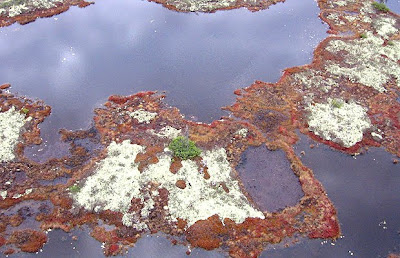
(Photo: "Lichen and shrub-covered palsas surrounded by a pond resulting from melting permafrost in a bog near the village of Radisson, Canada.")

Wednesday, February 17, 2010

Perceived Misbehavior


An editorial on climate science in today's New York Times presents an interesting counterpoint to yesterday's denialist manifesto in the WSJ. Since the NYT is a sober, moderate paper, it naturally affects a sober and moderate tone in order to deliver a sober and moderate version of the basic denialist message.

First off, we need to consider the significant errors the IPCC made, as evidenced by the only one that's really obvious.

The controversy over the 2007 report has been stoked by charges of poor sourcing and alarmist forecasts, prominently a prediction — in a 938-page working paper — that the Himalayan glaciers would disappear by 2035. This was clearly an exaggeration, though it was not included in the final report.
I'm going to go out on a limb here and say that mistakes are mistakes and incorrect forecasts are incorrect. It doesn't matter whether an inaccurate forecast predicts melting Himalayan glaciers or a glorious new age of sunshine, lollipops, and rainbows; what's at issue is the validity of the science behind it, not the possibility that it represents a sin against the holy spirit of optimism.

Regardless, the NYT is careful to note that this was an alarmist forecast, according to "charges" made by unidentified but presumably serious-minded people. Never mind that the IPCC report comprises any number of alarming forecasts, including -- as I noted yesterday -- its corrected forecast for glacial melting. Never mind that anyone who's capable of being frightened by the near-term disappearance of Himalayan glaciers ought to be frightened by IPCC forecasts that have not been retracted, and may even be conservative. What's important here is that during the process of quantifying and describing a serious threat to modern civilization, the IPCC arguably fell prey in one semi-unequivocal instance to alarmism.

And not the good kind of alarmism, like claiming that Colin Powell's colorful drawings of mobile bioweapons labs oblige us to attack Iraq, or that capping carbon emissions will condemn us to living in some UN-administered troglodyte gulag, where we'll gnaw roots and fronds by the ghostly light of bioluminescent fungus. Nope, this is the bad kind of alarmism...the kind that posits serious problems that can't be solved by electing more centrists, deregulating more industries, beating up more hippies, or dropping bombs on more ragheads.

When an orchestrated ideological attack is launched on science -- on the basis of blinkered business interests, zero-sum competition for authority, and seething resentments that go all the way back to the goddamn Scopes trial -- what can it mean but that science needs to mend its ways?
[G]iven the complexity and urgency of climate change — and its vulnerability to political posturing — scientists engaged in the issue must avoid personal agendas and be intellectually vigilant and above reproach.
That's good for a start, but I could use a footrub while they're at it. If Rajendra K. Pachauri weren't so deeply embroiled in alleged (but still shocking!) conflicts of interest that have undermined the great eternal work of debating whether AGW is really a serious problem, he could be soothing my bunions right now with Ayurvedic massage.

I submit that it's not actually possible to be "above reproach" when ciphers like Steve McIntyre and Anthony Watts can casually invalidate your life's work by waving the magic wand of blog science, and virtually any paranoiac halfwit with a Website and an axe to grind can have his or her "charges" about your "alarmism" stovepiped into the mass media. Worrying that scientists are "thin-skinned" because they object -- in private e-mails -- to being called incompetent socialistic genocidal frauds is not really fair. Especially since our nation's Titans of Industry routinely treat any scientific theory that challenges their worldview (i.e., their outdated business model) as a personal affront.

For some reason, the tantrums of these glibertarian dead-enders have a certain nobility and grandeur. But when scientists weary of being told by Dunning-Kruger casualties that OMG ITS TEH SUN STOOPID LOLOLOLOL, they need to be reminded that "perceived misbehavior...can diminish the credibility of science as a whole.”

That last quote is actually from Ralph Cicerone, president of the National Academy of Sciences. As such, it's a pretty good example of how poorly scientists tend to function in the political field, and how easily their words can be used against them. If you want to talk about "perceived misbehavior," you need to talk about how scientific behavior is represented to the public, which means you need to talk about media and politics, which means you need to talk about money and power.

It's nice to imagine that as long as scientists "behave," misperceptions won't arise. But as this editorial shows, the official lesson of the recent denialist onslaught is not that powerful, coordinated interests are dedicated to putting every single thing "warmists" do and say in the worst possible light while avoiding close scrutiny themselves, but that scientists shouldn't scare people and must maintain a saintly patience when they're accused of being frauds and fools. Essentially, climate scientists get a defective dueling pistol and are expected to hit their target eleven times out of ten, while denialists get a flamethrower and are allowed to burn down entire neighborhoods so long as they claim afterwards that their target was destroyed. Or failing that, singed.

The "liberal" NYT may favor a different tone than the "conservative" WSJ, but they work together nicely: In effect, the NYT holds climatologists' arms behind their back while the WSJ punches them in the face. And as is traditional in American life, any "perceived misbehavior" tends to be on the part of the victim, who clearly asked for it.

Tuesday, February 16, 2010

Rigorous Scrutiny


There were a couple of errors in the IPCC Fourth Assessment Report, which comprises many hundreds of pages. A Wall Street Journal editorial that scolds the IPCC for its sloppy work comprises 12 short paragraphs. Let's see how well its facts hold up, by comparison.

It has been a bad — make that dreadful — few weeks for what used to be called the "settled science" of global warming, and especially for the U.N. Intergovernmental Panel on Climate Change that is supposed to be its gold standard.
Wrong. The errors do nothing to change the "'settled science' of global warming." They change a couple of predictions about its likely effects.

As a subsidiary point, denialists tend to gloat when such errors come to light, because their default position is that all errors and uncertainty support their rosy outlook. In reality, uncertainty is not a reassuring thing, and could just as easily lead us to underestimate the threats we face.
First it turns out that the Himalayan glaciers are not going to melt anytime soon, notwithstanding dire U.N. predictions.
Wrong. The IPCC's correction acknowledges that Himalayan glaciers are not expected to decrease by 80 percent -- let alone disappear -- within the next four decades. However, the IPCC stands by its prediction that "Widespread mass losses from glaciers and reductions in snow cover over recent decades are projected to accelerate throughout the 21st century, reducing water availability, hydropower potential, and changing seasonality of flows in regions supplied by meltwater from major mountain ranges (e.g. Hindu-Kush, Himalaya, Andes), where more than one-sixth of the world population currently lives.”

That's not quite the same thing as saying that "Himalayan glaciers are not going to melt anytime soon." And the phrase "anytime soon" is silly in any case, partly because it's hopelessly vague, and partly because it would not provide grounds for complacency even if it were accurate.
In its 2007 report, the IPCC wrote that "up to 40% of the Amazonian forests could react drastically to even a slight reduction in precipitation; this means that the tropical vegetation, hydrology and climate system in South America could change very rapidly to another steady state."

But as Jonathan Leake of London's Sunday Times reported last month, those claims were based on a report from the World Wildlife Fund, which in turn had fundamentally misrepresented a study in the journal Nature. The Nature study, Mr. Leake writes, "did not assess rainfall but in fact looked at the impact on the forest of human activity such as logging and burning."
Wrong. The author of the study in question says, "The scientific statement in the IPCC WG2 report is essentially correct, but has a referencing error. IPCC WG1 get it right." He went on to call Leake's piece "an outrageous piece of journalism."
The IPCC has relied on World Wildlife Fund studies regarding the "transformation of natural coastal areas," the "destruction of more mangroves," "glacial lake outbursts causing mudflows and avalanches," changes in the ecosystem of the "Mesoamerican reef," and so on. The Wildlife Fund is a green lobby that believes in global warming, and its "research" reflects its advocacy, not the scientific method.
Wrong, inasmuch as this is simply situational ad hominem. By this logic, any institution or scientist "that believes in global warming" is suspect by definition. (Of course, research by denialist groups and individuals remains purely disinterested and objective, no matter who funds it or how many times it's debunked.)

Beyond that, WWF's staff does publish scientific research in peer-reviewed journals, which is more than most denialists can say.
The IPCC has also cited a study by British climatologist Nigel Arnell claiming that global warming could deplete water resources for as many as 4.5 billion people by the year 2085. But as our Anne Jolis reported in our European edition, the IPCC neglected to include Mr. Arnell's corollary finding, which is that global warming could also increase water resources for as many as six billion people.
Wrong, inasmuch as it groundlessly implies the IPCC did something dishonest. In the first place, Arnell specifically told Jolis that the IPCC's representation of his research was appropriate. In the second place, one person's increased "water resources" is another person's increased flooding. As I noted here, Arnell's 2004 paper, and the work he's done since then, is basically in line with IPCC conclusions, and utterly at odds with the WSJ's happy talk.
The IPCC report made aggressive claims that "extreme weather-related events" had led to "rapidly rising costs." Never mind that the link between global warming and storms like Hurricane Katrina remains tenuous at best.
Arguably wrong in factual terms, and certainly wrong in its implication that the IPCC has done something dishonest. The IPCC's conclusions are clearly qualified, and acknowledge that "for a number of regions, such as Australia and India, normalised losses show a statistically significant reduction since 1970." That's not what I would call "aggressive." Furthermore, the IPCC stands by its assessment of the evidence. Unless the WSJ knows something they don't, there are no good grounds for treating this as an "aggressive" overstatement, let alone as an error.
In Holland, there's even a minor uproar over the report's claim that 55% of the country is below sea level. It's 26%.
Yes, but the initial figure came from the Dutch government, which is also the source of the so-called "correction." If they got something this fundamental wrong at the outset, how can we believe anything they say ever again? For all we know, every inch of Holland is well above sea level, and its dike rings were built as part of an alarmist conspiracy, in order to compel citizens to accept nanny-state intervention in their personal lives.

Kidding aside, the Netherlands Environmental Assessment Agency's correction states that "55 per cent of the Netherlands is at risk of flooding; 26 per cent of the country is below sea level, and 29 per cent is susceptible to river flooding." So obviously, the IPCC is a joke and Doomsday has been canceled.
Phil Jones, who stepped down as head of the University of East Anglia's Climatic Research Unit amid the climate email scandal, told the BBC that the world may well have been warmer during medieval times than it is now.
To which the simplest response is, so fucking what? What's at issue is not how warm the world is today, but how much warmer it's going to get over time if no action is taken.

And Jones didn't say this in any case, as one can easily surmise from the lack of an actual quote. Instead, he responded at some length to a wildly hypothetical scenario:

[I]f the MWP was shown to be global in extent and as warm or warmer than today (based on an equivalent coverage over the NH and SH) then obviously the late-20th century warmth would not be unprecedented. On the other hand, if the MWP was global, but was less warm that today, then current warmth would be unprecedented.

We know from the instrumental temperature record that the two hemispheres do not always follow one another. We cannot, therefore, make the assumption that temperatures in the global average will be similar to those in the northern hemisphere.

And of course, whether current warmth is "unprecedented" has no bearing on whether it's anthropogenic. Compared to this tactic, quote-mining is downright respectable. Paraphrasing Jones as the WSJ did is an act of elemental dishonesty that, in my view, dwarfs every single one of the accusations they're making against the IPCC.
Mr. Jones also told the BBC there has been no "statistically significant" warming over the past 15 years, though he considers this to be temporary.
So Phil Jones is right when he says things the WSJ likes, and wrong when he explains what they actually mean. Hooray for the scientific method! And hooray for rational self-interest!
The lesson of climategate and now the IPCC's shoddy sourcing is that the claims of the global warming lobby need far more rigorous scrutiny.
"Shoddy sourcing"? That's pretty fucking rich coming from people who treat Anne Jolis and Jonathan Leake as more credible than the scientists whose work they shamelessly twist to their own ends.

"Rigorous scrutiny?" That's pretty goddamn droll coming from people who've cobbled together a few minor errors of fact, interpretation, or attribution, magnified them ten-thousandfold, garnished them with outright lies, and still ended up with an underwhelming and astonishingly petty case against the IPCC.

As the great Irish phenomenologist Merle O'Ponty noted, there is "no realm in which consciousness is fully at home and secure against all risk of error." That said, it seems pretty clear that this brief, unsigned editorial contains more errors -- and more lies -- than the IPCC Fourth Assessment Report. And unlike that report, there's precious little chance its errors will ever be corrected.

UPDATE: RealClimate covers many of the same points in a lot more detail, but spoils the effect by neglecting to use the word "fucking" as often as circumstances dictate. I say we call it a draw. (h/t: Chris in comments.)

Tuesday, February 02, 2010

Increased Runoff


When you're conducting a massive, semiconscious experiment with the climate of the only planet you have, it's important to remember that things may possibly turn out well, for some people.

Certain "experts" argue that we're running a terrible risk, but that's only because they've focused ghoulishly on the worst-case scenario. Which tells you all you need to know about their priorities: Who but an enemy of capitalism would weigh the costs of a devastated world against the benefits of a very slightly improved one, and come down on the side of realism and responsibility?

With these concerns firmly in mind, Anne Jolis of the WSJ does something the Warmists never do. She looks at the science:

According to a 2004 paper [link added, since Jolis couldn't be bothered] by British geographer and climatologist Nigel Arnell, global warming would likely reduce the world's total number of people living in "water-stressed watersheds"...even though many regions would see increased water shortages. Using multiple models, Mr. Arnell predicted that if temperatures rise, between 867 million and 4.5 billion people around the world could see increased "water stress" by 2085. But Mr. Arnell also found that "water stress" could decrease for between 1.7 billion and 6 billion people. Taking the average of the two ranges, that means that with global warming, nearly 2.7 billion people could see greater water shortages — but 3.85 billion could see fewer of them.
According to Jolis, the IPPC emphasizes the negative scenario and "largely ignores the greater number likely to see more water courtesy of climate change."

The problem is, you can't simply balance drought here with extra rainfall there, as though they were debits and credits in some cosmic ledger. What matters is where and when droughts and rainfall and snowmelt occur, and the overall effect on ecosystems as well as population and infrastructure. As a simplistic example, more runoff (and perhaps flooding) in Turkey isn't necessarily going to make up for drought, forest loss, and wildfires in the Amazon. As Arnell himself explains:
People living in these watersheds have an apparent decrease in water resources stress, but in practice the extra water may not alleviate water stress because it may occur largely during increased flood flows.
Jolis gets her information from Indur Goklany, a cornucopian dingbat whom she claims was formerly "with the U.S. Department of the Interior" (even though his career with thinktanks like Cato and the Heartland Institute should be far more impressive in her circles). Needless to say, Goklany is neither a climatologist nor a hydrologist. But then, neither is Al Gore, so it all evens out.

Since Arnell's work provides the evidence Jolis requires in order to trash the IPCC, you might think she'd treat him with a bit of deference. But it turns out that he's part of the problem:
Mr. Arnell, who helped author the summary and some sections in the full report, told your correspondent he is "happy" with the way his work was represented. He said one reason for the omissions was "space"....The other reason Mr. Arnell cited — which he emphasized in his 2004 paper — is that increased and decreased water stress are asymmetrical indicators, and comparing them is "misleading."

"Having a bit more [water] is not as good as having a bit less is bad," Mr. Arnell explained....
Jolis complains that "Mr. Arnell's 22-page paper is rife with caveats and uncertainties," but this doesn't prevent it from being a sturdy club with which to beat the IPCC. After all, "uncertainties" in climate science always support the status quo, even when authors emphasize (as Arnell does) that they're probably understating the problems we face.

What's really sad is that some of the uncertainties in predicting water stress depend on our own willingness to mitigate or prepare for warming, which in turn depends on the extent to which know-nothings like Jolis are allowed to influence the debate.

As a working scientist, Arnell has more recent papers and more current statements on this issue, and they underscore the fact that there really isn't a "bright side" here. But who cares? All that matters is that the IPCC has taken some hits lately, and lots more mud needs to be thrown as quickly as possible. Since Goklany had a readymade complaint from several years ago, which could be recirculated with a minimum of effort, Jolis is dutifully trotting it out.

If you claim that a warmer world will be better world, readers might be tempted to leave all their lights on 'round the clock, regardless of personal expense, in hopes of making their own small contribution to human happiness. That's a slippery slope indeed, and so Jolis is careful to stress that what's needed here is not activism but complacency:
The point here is not to suggest that pollution and any resulting warming will deliver the Third World from its troubles, or that emitting ever-more carbon dioxide should be pursued as humanitarian policy. Clearly any benefits of global warming are extremely speculative — but then so are the costs.
Lovely, isn't it? When Arnell projects water decreases in Europe and North America and China, it's "extremely speculative" and therefore not worth worrying about. Meanwhile, there may be a bit more water in some areas of the Third World, for reasons and with results that don't bear going into. This is also extremely speculative, but it's still useful as a counterweight to the hysterical claims of "alarmists"...like, for instance, Nigel Arnell.

In other news, Brazil intends to dam the Xingu River.
Critics say the Belo Monte plant will be hugely inefficient, generating less than 10% of its capacity during the three to four months of the low-water season.

Wednesday, January 13, 2010

The Anxieties of Our Time


When we last encountered Frank Furedi, he was using the principles of metaphysico-theologo-cosmolonigology to prove that environmentalists are wrong because they say depressing things that frighten people. Bourgeois complacency, to him, is as integral to human excellence as stereo vision and opposable thumbs, and anyone who challenges it has no more ethical sense than a spirochete. For Furedi, it'd be insane to wonder whether one can write poetry after Auschwitz; he prefers to attend to practical matters, like whether the poem should be about babies or unicorns.

His latest column begins by considering the snowstorms in the UK. Like Mona Charen, he knows perfectly well that weather isn't climate. And like Charen, he sees something sinister in the fact that scientists keep reminding him of this. If global warming is a real threat, why are scientists trying so hard to convince us that it's actually happening?

There's a bigger problem, though. Furedi is able to tap into the Collective Unconscious as easily as you or I might order a pizza, so he knows that when we talk about "extreme weather," we're really talking about ourselves.

Extreme weather is not so much a scientific as a cultural metaphor that expresses the anxieties of our time. The conceptual linkage of weather with extreme symbolises a growing tendency to endow natural phenomena with moral meaning.
First off, weather per se is not a scientific or a cultural metaphor; it's fucking weather, for fuck's sake. Second, the "conceptual linkage of weather with extreme" is based on the hard-won knowledge that some types of weather are more powerful than others, which is why we place, say, hurricanes into different categories depending on their strength. Third, the word "extreme" has no moral meaning whatsoever in this context; it's simply a measure of relative force. As much as Furedi might wish to pretend this is some sort of bizarre value judgment that stands in need of glibertarian deconstruction, I'm pretty sure that like most people who have the choice, he's more likely to stay indoors during episodes of "extreme" weather.

Last, you have to be a truly monumental asshole to complain about the "growing (!) tendency to endow natural phenomena with moral meaning" while arguing that decades of scientific data on natural phenomena, extreme and otherwise, should be dismissed as evidence of a collective character flaw.

Speaking of which...you know what this crazy idea that human activity can affect the climate reminds Furedi of, when you come right down to it? A belief in witchcraft!
Today unexpected weather conditions are blamed on the impact of human beings on the environment. In medieval times unusual climatic episodes were seen as the handiwork of wicked demonic forces. Witchcraft was used to account for virtually every misfortune and unpleasant act. It was the climatic change brought by the so-called Little Ice Age in the 16th century that led to a resurgence of witch-hunting in Europe. From 1380 onwards, accusations of magic and weather-making increased dramatically in inquisitorial trials.
This is fertile ground indeed. In medieval times, witch hunters used to prick moles and warts with knives and needles in order to "prove" that people were witches. Today, climatologists take core samples from the polar ice caps in order to "prove" that people are using some sort of magical, unquantifiable power to affect the climate. When you treat these obsessively penetrative, probing behaviors as cultural metaphors, they're almost identical!

Thanks to Furedi's psychohistorical Doctrine of Signatures, we can easily ascertain which sciences are on the right track, morally speaking, and which signify the return of some repressed irrationality from the Bad Old Days. Monsanto's genetically engineered seeds are simply an improvement to the gentle art of gardening; you'd have to be insane to let it worry you. But as for ecotoxicology...weren't Jews once accused of poisoning wells, much as mining companies are now accused of contaminating groundwater? That being the case, couldn't one argue that the extraction industry is, in fact, the Jew of enviro-fascism?

The answer is plain to all those who are versed in Naturall Philosophy, for so universal and perpetual an Analogy can arise from nothing but its Pattern and Archetype in the infinite God our Maker.

Incidentally, Ferudi is the author of a book called Where Have All the Intellectuals Gone?. Which just goes to show that it's lonely at the top.