Wednesday, January 31, 2007

Perfect Transportation


I just noticed that Kathie Hodge of the Cornell Mushroom Blog - which I previously praised here - was kind enough to alert me to their recent time-lapse film entitled Pilobolus and the lungworm, which teaches a beautiful message about sharing:

Pilobolus species aren’t animal pathogens, but they have the same problem as the infective larvae—they need to get far from the offending dung heap to get a herbivore to eat them. With their far-shooting ability (sporangia land up to 3 meters from the dung), Pilobolus sporangia might be the perfect transportation for lungworms. To test this speculation, an experiment was designed to test what effect Pilobolus has on the dispersal of lungworm.
Two thumbs way up!

Tuesday, January 30, 2007

Agents of the Crown


Cryptome has compiled several articles on the MI5-funded "serial killer" Mark Haddock, a police informant ostensibly hired to provide information on terrorist attacks by the Ulster Volunteer Force:

McIlwrath added "Mark Haddock should have been in jail instead of being protected, but Special branch were now making sure he was being kept right. It makes me physically sick to think that I was sitting in my car paying this man tens of thousands of pounds to find out who was doing all the murders to find out that it is him who is doing them himself. I couldn't believe that people who were agents of the crown were committing murders, and a blind eye was being turned to it."
For some reason, this strikes me as an ideal introduction for Defense Tech's feature on microdrones:
[I]t’s not surprising that British SAS troopers should decide that rather than just spying on Taliban with their WASP micro air vehicles, they should be able to take them out. Sticking a small C4 charge on these toy-sized craft is a relatively crude approach, but one that should effectively convert them from silent spies to stealth assassins. And at $3,000 a time they are by no means the most expensive weapon around.
David Hambling suggests that swarms of microdrones could form a robotic network that would use "collective intelligence" to launch attacks, perhaps even synchronizing themselves like starlings:
A single insect-sized MAV carrying a few milliliters of napalm would be a dangerous nuisance, especially indoors or inside a vehicle. Several dozen of them would be lethal, especially when they can locate stored fuel or ammunition. Just program them to look for those distinctive ‘danger inflammable’ signs.
And hope that the enemy doesn't decide to stick them on dummy tanks, boulders, hospitals, or the houses of political enemies.

Hambling also envisions swarms of incendiary thermite-bearing "termites" that would infest enemy bunkers, and, like suicide bombers, choose effective sites at which to immolate themselves.
With their collective intelligence they can identify the complexes vulnerable points, and by combining together, they can destroy most things.
Hambling considers such species of drones to be "too indiscriminate to be used in an urban environment." But as the firebombing of Dresden and Tokyo reminds us, what's "indiscriminate" to one person may be a moral necessity to another. Arthur "Bomber" Harris made this quite clear when he said, "I do not personally regard the whole of the remaining cities of Germany as worth the bones of one British Grenadier."

The idealist's vision for incendiary drones and their ilk is one of autonomy and decentralization, based on the advent of "intelligent machines" that can distinguish between friend and foe. I don't think that vision is realistic, although the attempt to achieve it is sure to result in all sorts of data-driven, quasi-predatory weapons. Still, as Russ Richards of Project Alpha says:
It will be difficult to overcome the resistance to replacing human pilots, soldiers, sailors, and Marines with robots. Or, to allow machines to make decisions.
And rightly so. After all, as the story of Mark Haddock demonstrates, it'd be a real shame if "tactical autonomous combatants" ended up killing people indiscriminately.

Monday, January 29, 2007

¡Viva La Reconquista!


Mark Steyn asks a rhetorical question:

Nobody’s anti-accents - well, okay, some folks are; I get a few complaints about mine). But people are concerned about the language the accent is speaking. If that’s not an issue, how come (to take an example sitting on my desk) the Post Office prints Priority Mail envelopes in English and Spanish?
This is utterly baffling. I've never seen Priority Mail envelopes printed in English and Spanish, and I'd be astonished if they existed. Last time I checked, Global Priority Mail envelopes weren't bilingual either, so I don't think he's confusing the two services.

In any case, Steyn needs to improve the quality of his anti-immigrant alarmism. Over at WND, they're accusing immigrants of spreading Morgellons disease, and have even gone so far as to post pictures of the fibrous material allegedly exuded by victims of this dubious ailment. If you're going to rely on apocrypha to stir up anti-immigrant outrage, you'll get a lot more mileage from a terrifying new disease than from bilingual envelopes.

Learn from the pros, Mark!

Friday, January 26, 2007

Friday Nudibranch Blogging


There lies Ceratosoma sinuata,
Sea-maid in purple dressed,
Wearing a dancer's girdle
All to inflame desire:
Scorning her days of sackcloth,
Scorning her cleansing fire.

Friday Hope Blogging


An MIT study predicts great things for geothermal energy.

A comprehensive new MIT-led study of the potential for geothermal energy within the United States has found that mining the huge amounts of heat that reside as stored thermal energy in the Earth's hard rock crust could supply a substantial portion of the electricity the United States will need in the future, probably at competitive prices and with minimal environmental impact.
You can read the full report here.

It turns out that investing in preventative medicine saves money as well as lives:
A new study by researchers at the Harvard School of Public Health (HSPH) finds that polio vaccination in the United States has resulted in a net savings of over $180 billion, even without including the large, intangible benefits associated with avoided fear and suffering.
Behold the soul-annihilating horror of the Nanny State!

Apropos of saving money, WorldChanging discusses the PowerCost Monitor:
If you can see your pennies piling up on account of a light you left on in the bathroom, you can bet you'll remember to turn it off. It's the real-time feedback that's key. Reading a steep bill at the end of the month can't compare. It's also key not only to be able to know how many kWh -- but also how many dollars -- are burning away with your lightbulb.

Combining all these digits onto one little screen is the PowerCost Monitor from Blue Line Innovations, a Canadian start-up focused specifically on developing real-time energy feedback products for domestic energy consumers. According to their research, immediate feedback can result in 10-20% energy savings.
I'm pleased to learn about a new collaborative site called Howtopedia:
Howtopedia's building a wiki-style library of DIY recipes that promote sustainability by helping us all become a little more independent....

Howtopedia is teeming with entries about truly useful tools and low-tech innovations, many of which we've covered on Worldchanging in the context of appropriate development in rural non-industrialized areas, such as the Roundabout Pump, small-scale wind power, the pot-in-pot [desert] refrigerator, and the Rocket Stove. And it's not just hands-on projects, but also strategies and skills for things like improving one's entrepreneurial approach or activating one's community towards a common goal.
You can find a number of "low-tech innovations" on a wonderful site called Afrigadget, which compiles Africans' ingenious solutions to everyday problems.

I've expressed some skepticism here about hydrogen-powered cars, but hydrogen-powered lawnmowers seem comparatively feasible:
The researchers believe the first applications for their technology will be in smaller engines. Fuel cells are currently inefficient on such scales due to the need for fuel recycling and excess hydrogen in standard designs. The researchers' new design is closed, so 100 percent of the fuel is used and there is no need for a costly fuel recycling system.

"The system is ideal for small internal combustion engines that lack emissions controls and are highly polluting," said Benziger. "There is also no need for an extensive hydrogen distribution system for these small motors; the hydrogen could be supplied in returnable tanks such as the propane tanks used for gas grills."
California has banned perchloroethylene, a move I heartily support. The usual mob of Chicken Littles is predicting ruin for small dry cleaners. That's nonsense, by and large, but to the extent that it's true, it's quite possible to mitigate the effects (I took a tentative stab at the math and logistics here, and also described what I think is a sensible approach to phaseout).

California has also banned the purchase of electricity generated by coal-burning power plants:
The rules - aimed at reducing emissions of heat-trapping gases linked to global warming - could have a far-reaching effect on the energy market across the West.
Five hundred cosmetics manufacturers have agreed to stop using potentially unsafe ingredients in their products. Here's a list of signatories.

Congolese rebels have agreed to stop killing endangered gorillas:
[O]ne of Nkunda's commanders known as Colonel Makenga had met senior Congolese national park warden Paulin Ngobobo, and agreed a truce on gorilla killings.

"This is a very positive result. We weren't expecting to succeed given the overwhelming odds against," Wildlife Direct's statement quoted Ngobobo as saying.
A new species of rodent has been discovered in a Peruvian cloud-forest; it goes by the appealing name of Isothrix barbarabrownae:
The nocturnal, climbing rodent is beautiful yet strange looking, with long dense fur, a broad blocky head, and thickly furred tail. A blackish crest of fur on the crown, nape and shoulders add to its distinctive appearance.
Here's an illustration:


Another recently discovered creature, the chestnut-capped piha, has gained some protection thanks to efforts by the American Bird Conservancy and other groups:
"Thanks to the generous support of Conservation International, the IUCN/SSC Amphibian Specialist Group, Robert Wilson, and Robert Giles, ABC has funded the purchase of an additional 1,310 acres, to be owned and managed by Colombian partner Fundación ProAves," said George Fenwick, the ABC president....

In addition to the piha, the reserve also contains populations of many other rare and restricted birds, including the black tinamou (known from one other site in southern Colombia, and one in central Peru), sharpbill, Stiles' tapaculo, Parker's antbird, semi-collared hawk, red-bellied grackle, multicolored tanager, black-and-gold tanager, and a wintering population of the rapidly declining cerulean warbler – a migratory songbird that nests in North America.
The piha is known locally for its song, which you can listen to here.

Speaking of birdsong, here's an x-ray movie of a singing cardinal. It's a little unsettling, but not nearly as unsettling as the sounds of termite head-banging.

Next up, the University of Hawaii's Infrasound Laboratory offers a gallery of "sounds recorded by a variety of infrasound recording systems. Signal processing algorithms were used to make them audible and occasionally pleasant. Many of the sound files are complex, and superpose breaking waves, distant storms, aircraft, and volcanoes." For starters, here's Kilauea.

Carthage Underground, a gallery featured at Underground Ozarks, comprises over 100 photos taken during the exploration of an abandoned quarry in Carthage, Missouri.


Also from the Ozarks, a haunting collection of Photographs from the Arkansas State Prison 1915-1937.


Last, via BLDGBLOG, a breathtaking series of wideangle photos by Nuri Bilge Ceylan, entitled Turkey Cinemascope.


(Photo at top via Museum of the History of Science, Ghent.)

Thursday, January 25, 2007

Portable Gods


Yesterday's demonstration of the active denial system - a directed-energy weapon that heats the water in human skin to an uncomfortable temperature - seems to have gone nicely:

During the first media demonstration of the weapon yesterday, airmen fired beams from a large dish antenna mounted atop a Humvee at people pretending to be rioters and acting out other scenarios that US troops might encounter in war zones....

Anyone hit by the beam immediately jumped out of its path because of the sudden blast of heat throughout the body. While the heat was not painful, it was intense enough to make the participants think their clothes were about to ignite….

"There should be no collateral damage to this," said Senior Airman Adam Navin, 22, of Green Bay, Wis., who has served several tours in Iraq.
This is the first time I've ever heard the ADS described as "not painful"; the whole point of the weapon is to produce a level of pain that people can't tolerate.

Beyond that, an angry mob whose members are simultaneously trying to get out of the path of a heat ray sounds to me like an unbeatable recipe for "collateral damage."

“Cheer up,” says Dick Destiny, “it may never happen!”
The military microwaver, you see, has always been coming but never quite arriving, perhaps one reason being because no sensible officer wants to see his career go down in flames over it when it's unleashed on a defenseless crowd and creates an atrocity that's captured on TV camera.
Although I agree with DD overall, I’m not entirely reassured by this argument. If a "sensible officer" doesn’t want to deploy the ADS, there are several ways of getting around that obstacle. Also, one nation’s atrocity is another nation’s weak-willed overindulgence; there are plenty of commentators and politicians whose biggest problem with the ADS will be that it gives "evildoers" a chance to escape.

That said, I do think the ADS is likelier to be used in a more relaxed and intimate setting, like a torture chamber.

Or perhaps it could serve as an invisible barrier against illegal border crossings. That could be very effective, especially if the pain rays were accompanied by a 75-foot, flag-waving, fire-breathing hologram of Michelle Malkin. In a post recently cited by Subtopia, Architectures of Control discusses the possible uses of projected or holographic images in conflicts large and small, and reproduces this snippet from a fascinating document called Nonlethal Weapons: Terms and References:


This reminds me of the “techno-colonial dream" described in 1883 by a New York Times op-ed piece, in which a phonograph serves as a "portable god" with which to overawe the savages. And of Henry Stanley, who used a concealed battery to shock African natives who shook his hand.

In other news, police in Tijuana are patrolling the streets with slingshots.

Wednesday, January 24, 2007

A Long History of Advocacy


Last night, George W. Bush took the calculated political risk of acknowledging "the serious challenge of global climate change."

This morning, Kevin Mooney reveals the terrifying liberal plot to defund denialist thinktanks.

Climate change skeptics - and journalists who report on them - have become the target of a campaign aimed at stifling legitimate debate....

Leftist activists masquerading as scientists are promoting false notions of "consensus" in an effort to back calls for mandatory caps on CO2 and other "greenhouse gas" emissions....
The problem, it seems, is that "consensus" is being used to cover up "real disputes that exist in the science over the quality of data."

To anyone who's familiar with, say, evolutionary theory, it won't seem peculiar that scientific consensus could coexist with real disputes over the quality of data. But like ID discoverists, climate denialists like to portray this "contradiction" as evidence for their opponents' secret socialist agenda. Thus, Myron Ebell announces the awful truth about the Union of Concerned Scientists:
Myron Ebell, director of energy and global warming policy at Competitive Enterprise Institute (CEI), a key target of the UCS report, characterizes the UCS as a "hardcore left-wing activist" organization with a long history of advocacy.
I can't imagine anyone being shocked to learn that people who refer to themselves as "concerned scientists" have concerns about science. But Ebell apparently feels that he's blown the lid off their seedy little racket.

Next, Mooney offers a fair summary of the UCS's accusations against denialists associated with the Independent Institute, including their funding by ExxonMobil. Without a trace of irony, he quotes Fred Singer, who's fast becoming the Denial Industry's answer to Baghdad Bob:
"The facts and the data are pretty convincing now," he said. "Any warming taking place is largely due to natural variability, not human activity. The way we can tell is by comparing the pattern of warming with what greenhouse warming models predict. They don't agree."
The idea of a congressional investigation into Exxon's funding of denialists like Singer strikes Jeff Kueter, of the Exxon-funded George C. Marshall Institute, as deeply unjust:
"It smacks to me of McCarthyism and big-brotherism and is completely antithetical to the scientific process and the American political philosophy of free speech," Kueter said.
The Exxon-funded denialist Ben Lieberman can't help but agree, and suggests that the real problem is sour grapes on the part of anticapitalist one-worlders (who, like many figures in conservatarian mythology, are both all-powerful and totally ineffectual):
"What's really going on here is the skeptical arguments have merit and they are resonating with American people," Lieberman said. As a result, "there's a frustration on the part of alarmists who have not been able to scare the American people."
That'd certainly explain these survey results.

On a positive note, I have to give some credit to Bonner Cohen, who's managed to come up with an argument I've never seen before:
Cohen counters that the so-called "peer review process" is too narrowly focused, because it does not allow for input from geologists who are better positioned to gauge the question of global warming than climatologists.
Just for the record, here's what the Geological Society of America has to say about climate change:
The Geological Society of America (GSA) supports the scientific conclusions that Earth’s climate is changing; the climate changes are due in part to human activities; and the probable consequences of the climate changes will be significant and blind to geopolitical boundaries.
The American Geophysical Union concurs:
Human activities are increasingly altering the Earth's climate. These effects add to natural influences that have been present over Earth's history. Scientific evidence strongly indicates that natural influences cannot explain the rapid increase in global near-surface temperatures observed during the second half of the 20th century.
It all seem very neat and tidy...until you consider the very real possibility that these once-great organizations have been infiltrated by double agents from New Swabia, and are fomenting global warming hysteria in order to usher in the Fourth Reich.

Teach the controversy!

Quick But Traumatic


A number of groups are petitioning the EPA to ban two potent poisons used for killing undesirable wildlife:

The two targeted poisons are sodium cyanide capsules (used in M-44 ejectors) and sodium fluoroacetate (known as “Compound 1080”), a toxicant used in “livestock protection collars” [pictured above] strapped to the heads of sheep and goats. Both agents are classified by EPA as having the highest degree of “acute toxicity.” Compound 1080 is a colorless, odorless, tasteless, water soluble toxin considered by several countries as a chemical weapon for its potential threat to water supplies. Compound 1080 has already been banned in California and Oregon but remains legal in eleven states.

These poisons are distributed by an arm of the U.S. Department of Agriculture, called Wildlife Services, which spend approximately $100 million per year aiding ranchers, farmers and special districts in killing wildlife, ranging from beavers to bears, deemed a nuisance. In 2004, the last year for which figures are available, Wildlife Services claimed to have eradicated 2.7 million animals, principally birds.
The person who developed the petition clams that "death by sodium cyanide is quick but traumatic,” which is a pretty strange way of phrasing it. (I wonder if you can suffer PTSD in the afterlife?)

Nitpicking aside, this taxpayer-subsidized handout to the livestock industry is problematic, especially considering that Wildlife Services failed two consecutive audits on its handling of "dangerous biological agents and toxins.” The historical evidence of a black market for Compound 1080 is also somewhat disturbing.

Compound 1080 is manufactured solely by Tull Chemical Co., which produces it primarily for export. There’ve been several attempts to shut Tull down since 9/11, the logic being that 1080 could be used by terrorists to poison our water supply; the discovery of a can of 1080 in Iraq added fuel to this fire. Not surprisingly, Tull’s owner thinks this concern is silly:
Other chemicals could be just as deadly in the hands of terrorists, he argues, and someone else could start making the poison. Besides, unknown quantities of the poison could be stored around the United States from decades ago, before production was regulated.

"If they shut me down it's not like it's going to just go away," Wigley said.
That actually sounds fairly reasonable to me, although it’s possible that Tull should be shut down regardless, given reports that “the company transports deadly chemicals in unmarked trucks, has virtually no security and sits on the bank of a creek that regularly floods.”

Personally, I’m in favor of banning 1080 mainly because its sole legal use is a stupid and shortsighted one. I don’t worry about terrorists dumping it into my water, and I have mixed emotions about using the threat of terrorism as an argument-settler in cases like this; other issues, like land use and wildlife management, seem to me to be more urgent, and to have more important long-term implications.

Honestly, if our day of doom ever comes, I suspect it’s going to have a lot more to do with our time-honored methods of addressing everyday problems than with any sort of terrorist attack.

Tuesday, January 23, 2007

Enemy Action


Defense Tech reports that the DoD has been lying about the cause of death in cases where soldiers were killed by bacterial infections linked to combat hospitals:

"For a long time, the DoD claimed that the bacteria... was a naturally occurring organism in the Iraqi soil that infected soldiers when they were wounded by IEDs," Silberman tels Defense Tech. "As you'll see, this is not the case, and the DoD has known the true source of the infections -- the combat support hospitals in Iraq themselves -- for over a year and a half."

One marine's mom was told her son died of "injuries as a result of enemy action." Turned out, it was Acinetobacter, instead.
A. baumannii is resistant to a broad spectrum of antibiotics, and has been plaguing soldiers in Iraq and Afghanistan for years. Indeed, it seems to have an affinity for war zones; the CDC claims that during the Vietnam War, "A. baumannii was reported to be the most common gram-negative bacillus recovered from traumatic injuries to extremities."

The bacterium can live on surfaces for weeks, which means that it can spread from former patients to incoming ones. And from hospitals in Iraq to hospitals in America:
About 240 cases have been treated at Army hospitals since 2003, Colonel Petruccelli said. Hospitals like Walter Reed now see 6 to 12 infected soldiers a month; before 2003 they had no more than one a month.
Back in September, a congressional study found that the Iraq War was costing the United States $2 billion per week. I can't help wondering what that money might accomplish if it were allocated to antibiotic research.

UPDATE: For more details, check out The Invisible Enemy by Steve Silberman, which was the source for the DT post.

An Overwhelming Case for Action


Having lost the scientific debate, climate denialists are increasingly demanding the respect they're due as good fellow creatures and children of God. For instance, they were very upset by Heidi Cullen's recent suggestion that the AMS should strip its certification from meteorologists who don't believe in anthropogenic climate change. That's extremism, you see.

I thought her idea was pretty good, myself. If you can't uphold the standards of your chosen field, there's no obvious reason why a professional body should have to tarnish its reputation - and those of your colleagues - by continuing to count you as a member in good standing. If I were certified by the AMA, I wouldn't want them to certify the homeopath down the street, because it'd dilute my credibility and the meaning of my accomplishments. From that standpoint, you can make a case that the AMS would be crazy not to distance itself from denialist dead-enders.

But ultimately, it's a silly argument. I agree with people like David Roberts, who feel that denialism is dying on its own, and manufactured scandals like this one are simply dragging out the process.

I'm still fascinated with denialist rhetoric, though...the postmodern relativist stuff, especially. People who once treated undergrad courses on the "phallocentric gaze" as evidence of declining academic standards have no problem hurling academic standards out the window, if it'll help to legitimize Exxon-funded pseudoscience. And people who formerly screamed bloody murder when Luce Irigaray talked about "sexed" equations are now willing to accept Michael Crichton's ravings as an antidote to the "hegemonic discourse" of mainstream climatology. (And why shouldn't they? The man can bend spoons with his mind!)

I actually sympathize, to an extent, with the conservative rank-and-file’s revolt against science, just as I previously sympathized with the Left's revolt against it (in the days before dewy-eyed technophilia became more or less a default stance of dirty fucking hippies). But there's a difference between critiquing science - in itself, or in its relation to political and corporate power - and embracing what Pierre Bourdieu calls the "naively Machiavellian view of scientists' strategies," in hopes of reducing them "to the calculated brutality of political power relations."

The latter approach used to have a certain radical chic, God knows, but these days it seems to be not entirely incompatible with "moderation." At least, that's what I gather from Eric Berger's article on the alleged overselling of climate change by a shadowy gang of "absolutists":

In their efforts to capture the public's attention, then, have climate scientists oversold global warming? It's probably not a majority view, but a few climate scientists are beginning to question whether some dire predictions push the science too far.
The opinions of "a few climate scientists" probably don't comprise "a majority view"? Fair enough.

Berger trots out Kevin Vranes, a climatologist at the University of Colorado, as an example of a scientist who worries about overselling the dangers of climate change:
Vranes, who is not considered a global warming skeptic by his peers, came to this conclusion after attending an American Geophysical Union meeting last month. Vranes says he detected "tension" among scientists, notably because projections of the future climate carry uncertainties — a point that hasn't been fully communicated to the public.
Berger dutifully goes hunting for corroborative accounts of this "tension." He speaks to two scientists who dismiss it, and one who argues that if it does exist, it may simply have to do with struggles "between younger researchers and older, more established scientists."

On his last attempt, though, he hits pay dirt:
"I can understand how a scientist without tenure can feel the community pressures," says environmental scientist Roger Pielke Jr., a colleague of Vranes' at the University of Colorado.

Pielke says he has felt pressure from his peers: A prominent scientist angrily accused him of being a skeptic, and a scientific journal editor asked him to "dampen" the message of a peer-reviewed paper to derail skeptics and business interests.
See how Pielke takes abuse from both sides? What can this possibly mean, but that he's a principled moderate struggling bravely against the mirror-image extremisms of Al Gore and James Inhofe?

From what I’ve read of Pielke, his main concern seems to be that scientists are “politicizing” science by taking positions of advocacy (i.e., by expressing opinions he doesn’t agree with). Putting aside whether Pielke’s specific targets are guilty - and, more important, whether his standards oblige him to fall on his own sword - it’s hard to see how an issue with such a huge potential impact on society (and on politically connected industries) could be anything but politicized. Pretending to be above the fray is a popular gimmick, but it certainly isn't objective, or neutral, or moderate. Quite the opposite, actually.

Anyhow, Berger goes on to say that "nearly all climate scientists believe the Earth is warming and that human activity, by increasing the level of greenhouse gases such as carbon dioxide, has contributed significantly to the warming." If that sounds serious to you, it's probably because you don't understand the uncertainties involved in predicting climate. Will earth get a little hotter, or a lot hotter? Only time will tell!
To the public and policymakers [but not to scientists?], these details matter. It's one thing to worry about summer temperatures becoming a few degrees warmer.

It's quite another if ice melting from Greenland and Antarctica raises the sea level by 3 feet in the next century, enough to cover much of Galveston Island at high tide.
Well, not exactly. Either way, you're looking at manmade climate change. And the two scenarios that Berger presents as possible outcomes aren't mutually exclusive, by any means.

Pielke gets the last word:
"The case for action on climate science, both for energy policy and adaptation, is overwhelming," Pielke says. "But if we oversell the science, our credibility is at stake."
I suppose you can lose credibility by overselling an "overwhelming case" for action, so it’s nice that Pielke’s trying to save these politicized scientists from themselves.

But I hasten to add that you can also lose credibility by claiming that there's an overwhelming case for action, and then indulging in hairsplitting, hippie-baiting, and general dilettantism. Or by claiming that the problem will be solved by the same splendid free-market principles that got us into it.

On that note, I believe I'll go burn some incense and read the Tarot.

Friday, January 19, 2007

Friday Nudibranch Blogging


"Rest and look at Hypselodoris villefranca. Whatever
It is. Dogs and crocodiles, sunlamps. Not
For their significance.
For their significant. For being human
The signs escape you. You, who aren't very bright
Are a signal for them. Not,
I mean, the dogs and crocodiles, sunlamps. Not
Their significance."

Friday Hope Blogging


An article in New Scientist has a lead paragraph that almost brings a tear to one’s eye:

Laying down their swords over how we came to exist, leaders from scientific and evangelical communities in the US joined forces today in an unprecedented effort to protect what we have.
Sounds good to me. As does this:
The group was spearheaded by leaders of Harvard University’s Center for Health and the Global Environment in Boston, Massachusetts, and the National Association of Evangelicals (NAE), an umbrella group that encompasses 45,000 churches, and represents 40% of the Republican Party’s supporters.
By an odd coincidence, the dirty fucking hippie who runs Lloyd’s of London is also demanding action on climate change:
Levene, formerly a skeptic on climate change, runs the world's biggest insurance market at London-based Lloyd's.

Lloyd's manages some of the world's most complex insurance risks, from celebrity body parts to oil rigs, and extends billions of dollars in global coverage.
A number of banks are refusing to invest in TXU’s demented plan to build 11 new coal-burning plants in Texas. Citibank, however, is not one of them, even though it’s signed the Equator Principles. If you bank with them, it wouldn't hurt to drop them a polite note asking them to live up to their green rhetoric.

I don’t normally discuss techniques for life extension here, but this one is very intriguing:
New research by the University of Warwick reveals that a Nobel Prize brings more than just cash and kudos - it can also add nearly two years to your life.
All I have to do is win a Nobel prize, and I’ll have two extra years to spend looking at sites like Undercity.org? What’s the catch?

There’s probably a point to be made here about correlation versus causation, but I’ve got other fish to fry. For instance, I’d be amiss if I didn’t mention the Democrat Party’s latest attempt to hand America over to the Mohammedans:
The Democratic-controlled House of Representatives passed legislation Thursday that would roll back tax breaks from an oil industry that's enjoying record profits, recoup oil and gas royalty payments and create a fund to promote alternative fuels such as ethanol.

The legislation, called the Creating Long-Term Energy Alternatives for the Nation (CLEAN), fulfilled a Democratic campaign pledge to reach into the pockets of Big Oil within the first 100 hours of House business.
As shocking as that is, I understand that the Dhimmicrats' next plan is to put Osama bin Laden’s face on the $1 million bill.

BushCo plans to check the no-fly list for accuracy, and remove the names of innocent people (like Senator Ted Stevens' wife Catherine, who's frequently been mistaken for that well-known Islamofascist firebrand Cat Stevens). That's not as good as scrapping this insane system altogether, but it's a step in the right direction.

The Robo-Builder can apparently build a house in 24 hours, with no human assistance. Inhabitat has a film of this machine in action. It left me somewhat baffled; your mileage may vary.

There's a heartening development underway in the South Bronx:
The Bloomberg administration, hoping to inspire more imaginative design in working-class housing, intends to turn over one of a dwindling number of large tracts of city-owned land to a development team with an unusual plan — to build a low- and moderate-income housing complex bound together by courtyards and roof gardens that would be used for everything from harvesting rainwater to farming vegetables and fruit.
In a largely symbolic but still powerful protest against clearcutting, the First Nation in northwestern Ontario has declared a moratorium on all industrial activity within its territory:
Grassy Narrows spokesman Joe Fobister said the moratorium on logging in the territory north of Kenora, Ont., doesn't have any legal weight, but is a strong statement that clear-cutting is hurting the aboriginal community.
Technology Review has an interesting article on metagenomics:
Researchers at the Joint Genome Institute…have just finished sequencing the microbial community living in the termite gut. They have already identified a number of novel cellulases--the enzymes that break down cellulose into sugar--and are now looking at the guts of other insects that digest wood, such as an anaerobic population that eats poplar chips. The end result will be "basically a giant parts list that synthetic biologists can put together to make an ideal energy-producing organism," says Hugenholtz.
Make of it what you will. The same goes for this energy-autonomous vehicle, and the most recent (as of this writing) revolutionary breakthrough in hydrogen power.

(what is this) takes "a fond look" at horror vacui, which is the ideal introduction for the rest of this week's features.

Luminous Lint has a terrific exhibition of salt prints. As a sample, here's an 1854 image from Jerusalem.


Things recommends An American Index of the Hidden and Unfamiliar. Also, Photography of the Unexpected and Neglected Architecture, which includes this wonderfully oneiric photo from the Toronto Power Generation Plant at Niagara Falls:


Apropos of which, Coudal called my attention to this photoessay describing three brave explorers’ illegal descent into the tailrace tunnel hidden behind Niagara. (Perhaps this will lead to a new sport, like border ball.)

The Many Faces of Medical Caricature in Nineteenth-Century England and France would be worth visiting just for the homepage’s animated Misery-Go-Round. But the rest of it repays inspection, and then some. I also advise you to take a gander at the Jewish Public Library's Five Centuries of Bestsellers, and World's Fair Overview: 1851-1970.

If you've got several months to dedicate to virtual flânerie, you might also visit Paris: Capital of the 19th Century, and BigWhiteGuy's seemingly inexhaustible photo albums of Hong Kong.

Last, but certainly not least, I suggest that you direct your attention to The Bottle Imp, which is one of the great Surrealist narratives of all time.


(Photo at top: "Ribbon Lightning," taken circa 1885 by William N. Jennings.)

Thursday, January 18, 2007

Physical Assets


Someone calling herself J. Goodrich argues that providing student loans is an appropriate function of government:

Financial markets are incomplete in the sense that a student cannot acquire a loan against the collateral of future earning power (except with the help of the government and the rules and regulations to ensure such help).
Atrios elaborates:
As we lack indentured servitude (a good thing), and there's no physical asset associated with education (a mortgage lender can take your house if you default, a student loan broker can't appropriate your brain), student loans aren't backed by anything.
Both writers are too quick to see this as a market failure, mainly because they’ve failed to reckon with the worldchanging power of the entrepreneurial spirit:
Police in southern India are investigating reports that poverty-stricken survivors of the Indian Ocean tsunami sold their kidneys because of the slow pace of rehabilitation after the disaster. Up to 150 people, mainly women around the coastal city of Chennai, in Tamil Nadu, are believed to have sold their organs for 50,000 rupees (£575) in the past few months.
Why shouldn’t this visionary form of bootstrapping be encouraged here, as a way for low-income students to collateralize their loans? While it’s true that having only one kidney can eventually lead to health problems, it’s also true that the formalized use of organs as collateral would assure successful graduates of getting a healthy replacement organ from new loan applicants. This would give students a tangible, real-world stake in their education, and help them to stay on track while pursuing an MBA in international business from Thunderbird.

Some doctors have already called for deregulation of kidney sales. If that happens, the kidney trade in Tamil Nadu could provide yet another example of how business opportunities in “first-plus-third" economies are leading to an exciting new era of decentralized global innovation.

Wednesday, January 17, 2007

All-Day Suckers


Kevin Drum claims that “the fact that Iraq is a clusterfuck” doesn’t necessarily vindicate people who were against the Bush Doctrine of preventive war, and also doesn’t necessarily prove that preventive war is wrong (he initially says “preemptive,” but then corrects himself).

Meanwhile, Megan McArdle claims that “doves” don’t deserve any credit for being right about Iraq, because “nothing that they predicted came to pass”:

If I say we shouldn't go to dinner downtown because we're going to be robbed, and we don't get robbed but we do get food poisoning, was I "right"? Only in some trivial sense. Food poisoning and robbery are completely unrelated, so my belief that we would regret going to dinner was validated only by random chance. Yet, the incident will probably increase my confidence in my prediction abilities, even though my prediction was 100% wrong.
The differences here are subtle, but important. Drum is being a schmuck, in that he suggests the invasion would’ve been acceptable if the UN had okayed it. The problem is, preventive war is illegal, so Drum’s essentially arguing that the war would’ve been better if a) it hadn’t been illegal; or b) the UN had ignored the fact that it was illegal.

McArdle, by contrast, is either lying or nuts. Plenty of people on the left predicted treasury-draining cronyism, insurgency, sectarian violence, civil war, a bumper crop of new al-Qaeda recruits…you name it. Atrios offers one example. There are others. The problem wasn’t a lack of informed or even prescient dissenters; the problem was that in the rare cases where they received any attention or airtime, they were presented as charter members of Saddam’s shoeshine brigade.

Who cares, though? The important thing is, people like McArdle and Drum were wrong for the right reasons. Sure, they may’ve been too naive, careless, cowardly, ignorant, or idealistic to be suspicious of BushCo’s motives or methods or lack of evidence. But at least they weren’t cynical (not about anyone who mattered, anyway).

Better yet, they didn’t fool around with giant puppets, or stride around on stilts while wearing rainbow-colored wigs. They kept their dignity. And isn’t that what this is all about, in the end?

I was a good deal less reasonable, I’m sad to say, in that I noticed that the people who wanted to invade Iraq were, by and large, war profiteers and former Iran-Contra figures. I found this more frightening than Saddam's balsawood drones, just as I'd previously found Elliot Abrams' whitewashing of the El Mozote massacre more frightening than the Sandinistas' prospective invasion of Harlingen, Texas.

In my admittedly extremist opinion, no one who’s unfamiliar with the background of these people has any business offering opinions about current American politics. And no one who is familiar with them could believe in good faith that their peculiar combination of postmodern theatrics and old-school racketeering would lead to anything but blood-drenched disaster in Iraq.

The Bush administration and its pet advisors are people who've demonstrated over the course of several decades that they can’t sneeze without costing the taxpayers billions, and can’t open their mouths without getting innocent people killed. They’ve been morally or factually wrong on almost every important issue of our time, from apartheid to SDI to public health. But they’re never so wrong, never so dishonest, never so dangerous, and never so deserving of pitiless, unyielding skepticism as when they propose to start wars.

I know it's not considered polite to say so, but political commentators who claim not to know this are either woefully ignorant dupes, or flat-out liars. Either way, they’re a danger to themselves and others, and don’t deserve to be taken seriously on any level. At least, not without first going through the rigorous public ritual of truth-telling, apology, repudiation, and atonement that we normally demand from, say, sexually indiscreet beauty pageant winners.

And even that’s not quite enough, really. Personally, I’m tormented by my knowledge that I could’ve and should’ve done more to stop this war before it started. The number of Iraqis we’ve killed thusfar weighs on my conscience, and makes me feel that I have blood on my hands. That’s one reason why I’m horrified by Drum’s casual claim that he turned against the war partly because “Bush wasn't serious about postwar reconstruction.”

The problem isn’t that Bush didn’t follow through on reconstruction; the problem is that commentators like Drum were foolish and ignorant enough to imagine that he might. That foolishness, that ignorance - that lack of seriousness - has helped, however tangentially, to kill and cripple a huge number of Americans and Iraqis.

It doesn’t mean that these commentators are unforgivable, necessarily. But it does mean that they should avoid abstracted, self-serving, pseudorationalist posturing like recovering alcoholics avoid bars.

And yet, Drum somehow finds it seemly to slap Atrios on the wrist for failing to devise a really airtight critique of the Bush Doctrine. As Iraq spirals out of control, he seems to want some acknowledgement of the fact that if everything had been completely different, he would’ve been right.

Iraq isn’t just a “clusterfuck.” That's a tough-sounding word, maybe, but it’s really just abstract, escapist bullshit. What’s happening in Iraq is murder, with malice aforethought, and it was enabled to a great extent by the casual contempt of people like Kevin Drum for the rule of law. Of all the political decisions an educated, intelligent person could’ve made in the last six years, the decision to support the Iraq War was by far the most serious. And if you got it wrong - if you helped, however modestly, to get us where we are today - you made just about the worst mistake you could’ve made, as an American and as a human being.

UPDATE: Thers has come up with a clever joke about Richard Cohen; see if you can divine its grain of deadly truth.
Cohen walks out into the street wearing a paper bag over his head. He gets run over by a bus. When he wakes up in the hospital a month later, he says, "who could ever have seen it coming!" And everyone laughs as the sitcom ends and the credits roll.

Tuesday, January 16, 2007

WFTFW (AIBOI)


In an op-ed on energy independence, the redoubtable neocon magus Frank Gaffney Jr. introduces a new term for the decisive ideological challenge of our time:

Last week, President Bush addressed the nation to describe a "way forward" in the War for the Free World and its Battle of Iraq.
Very nice! I like it much better than "War on Terror," "Global War on Terror," or "Global Struggle Against Violent Extremism."

Not long ago, Stephen J. Hadley said, "We need to dispute both the gloomy vision and offer a positive alternative." And he's right. It's not enough to say what you're against; people want to know what you're for. That's why "Coke Adds Life" is a better slogan than "Coke Will Annihilate Pepsi and the Vermin Who Drink It."

Of course, WFTFW (AIBOI) is a bit wordy, but it's still a vast improvement over "The Struggle Against Ideological Extremists Who Do Not Believe In Free Societies Who Happen To Use Terror As A Weapon To Try To Shake The Conscience Of The Free World" (TSAIEWDNBIFSWHTUTAAWTTTSTCOTFW), which Bush test-marketed back in 2004.

The rest of Gaffney's piece isn't quite as exciting, but it's worth a look all the same:
[O]ur society and economy...are at risk of grievous disruption if either of two things happen: (1) There are disruptions in the supply of oil from overseas sources and/or (2) the price of oil products goes through the roof.
Don't laugh...it could happen!

Gaffney's prescription is basically ethanol, methanol, and hybrid cars, along with "production of advanced, high-performance lithium-ion batteries." That's in line with the recommendations of the Set America Free Coalition, which was founded by R. James Woolsey in one of those odd moments when he wasn't cashing in on the War for the Free World and its Battle of Iraq, or demanding that we bomb Syria.

Just for the record, the SAFC is a bit too captivated by biofuels and coal-to-liquids for my tastes. And I also worry that these neocon dingbats will use whatever credibility and visibility they gain by pushing for energy independence to promote things like preemptive war, EMP fearmongering, and dubious geoengineering schemes (in fact, EMP alarmist Lowell Wood is now touting himself as the man who'll save us from climate change with geoengineering).

That said, who among us does not love lithium-ion batteries?

Monday, January 15, 2007

A Lot of Talk About Feelings


Thers has written a fine denunciation of Josh Trevino, who recently waxed nostalgic over Boer War-style concentration camps (but not Nazi-style ones, so stop saying that!).

Thers ended his post by quoting from Heart of Darkness, not because doing so is particularly clever or original, but because its relevance to current conservative rhetoric is obvious to anyone with a goddamn brain:

[Mr. Kurtz's report] gave me the notion of an exotic Immensity ruled by an august Benevolence. It made me tingle with enthusiasm. This was the unbounded power of eloquence -- of words -- of burning noble words. There were no practical hints to interrupt the magic current of phrases, unless a kind of note at the foot of the last page, scrawled evidently much later, in an unsteady hand, may be regarded as the exposition of a method. It was very simple, and at the end of that moving appeal to every altruistic sentiment it blazed at you, luminous and terrifying, like a flash of lightning in a serene sky: 'Exterminate all the brutes!'
But Trevino won't have it like that, 'cause his momma didn't raise no suckas. He draws himself to his full height - aflame with a pellucid probity that vitiates the impuissant obloquy so vainly essayed by the tongues of the imponderous (or words to that effect) - and announces that:
'[E]xterminate all the brutes' is hardly an apt description of British strategy in the Boer War....
Bwa ha ha! You lefty suX0rz are totally pwned, LOL!!!! And if you must persist in thinking that Conrad had a point about how easily the West's sentimental burbling about "spreading light to the dark corners of the earth" devolves into racialist bloodlust, then know, oh foolish mortal, that you do so under the pain of Josh Trevino's displeasure.

Meanwhile, NRO's Rod Dreher complains that the Iraq War has caused him to see "the limits of finitude of American power." Apparently, he used to think that as long as you have power, you get to have whatever you want, whether it be the Suppression of Savage Customs or a second helping of butterscotch pudding.

Dreher's piece is notable more for its sad-sack abjection than its forcefulness. And since he's already a laughingstock among Bush cultists, he certainly won't earn any brownie points by spouting meaningless pre-Reagan catchphrases like "question authority." Worse, Jonah Goldberg has pointed out that "there's a lot of talk about feelings" in Dreher's piece. In other words, Dreher's a pussy. And unless you want to be a pussy too, you'll prefer not to walk any portion of our national Via Dolorosa in his Birkenstocks.

Real conservatives like Goldberg don't go in for that touchy-feely stuff any more than they sit down to pee. Unlike the softheaded liberals in dairy states, they understand the imperfectibility of human nature, and the impossibility of avoiding "unintended consequences" when you undertake massive social re-engineering projects (unless you put someone smart in charge, like General Pinochet). That's what makes 'em great, and that's why it'd be a tragedy for America and the world if the chaos in Iraq hurt their credibility with the public or their peers.

Thus, as the floodwaters of disillusionment lap at the Plantation-style verandah of the Kool Kids' Klubhouse, dead-enders like Trevino and Goldberg still hope to protect themselves by building a sky-high levee out of Iraqi corpses. Not for their own sake, you understand, so much as for the good of humanity.

How many darkies must die to maintain the illusion of conservatarian competence?

How many ya got?

I mean, when you think about it, the fact that we're so civilized is really the only thing that keeps us from civilizing the brutes, isn't it? It's a Chestertonian paradox, by God, and what could be more admirable or instructive than that? We can be proud that we've kept our claws sheathed up 'til now - hooray for the better angels of our nature! - but from here on out, we need to practice the art of cruelty with a steady hand and a dry eye. For as no less imposing a military strategist than Josh Trevino has made clear, "to eschew it is folly."

Aye, it were folly indeed to eschew it, and those who contemplate it, why, they show a want of wits. Not until we lay down the law book and the lorgnette will we be able to mop up these Muslim chappies properly. And our children will thank us when Iraq has friendly natives and year-round skiing, like Dubai.

Plus, as Mark Steyn notes, "great powers can't go around losing every war that comes up and expect to remain great powers."

If you're a member of what Steyn calls "the parochial left," you might see this as an excellent argument against allowing peabrained authoritarian loudmouths to drag your country into unnecessary wars that it can't win. But that's just because you don't have Steyn's grasp of geopolitics.

Come to think of it, you probably don't have his grasp of anthropometric history, either:
[A]ny proper study of Continental “standards of living” or “biological standards of living” should take into account U.S. defense welfare, which relieves Continental governments of the need to maintain credible militaries and enables them to provide generous social programs instead. Hence, the paradox of all these 6’5” Dutchmen and Scandinavians protected by squat knuckle-dragging 5’2” Americans. Those Continentals seem tall because they’re standing on the backs of Texan midgets.
Well said! The fog of war can be well-nigh impenetrable at times. But as long as thinkers like Trevino, Goldberg, and Steyn remain on the job, Western Civilization's triumph over the savage races is assured.

(Illustration at top from the French magazine L'Assiette au Beurre, circa 1901.)

Friday, January 12, 2007

Friday Nudibranch Blogging


Hypselodoris purpureomaculosa is it?
With a soúth-wésterly wínd blústering, with a tide rolls reels
Of crumbling, fore-foundering, thundering all-surfy seas in; see
Únderneath, their glassy barrel, of a fairy green.

(Photo by Jun Imamoto.)

Friday Hope Blogging


I've written a few posts about the Army's rather...impetuous plan to dump nerve gas hydrolysate in the Delaware River. Today, I'm happy to say that my efforts have paid off:

Under heavy pressure, DuPont Co. yesterday dropped out of an Army plan to dispose of caustic wastewater from the destruction of the deadly VX nerve agent in South Jersey....

"There will be no VX byproduct dumped in the Delaware River," said U.S. Rep. Robert Andrews (D., N.J.). "This is a real victory for the residents of South Jersey and the health of the Delaware River."
If you have any other problem you'd like me to solve, write it on a piece of lined notepaper, place it face up in a shoebox full of hundred-dollar bills, and send me an e-mail notification with your address. My trusty couriers will do the rest.

Israel's Yarkon River was formerly so contaminated that a couple of athletes who fell into it died. Now, after years of rehabilitation, about one-third of it is cleaned up. That's nice, but as Treehugger points out, the really heartening thing is the extent to which such efforts require cooperation between Israelis and Palestinians.
That’s because people are understanding that there is no use in rehabilitating rivers and parks if there isn’t cooperation from all the people who share Israel’s borders. A concept that gets good PR for the environment is the partnering of Palestinians and Israelis on different local issues. The most recent incarnation is the joint Palestinian-Israeli cleanup of the Alexander River that runs through the center of Israel.
AlterNet has an interesting article on the Zero Waste movement:
According to GRRN, "Markets today are heavily influenced by tax subsidies and incentives that favor extraction and wasteful industries." It's mainly for this reason -- and not for lack of the appropriate technology -- that waste has persisted, even in the wake of increasing environmental awareness. GRRN estimates that we have the existing technology to redirect 90 percent of what currently ends up in landfills.
Boeing-Spectrolab claims to have built a photovoltaic cell that's 40.7% efficient at converting sunlight to energy:
The solar cell represents "the highest efficiency level any photovoltaic device has ever achieved," according to David Lillington, president of Spectrolab. That claim has been verified by the DOE's National Renewable Energy Laboratory in Golden, Colo. Most of today's solar cells are between 12% and 18% efficient.
That being the case, it's just as well that homeowners will soon be able to rent solar panels:
The rental program, called REnU, is billed as a cost-effective response to the challenges many would-be solar users face when confronted with the high costs of solar system equipment, installation, and maintenance. The program’s only upfront charge is a security deposit of roughly US$500, which is paid back—with interest—at the end of the contract. The REnU website has a “solar savings calculator” that estimates the amount of money households will save by switching to solar power.
According to Inhabitat, the Skystream residential windmill "can produce 400 kilowatt hours of energy per month, up to 90% of an average household’s energy consumption."

The word on the street is that Brookhaven lab scientists have stabilized platinum electrocatalysts for use in fuel cells.
Platinum is the most efficient electrocatalyst for accelerating chemical reactions in fuel cells for electric vehicles. In reactions during the stop-and-go driving of an electric car, however, the platinum dissolves, which reduces its efficiency as a catalyst. This is a major impediment for vehicle-application of fuel cells. Now, scientists at the U.S. Department of Energy's Brookhaven National Laboratory have overcome this problem.
The EU is bringing a whole new meaning to "off-road vehicle":
Gas-guzzling sports cars, 4x4s and people carriers could be priced off the road within five years after a crackdown on carbon emissions to be announced by the European Commission this month.
An interesting new water purification system has been developed in response to Hurricane Katrina:
Engineers have developed a system that uses a simple water purification technique that can eliminate 100 percent of the microbes in New Orleans water samples left from Hurricane Katrina. The technique makes use of specialized resins, copper and hydrogen peroxide to purify tainted water.

The system--safer, cheaper and simpler to use than many other methods--breaks down a range of toxic chemicals. While the method cleans the water, it doesn't yet make the water drinkable. However, the method may eventually prove critical for limiting the spread of disease at disaster sites around the world.
Speaking of Katrina, a jury has ordered State Farm to pay a $2.5 million penalty for refusing to cover losses suffered by a couple in Mississippi:
Yesterday’s decision was the first by a jury in a sprawling dispute that sprang up after thousands of homes were damaged or destroyed by Hurricane Katrina and the insurers were accused of narrowly interpreting coverage and vastly underpaying claims.
A new site called WikiLeaks claims to provide a safe means for whistleblowers to report on government and corporate wrongdoing, in the form of "an uncensorable Wikipedia for untraceable mass document leaking and analysis":
Their goal is to ensure that whistle-blowers and journalists are not thrown into jail for emailing sensitive documents. That was the fate of Chinese journalist Shi Tao, who was sentenced to a 10-year term in 2005 after publicising an email from Chinese officials about the anniversary of the Tiananmen Square massacre.

According to the group's website www.wikileaks.org, its primary targets include China, Russia, and oppressive regimes in Eurasia, the Middle East and sub-Saharan Africa. It is not limited to these countries, however, and people anywhere will be able to use the site to reveal unethical behaviour by governments and corporations.
You can get more info here.

President Bush has suffered a setback, which means that the rest of the world has inched slightly forward:
The Bush administration yesterday withdrew a proposal to change the way federal agencies assess environmental hazards, health threats and other risks, after an expert panel declared that it was so scientifically flawed that it “could not be rescued.”
Too bad. Perhaps the next proposal could be drawn up by that noted polymath Frosty Hardison; I'm sure he works cheap.

Changing lobster-fishing strategies could help to save the endangered North Atlantic right whale:
The authors propose that if Maine restricted its lobster fishing season to 6 months and reduced the number of traps by a factor of ten, the more optimal fishing strategy--including decreased costs and improved total income--would allow greatly reduced risk to the remaining right whales while providing benefit to fishermen.
A new form of life has been discovered in the Arctic. It seems kind of surprising, until you remember that we really haven't been looking for very long, and we're often distracted by one thing and another.
The researchers have discovered a new group of microscopic organisms, which they have baptized "picobiliphytes": pico because of their extremely small size, measured in millionths of a meter, bili because they contain biliproteins, highly fluorescent substances that transform light into biomass, and phyte meaning they are plants.
Save the Bay, a Northern California-based wetlands protection group, plans to plant 40,000 seedlings around the bay, which will protect the clapper rail and other endangered species.
"The overall goal is to restore 100,000 acres in the Bay Area to tidal wetlands in partnership with other agencies," said Marilyn Latta, the advocacy's habitat-restoration director....

Volunteers can join Save the Bay for canoe trips to the island and to help plant seedlings there. Such outings are set for Jan. 20, Feb. 17 and March 17.
Tyson Foods must pay $1 million in penalties for the appalling problems caused by its meat-processing plant in Joslin, Illinois:
Tyson must pay $100,000 for environmental projects for Rock Island County schools, $50,000 for construction of the Quad City Botanical Center Children's Garden in Rock Island and $45,000 to remove low-concentrations of metals in a soil pile in the residential portion of Bass Street Landing in Moline.

An additional $600,000 has been earmarked for installation of idling reduction technology on Tyson-leased trucks and heavy vehicles, and $100,000 will be given to the Illinois EPA Special State Projects Trust Fund and another $100,000 to the Attorney General State Projects and Court Ordered Distribution Fund. A $30,000 civil penalty also was awarded to the state EPA, according to Gary Mickelson, a spokesman for Tyson Foods Inc.
The photo at the top is from a lovely gallery of gelatin silverprints by Jonathan Bailey. Check out the rest of his work, and if you've got a couple days' worth of time on your hands, you might also browse through all the carbroprints, bromoils, and cyanotypes exhibited at Alternative Photography.

If that doesn't satisy your appetite for the work of the antiquarian avant-garde, you can proceed to these gum bichromate images of Ghana. Or these stunning camera obscura photos by Shi Guorui (link via Subtopia).


Of all the photos I've seen this week, though, I think my favorite is this image from a Flickr set by Chicanery in WI (whose other work is well worth a look, too):


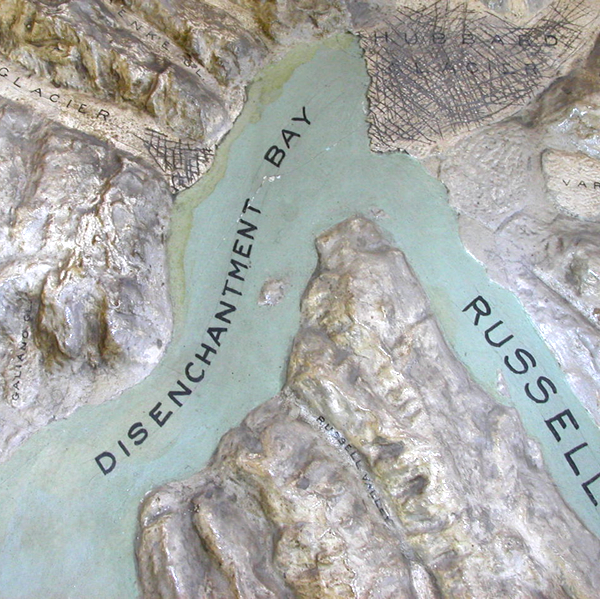
That reminds me: The University of Wisconsin's Relief Map Restoration Project is attempting to raise money to repair vintage relief maps like this one:


In addition to being a worthy cause, the photos are fascinating.

Not quite as fascinating, however, as John Logie Baird's Phonovision. After clicking the link, you can scroll down to see a small clip of the Paramount Astoria Girls, as captured by this mechanical television in 1933. And thanks to this BBC test card gallery, we even know what Baird's test card looked like:


Last, a beautiful online exhibition called The Old Order and the New spotlights photos taken in East Anglia between 1885 and 1895 by Peter Henry Emerson.

That ought to shut you people up for a while. Meantime, if anyone wants me, I'll be here, with a beehived divorcee at one elbow, and a sloe gin fizz at the other.

Thursday, January 11, 2007

Small World


The U.S. Chamber of Commerce is attempting to get American businesses exempted from the Clean Air Act by blaming local air pollution on China:

“This boils down for me to a pretty patent attempt by the Chamber to shift responsibility for clearing up air pollution from its members to sources offshore,” said the director of the Clean Air Program at the Natural Resources Defense Council, John Walke.

He insisted that most of the areas in non-attainment would fail to meet the federal standards regardless of the foreign-born pollution within their borders, an assertion that the Chamber disputes.
Here's one of the Chamber's counterarguments:
“When an area is in non-attainment [of the Clean Air Act], no manufacturer in the U.S. will work there and companies already there leave the state: They go to China,” William Kovacs, who heads up environmental lobbying for the Chamber, said.
Well, if American companies are setting up shop in China because they can't or won't comply with U.S. air standards, then it's pretty goddamn obvious that we have to weaken those regulations. Otherwise, increased pollution in China could adversely affect U.S. air quality. Right?

I discussed the problem of Chinese desertification a couple of weeks ago; it takes approximately five days for dust from Mongolia to cross the ocean. Apropos of which, Lawrence Berkeley Lab is conducting a fascinating census of airborne microbes:
An airborne bacterial census will also enable scientists to track how climate change impacts the microbial composition of the atmosphere. This process is already occurring. Wind-blown dust and biomass from Africa’s expanding Sahara desert are reaching North America in significant quantities.
A primary goal of this research is to measure normal fluctuations in airborne pathogens, so that the hundreds of bioterror sensors currently deployed in American cities will eventually...um...work properly:
“Almost all of the bacterial bioterror pathogens are in the environment and in the air naturally, so we need to find their natural backgrounds,” says Andersen.
In Austin, Texas - which happens to have been the site of LBL's recent microbe census - there was reportedly a small mishap with a container of genetically engineered avian flu:
Rather than waiting for the aerosolized flu to settle, the centrifuge had been immediately opened. In an invisible puff of air, virus particles wafted out of the machine. Now, the virus was floating around the whole lab, stirred by air movements, then slowing settling on exposed surfaces or being sucked out the exhaust which, hopefully, had effective HEPA filtration (the UT documents are silent on this item).
The recent die-off of Austin's birds is probably just a coincidence, but I'm guessing that people will get plenty of mileage out of that coincidence in the event of a flu pandemic.

It's very odd how nothing seems to stay where you put it. Through a process that can only be described as supernatural, pesticides in Costa Rica have traveled from one place to another:
Researchers say that a meteorological quirk created by mountain ranges carries the pesticides to destinations previously considered too far from agricultural areas to be of concern.
You can talk all you want about "meterological quirks," but I know the handiwork of goblins when I see it.

On the bright side, Norway has figured out what to do about a sunken U-boat that carried 65 tons of mercury intended for the Japanese munitions industry:
[T]he plan is to pour up to 300,000 tons of sand down a vertical chute to create a burial mound. The mound would rise about 10 meters feet above the surrounding sea floor, enough to cover the highest points of the wrecked vessel. The sand would then be covered by a half-meter-thick layer of rocks to prevent erosion.

"There is nothing temporary about such a solution," Gjellan asserted. "We have been told it would last forever, with zero leakage."
In an unrelated story, zircon doesn't work as well for nuclear waste storage as some people had hoped:
[R]esearchers have argued that zircon, or similar synthetic ceramics, could trap nuclear waste within their crystalline structures for at least 241,000 years, the time plutonium-239 takes to become relatively safe.

Now a study shows that this is unlikely. It turns out that alpha particles released as plutonium decays knock the atoms in zircon out of position faster than originally predicted, impairing the material's ability to immobilise waste (Nature, vol 445, p 190).
Other than that, things are going pretty well, wouldn't you say?

Outright Lies


A sympathetic SFGate article on Spocko features this droll counterattack from KSFO:

In a statement Wednesday, KSFO program director Ken Berry said, "Many of the remarks attributed to KSFO on the Internet are old, lacking context and, in some cases, outright lies. When our hosts have stepped over the line, they have apologized and have been reprimanded."
Which line is that, Ken? And which of Spocko's audio clips are "outright lies"?

I guess we'll find out at noon tomorrow. KSFO is planning a sort of community outreach program, in which the hosts targeted by Spocko will take calls and e-mails from interested parties, and perhaps even apologize for - or at least explain - some of their more offensive remarks. That's the official story, at least. My assumption is that it'll actually be an unctuous wingnut love-in, with plenty of starstruck listeners begging the hosts to stand firm against political correctness, and a handful of inarticulate lefty dissenters trotted out for cheap laughs. But only time will tell, and I'd be very pleased if I turned out to be mistaken.

They've asked Spocko to participate; needless to say, he wasn't stupid enough to accept. Spocko's strength is that he appeals in good faith to broad community standards and sensible business practices (e.g., questioning the wisdom and morality of funding people who want to exterminate half your prospective customers). He has nothing to gain by singlehandedly taking on these bullies - and their engineers and audience - on their own turf. He understands that they're hothouse flowers, and can thrive only in a heavily controlled environment; the idea that their abuse of power could effectively be addressed by helping them to abuse their power further is a nonstarter, obviously.

Since they've essentially lost the real battle with Spocko, it's not surprising that these folks would want to drag him into their lair for a carefully choreographed rematch. My understanding is that Melanie Morgan has called Spocko a coward for refusing to climb into KSFO's hot seat, but as he points out, there's no reason such a debate couldn't have a more evenly matched lineup, and be held on neutral territory. For that matter, there's no reason Morgan et al couldn't venture out of their bubble, for once, and into "enemy" territory, without their training wheels or safety net. No reason, that is, beyond the obvious fact that they want ratings, and complete control of the discussion. And revenge.

It's not cowardly to decline an invitation to one's own lynching. What's cowardly is being unwilling to debate your opponent unless you and your cronies outnumber him four to one, and can cut him off or shout him down at will, and can choose whether or not to give his supporters a voice (as opposed to regular listeners who agree with you that "the liberal tree needs to be pruned").

KSFO's morning show is a microcosm of modern conservatism, really: thin-skinned, petty bullies remarkable only for their ability to lie fluently, and their inability to take even a fraction of the abuse they dish out.

Having gotten that out of my system, I'd like to draw your attention to the "Make a Donation" button at Spocko's Brain, which allows you to contribute to his legal defense fund. Alternatively, you can contribute to the EFF, which has been giving him free legal help. Or both.

I'll leave the last word to Spocko:
I’ve been called a hero. I’m not a hero, a hero is a journalist in the middle-east working his or her ass off to tell a story that might cost them their life. Consider donating to the Committee to Protect Journalists.

My button for donations is on the right. It’s the button for PayPal right under Spocko's United Reserves Against Killing of Journalists and Liberals (Hey that spells out SURAK, of JAL wow what a coincidence!), and I put it up only at others’ insistence, but if you don’t have money, your kind words are welcomed too.
(Crossposted to Online Blogintegrity.)

The New Multiculturalism


Peak Energy has a good post on the recent controversy at a school in Federal Way, Washington, whose genius loci is apparently a fellow named Frosty Hardison:

"Condoms don't belong in school, and neither does Al Gore. He's not a schoolteacher," said Frosty Hardison, a parent of seven who also said that he believes the Earth is 14,000 years old. "The information that's being presented is a very cockeyed view of what the truth is. ... The Bible says that in the end times everything will burn up, but that perspective isn't in the DVD."
I've seen many oddball refutatations of global warming, but the notion that it won't make things hot enough is a new one on me.

On the other hand, Hardison's wife agrees with him. So for now, at least, it's two against one:
"From what I've seen (of the movie) and what my husband has expressed to me, if (the movie) is going to take the approach of 'bad America, bad America,' I don't think it should be shown at all," Gayle Hardison said. "If you're going to come in and just say America is creating the rotten ruin of the world, I don't think the video should be shown."
Damn straight. There's no need to believe anything that might make you feel bad about yourself, or your country, unless it has something to do with sex. Which is why we should restrict our ahistorical, prejudicial scapegoating to fags, the media, and all former members of the Clinton administration.

Luckily, the dispute in Federal Way will be solved through strict adherence to the principles of Scientific Inquiry:
School Board members adopted a three-point policy that says teachers who want to show the movie must ensure that a "credible, legitimate opposing view will be presented," that they must get the OK of the principal and the superintendent, and that any teachers who have shown the film must now present an "opposing view."
Credible and legitimate denialism? They might as well demand the Gorgon's head while they're at it.

All this is necessary because, as Board president Ed Barney suggests, there are other beliefs out there, and it'd be wrong to indoctrinate children by pointing out - in a science class, for instance - that some of them are more plausible than others.

That sounds a bit like multiculturalist relativism to me. But as far as I can tell, the Right's famous arguments against "lowering academic standards" by teaching ebonics, or "thwarting the pursuit of excellence" by giving prizes to winners and losers, don't apply here even tangentially. For some reason, the idea that there's a qualitative distinction to be made between the peer-reviewed findings of world climatologists, and the bad-faith bullshit spouted by conservatarian economists like Alister McFarquhar, remains scandalous to the pitiless scourges of postmodern thought.

Beyond that, a speaker's credibility depends more on her audience than her facts; very few of us will ever manage to become "credible" to people like Mr. and Mrs. Hardison, so long as we insist on interfering with their smug pursuit of cheap grace.

Then again, who cares? It's not like anything important hinges on this debate.

UPDATE: Frosty Hardison is much, much crazier than I thought, not least because his solution for global warming is worldwide baptism, and a nuclear-powered refrigerator at each pole.

Isn't it nice that he's able to control what his neighbors' children can, and can't, learn about in school?

Dictator Pawns


This morning, Echidne piqued my curiosity by referring to an "extremely odd" anti-feminist article by Nancy Levant.

She wasn't kidding. This is a strange outburst even by Levant's standards. For one thing, she tosses scare quotes around like handfuls of rice at a (traditional) wedding. She's obviously very eager for her readers to understand that she's not taken in by the shadowplay of modern discourse; she means to strip our secular-humanist pieties of their disguise, like the revellers in "The Masque of the Red Death," and reveal that they're "untenanted by any tangible form."

She also has frequent recourse to the concept of dialectics, without demonstrating that she has any idea of what the term means to her, let alone to anyone else.

Her arguments were dialectically predictable as she simply regurgitated the pat lines of the movement, but for the benefit of young women who grow up amidst the dialectic, I will respond with clarity.

The one-world government scenario is dialectically based upon economics, environment, and equity – known as the Three E’s.
As you may already have guessed, the "clarity" Ms. Levant is hawking turns out to comprise a crazy quilt of conspiracy theories gleaned from old Christian Crusade pamphlets and links compiled haphazardly at Rense.com. The gist of it is, feminism - sorry, "feminism" - is working hand in claw with the Three E's to enslave the "commoners" in a nightmare world of "financial sameness" that is at once communistic and corporatist.

I mentioned a while back how often global depopulation theory informs anti-environmental rhetoric; Levant's work is a good example. "Sustainability," you see, is merely a code word for global depopulation, and feminism plays its part by making women chafe under the yoke of childbearing, or better yet, making them sterile:
The feminist piece of the global puzzle deals specifically with depopulation through women’s “healthcare,” big pharma, and the “mental health” industrial complex. Women’s rights are now defined by the right to abort, the right to be drafted, and the right to take drugs that will render women and children incapable of bearing children. And just as many women worldwide earned the right to own property, that right has now fallen to other plans, which state that no “individual” may own private property.
See how it works, ladies? You thought you were agitating for the right to vote, but in reality, you were enslaving the entire world.

Levant is retelling, in her own inimitable way, the tale of the Fisherman's Wife. First, she wanted a pretty cottage instead of a miserable hovel. That seems reasonable enough, but of course, her ambition didn't end there. Soon enough, she wanted to be king, and then Pope. And the end result of all her upward striving was that she got nothing.

A little of this stuff goes a long way, but Levant's sign-off is too good to pass up:
[T]o the world’s feminists – I say this: You are the dumbest women who have ever walked the face of the Earth. Week by week, day by day, you are losing every right you thought you invented. You fell hook, line, and sinker into the dialectic, and you are nothing but dictator pawns to the larger mission of total control over people and freedom.
What's interesting here - besides Levant's talent for mixing metaphors, and the decision by American Chronicle to publish her gibberish - is that Levant has actually toned down her usual rhetoric, particularly as regards her religious beliefs and her pet theories about the Illuminati. For instance, compare this earlier column on the same theme:
The ultimate goal is to control the Earth and its inhabitants. Though they are often referred to as The Illuminati, they are master criminals led by the guiding principles of Luciferian religion, which believes in opposing God and acting in opposite to all scriptural mandates.
It almost seems as though Levant is trying to make her thought sound a bit more mainstream, and figures that more beating up on feminists, and less ululating about Lucifer, is a good way to do it.

The sad thing is, she's probably right.

Wednesday, January 10, 2007

A Decisive Ideological Struggle


The Decider speaks:

The challenge playing out across the broader Middle East is more than a military conflict. It is the decisive ideological struggle of our time....
Sounds serious. But apparently, it wasn't serious enough to justify sending an adequate number of troops to Iraq, or supplying them with the necessary equipment, or outlawing and punishing war profiteering.

And now, all these years later, it's not serious enough to justify sending adequate reinforcements, or supplying them with the necessary equipment.

You'd have to be crazy to believe that this reprehensible war of choice was a moral necessity. And you'd have to be much worse than crazy to believe that it was a moral necessity, and then willfully botch it, and then demand praise for grudgingly adopting a dumbed-down, toothless version of the same recommendation you'd been ridiculing for years.

As this idiot adventure descends into the chaos predicted for it by sane people everywhere, the Right shrieks ever louder about the existential threat of "Islamofascism," as though insisting on the enemy's fiendishness could somehow ennoble BushCo's manifest failure to fight that enemy wisely and effectively.

In reality, the more insistent the Bush Cult is on the larger-than-life evil of Islamic extremism, the more foolish and irresponsible they look for consistently trying to pass off their failures as triumphs, and their giddy crony-capitalist hijinks as realpolitik. A serious threat requires a serious response, after all, and the spectacle of five hundred frightwigged clowns streaming out of a broom closet at the American Enterprise Institute doesn't fit the bill.

Which reminds me that If I had my way, frightwigged clowns like Jonah Goldberg and Sean Hannity and Melanie Morgan would be rounded up and forced to spend the rest of their lives cleaning wounded veterans' bedpans with their lying tongues. Sad to say, the only outcome less likely is that these snake-oil merchants would decide of their own free will to care for the young men and women whose lives they helped to destroy with their dead-hearted parroting of Scaife-funded neocon bullshit.

At any rate, Bush's speech said nothing reasonable and will accomplish nothing good. The goal for the architects of this war is to find a scapegoat, or to wait for some distraction - like a new terrorist attack, or some other convenient excuse to nuke something - that'll drive Iraq out of people's minds. Until then, the "plan" is to limp along as we've been limping along for years, with Americans and Iraqis dying pointlessly, and the president doing his mediocre best to look rueful, and a squadron of flying monkeys lashing out indefatigably at anyone "unpatriotic" enough to demand competence or seriousness or honesty from the people who claim to be waging the "decisive ideological struggle of our time."

UPDATE: Noah Shachtman - whose grasp of military affairs is infinitely superior to mine - offers a smidgin of faint praise for Bush's speech. Much as I'd like to, I can't agree with him. I tend to go along with what RMJ says:
Assuming arguendo that a military solution will always trump a political one, we still have a problem: when was the military solution ever available? When did we ever have enough troops under arms to control Iraq? Even with the "Coalition of the Willing," we weren't able to do that.

Which is what makes this latest excuse for another chance at victory, such a tragic farce. Condoleeza Rice says: "We cannot afford to fail." But the fact is, by the Administration's own terms: we already have. We failed before we even started.
Exactly. I saw nothing in the President's speech that suggested he had any serious comprehension of his failures, nor any serious plan to remedy them. This is a stalling strategy, and the only thing it signifies, to my mind, is that George W. Bush is willing to continue stuffing human beings into a meat-grinder in order to stave off the day of reckoning for himself, his party, and the ideological apparatus that supports them.

Times of Crisis


Thusfar, Keith Ellison has been very good at hiding his Islamofascist leanings. But today, the jig is up. WND has found the smoking gun:

Ellison has allowed his supporters to shout, "Allahu Akbar!," the same phrase allegedly used by the 9/11 suicide pilots....
There you have it. Praise the Lord, and pass the ammunition!

Meanwhile, as the struggle against Islam heats up, formerly great nations are losing ground faster than Bill Bennett at a convention of three-care monte dealers. Michael Freund is the latest commentator to weep hot salt tears over the ravished corpse of Europe:
If you ever wanted to see Paris or Rome before you die, but haven't had a chance to do so, you might want to hurry. Soon enough, most of what we now think of as Western Europe will be transformed into a branch of the Muslim world, which is sure to make it an even less welcoming place for Americans, Israelis and for Jews.

That, at least, is the unpleasant, yet entirely unavoidable conclusion to be drawn from Europe's headlong demographic drive toward oblivion....

And while Europeans may be busy everywhere but in the bedroom, the Muslim populations in their midst are proving far more expansive.
You know what this means, of course. Europe languishing under sharia, instead of exporting anti-capitalist, atheo-socialist twaddle to American universities. Page Three girls replaced by pictures of fish with Allah's name on their fins. Streetcorner misunderstandings turning into a bloody confusion of flashing scimitars and lopped-off limbs, just like in "Abdul Abulbul Amir."

And it's all entirely unavoidable. Sort of:
Even if European governments succeed in reversing the curve, which seems highly unlikely, it will be decades before it would begin to be felt.
Unlike the effects of declining European fertility rates, which will become catastrophic by - wait a moment, please, while I check my al-Gebra - June 27th, 2007, at 3pm PST.

The worst part of it is, the American and Israeli hard right might not be able to rely on the doglike servility of "Old Europe" anymore:
This makes it far less likely that Israel and the US can count on Europe - if they ever really could - at times of crisis in the decades ahead.
It's no laughing matter. Suppose that twenty years from now, we decide to invade and occupy Syria. Would a muslimified France or Germany wholeheartedly back this decision? Or would they erect petty roadblocks, sow doubt about our motives, and insist on silly rules of engagement dreamed up by UN one-worlders?

Anyway:
[I]f you really want to see the Eiffel Tower up close, you had best not delay. Before you know it, it might just turn into a minaret.
No offense, but that's defeatist talk. There's still time to fuck our way back to world domination. Close your eyes, ladies, and think of Vienna in September of 1863.

And no more of this nonsense, either. Don't you people know there's a war on?

R.I.P. Maxx


And heartfelt condolences to Four Legs Good.

For there is nothing sweeter than his peace when at rest.
For there is nothing brisker than his life when in motion.

--Christopher Smart, Jubilate Agno (1762)

Tuesday, January 09, 2007

Yet Another Attack On Industry


A new study has found that research financed by the food industry tends to deliver results favorable to that industry:

Of 24 studies of soft drinks, milk and juices financed by the industry, 21 had results favorable or neutral to the industry, and 3 were unfavorable, according to the research led by Dr. David S. Ludwig, director of the Optimal Weight for Life Program at Children’s Hospital Boston and an associate professor at the Harvard Medical School.
However, as Susan Neely of the American Beverage Association points out, the results are untrustworthy because the research was conducted by dirty fucking hippies who hate science:
"This is yet another attack on industry by activists who demonstrate their own biases in their review by looking only at the funding source and not judging the research on its merits," says a statement by Susan Neely, president of the American Beverage Association. "The science is what matters - nothing else."
Which just goes to show you that, as Pierre Bourdieu says in Science of Science and Reflexivity, "the definition of what is at stake in the scientific struggle is one of the things at stake in the scientific struggle.”

Neely's not being entirely fair, in that she fails to consider the possibility that these researchers are suffering from an acute psychosis that prevents them from conducting the sort of objective study favored by the members of the American Beverage Association.

If that's what's producing these skewed results, the researchers should probably be dosed with antipsychotics and made to start from scratch. Fortunately, the choice of medication is clear. Earlier this year, research funded by Eli Lilly showed that in five studies, its antipsychotic drug Zyprexa outperformed Janssen's Risperdal, while Jannsen-funded studies showed that Risperdal beat Zyprexa only three out of four times. Thus, unless Jannsen shells out for research that delivers more impressive results, Zyprexa will continue to be the drug of choice for treating Fallacious Activist Guile Syndrome (FAGS).

But even if Dr. Ludwig's study were accurate, the fact remains that 3 dissenting studies out of 24 represents a remarkable degree of scientific autonomy, and shows how far we've come since 2004:
Researchers have found that 100% of industry-sponsored studies recently presented at the annual scientific meeting of a medical professional society reported findings that support product use. The study, by Drs Thomas Finucane and Chad Boult (Johns Hopkins School of Medicine, Baltimore, MD), appears in the December 1, 2004 American Journal of Medicine.

"The overwhelming nature of this finding was a little surprising," Finucane told rheumawire. "But then again, it would be surprising if the results didn't favor the product. On reflection, it makes sense."

Accentuate the Negative


This photo is by Vera Lutter.

Using room-sized cameras, Lutter often inhabits the camera during the exposure which can last hours, days or even weeks.
Via Moon River.

Jumping to Conclusions


You’ve probably heard about the mysterious odor in New York City, which is similar to the methyl mercaptan with which natural gas is odorized.

At Whirled View, CKR considers the possibility that the government - or a terrorist group - is conducting a vulnerability test to ascertain the reach of a biological or chemical agent. We know that the government has resumed open-air vulnerability testing in NYC (albeit with odorless agents), so her theory isn't entirely farfetched.

And that's just what's wrong with it, frankly. Someone has to come up with an entirely farfetched theory, and it might as well be me.

Methyl mercaptan occurs naturally in natural gas fields. Suppose the smell in NYC had something to do with this?

According to U.S. maritime industry sources, tanker captains are reporting an increase in onboard alarms from hazard sensors designed to detect hydrocarbon gas leaks and, specifically, methane leaks. However, the leaks are not emanating from cargo holds or pump rooms but from continental shelves venting increasing amounts of trapped methane into the atmosphere. With rising ocean temperatures, methane is increasingly escaping from deep ocean floors. Methane is also 21 more times capable of trapping heat in the atmosphere than carbon dioxide.

In fact, one of the major sources for increased methane venting is the Hudson Submarine Canyon, which extends into the Atlantic 400 miles from the New York-New Jersey harbor.
(Link via Peak Energy.)

To be fair, underwater methane venting probably has nothing at all to do with the smell in NYC. But what’s the point of having a blog if you can’t indulge in a bit of ill-informed, irresponsible speculation from time to time?

Meanwhile, the spoilsports at Newsday take the easy way out, and blame New Jersey:
"We think it emanates somewhere between Secaucus and Jersey City," said Charles Sturcken, a spokesman for the New York City Department of Environmental Protection….

[New Jersey Environmental Protection Commissioner Lisa Jackson] bristled upon hearing that New York officials said they believed the smell came from New Jersey. "It looks an awful lot like jumping to conclusions," she said.

Poisonous Attitudes


At Phi Beta Cons, Mark Bauerlein finds fault with an article by Rutgers professor Barbara Foley, who says:

As one who in fact suspects that it is primarily liberals, rather than "the right," who are paving the way to a possible U.S. fascism, I include myself among those who yearn to bypass [David] Horowitz and confront what I consider to be the greater danger posed by mainstream political discourse, as articulated—and put into practice—by Republicans and Democrats alike. But we cannot so readily ignore Horowitz and other ideologues of the far right. For it is crucial to recognize the role that they play in defining and extending the political spectrum. Their assertions and proposals function as trial balloons that, even when brought to earth, turn out to have introduced various reactionary ideas into the realm of accepted political debate.
This is a rather poor piece of writing, and Bauerlein is right to complain that Foley doesn’t explain how liberals are “paving the way to a possible U.S. fascism.”

But Bauerlein’s much more concerned by her attack on David Horowitz, who’s admirable because he’s right even – or especially – when he’s wrong:
Some people have said that Horowitz exaggerates the extent of liberal/progressive indoctrination on campus, and in some instances they're right….But Horowitz does have a way of exposing poisonous attitudes on campus, if only by his provocative, in-your-face manner.
Sure. And Gene Ray has a way of exposing the blinkered corruption of the scientific establishment, if only by the sheer force of his personality.

Bauerlein is shocked that Foley would dare to accuse Horowitz of being part of “the growing racist movement within the United States.” But she actually makes a good case, both by quoting Horowitz on the alleged moral failings of the black underclass, and by pointing out that he published articles by the white supremacist James Lubinskas in FrontPage. (Lubinskas is a former assistant editor of American Renaissance, an omphalos of “polite” racism that bills itself as a “journal of race, immigration, and the decline of civility.”) [emphasis added]

Apparently, it’s irresponsible to accuse liberals of paving the way to fascism without explaining oneself...but perfectly reasonable to defend Horowitz against the charge of racism without acknowledging – let alone rebutting – the evidence for that charge. Bauerlein simply accuses Foley of “character assassination,” and presents her as illustrative of the American intellectual's “disconnection of [sic] real public affairs.”

And this, mind you, is the sort of extra-fancy-grade thinking to which higher education must learn to conform.

Saturday, January 06, 2007

Spockomania!


At Online Blogintegrity, ¡El Gato Negro! has posted what will probably be the last (for now) guest post from Spocko, who's just about to go live with a new - and, we hope, SLAPP-proof - blog. Read it, and reflect on the fact that although KSFO is owned by one of the largest corporations on earth, and broadcasts over an area comprising roughly seven million people, one brave person has managed to hold them accountable for their vile, dangerous, un-American rhetoric.

Solidarity with Spocko should be the default position across the political spectrum. Conservative and libertarian bloggers who fancy themselves media critics and citizen journalists are made vulnerable by legal attacks like ABC/Disney's, and ought to oppose them on principle.

For those on the Left, the situation is more elemental. Getting involved in this fight isn't a choice; you already are involved. The hosts on KSFO are talking about killing you, along with the politicians who are supposed to represent your interests and protect your rights. And they're not talking about it as some painful duty, either, though God knows that would be bad enough. They're talking about it as a pleasure, to be drawn out and savored.

It seems unthinkable that talk-show rhetoric could really inspire Americans to murder each other. Unfortunately, unthinkability is precisely what makes the unthinkable possible. These things can happen, and have. And they will again, unless our society somehow becomes sane enough to realize that it's far more obscene to call for someone's death than to use words like "fuck," and starts recognizing people like Melanie Morgan as uncivilized, unpatriotic thugs.

Anyway, Mike Stark has written a terrific post that includes a list of KSFO's sponsors, and explains how to contact them effectively.

Spocko's audio clips are still posted at OBI, and Ripley continues to work on more media. In the meantime, mirror sites for the audio are springing up everywhere. If you'd like to host the clips on your site, Mike's post addresses some of the legal issues.

Also, if you'd like to send the video at the top to a friend, click the "share" button at the lower right.

Monday should be a very interesting day for all concerned...

UPDATE: Disney responds!

UPDATE II: Spocko is back!

UPDATE III: Jesus' General writes a letter to Disney president Robert A. Iger.

Friday, January 05, 2007

Friday Nudibranch Blogging


Here's Hypselodoris infucata, in "a sea
uniform like tapestry;

here, a fig-tree; there, a face;
there, a dragon circling space --

designating here, a bower;
there, a pointed passion-flower."

(Photo by Jun Imamoto.)

Friday Hope Blogging


The "Wise Use" movement has spent the last couple of decades arguing that every American has a God-given right - if not a duty - to mow down the wilderness in off-road vehicles. Which makes this story both droll and heartening:

Snowmobile use in Yellowstone National Park -- long a bone of contention between aficionados of motorized snowsleds and environmentalists -- has taken an inexplicable plunge, according to a story last week in the Star-Tribune of Casper, Wyo.

The story, widely distributed this week by the Coalition of National Park Service Retirees, says snowmobiles entering Yellowstone have dropped from a peak of 60,000 per season in the 1990s to 10,000 by the winter of 2004-05.
If you liked that, you’ll love this:
Associate Professor Michael King of the University of Rochester Biomedical Engineering Department has invented a device that filters the blood for cancer and stem cells. When he captures cancer cells, he kills them. When he captures stem cells, he harvests them for later use in tissue engineering, bone marrow transplants, and other applications that treat human disease and improve health.
Furthermore, environmentalists and hunters are working together to shut down captive elk ranches:
The unlikely bedfellows of animal-rights and hunting groups again are taking a collective run at closing Oregon's captive elk-ranching industry over fears the exotic herds threaten wild elk populations….

"We'd like to see them out of business entirely because the threat to wildlife is so high," says Jan Wilson, a Eugene attorney and member of the coalition, which includes the Humane Society of the United States as well as the Oregon Hunters Association and several preservation groups.
Perhaps Der Kulturkampf is running out of steam. (Or methyl bromide, or whatever it runs on.)

Three men in Florida have launched a nonprofit called the Green Armada Foundation in order to keep coastal waterways clean:
The boat travels to local bridges and causeways and anchors in full view of passers-by. Maksimowicz and his crew, wearing plastic boots and gloves, pick up litter one piece at a time and haul it away.

They say they collected eight tons of litter in two months.
They're looking for sponsors, and hoping to to go statewide. If you're inclined, you can help them out by clicking here.

Professor Bunyan Bryant, of the University of Michigan, is putting his money where his mouth is on environmental issues:
Bryant, 71, believes in his work so strongly that he announced this fall that he will donate $100,000 over the next five years to the university to teach more students about environmental justice issues.

With a goal of raising $14 million in endowments, Bryant hopes to create a center and fund a chairmanship and number of scholarships devoted to the study of environmental justice issues.
And Rorschach is impressed with the OpenCourseWare movement:
By the end of this year, the contents of all 1,800 courses taught at one of the world's most prestigious universities will be available online to anyone in the world, anywhere in the world. Learners won't have to register for the classes, and everyone is accepted.

The cost? It's all free of charge.
Business Week has a nice story on microinsurance in Mexico:
Just as Mexico's microfinance lenders have carved out a lucrative niche making tiny loans to some of the country's smallest entrepreneurs, a handful of insurers are proving that it can be profitable to sell life insurance to the country's working poor and lower-middle class.

"The issue isn't that the population doesn't have the economic capacity, disposable income, or an insurance culture, rather we as insurance companies need to adapt to their means," said Alfredo Honsberg, chief executive of insurance company Seguros Azteca, in an interview.
In a pleasing display of sanity, a German engineer has decided not to convert a British power plant to run on rainforest-sourced palm oil:
The decision by RWE power to scrap the project at its Littlebrook plant in Dartford, Kent, which was seen as a test case for palm oil as an alternative energy source, comes after it was unable to secure sufficient supplies without risking damage to tropical rainforest.
A new sucker-footed bat has been discovered:
Scientists have discovered a new species of bat that has large flat adhesive organs, or suckers, attached to its thumbs and hind feet. This is a remarkable find because the new bat belongs to a Family of bats endemic to Madagascar--and one that was previously considered to include only one rare species.
Uganda is experimenting with BTI, which is a comparatively safe mosquito-control agent produced by the soil bacterium Bacillus thuringiensis israelensis:
The drug which is promoted by Xenorex, a Canada-based organisation, will be sprayed outdoors in mosquito breeding places like water bodies and footmarks, while DDT will be used indoors, according to the Ministry of Health.
Speaking of Canada, Port Moody, BC banned the use of pesticides on private land a year ago. No reports yet of people living in caves, eating their pets, or seeking medical advice from bloodletters.

A bill introduced in the Kentucky legislature would make it mandatory for young girls to be vaccinated against the virus that causes cervical cancer. The usual people are making the usual objections, which you can be quite certain will backfire.

If we must have nuclear plants, we may as well make them safer and more efficient:
By reconfiguring nuclear-fuel pellets into "doughnuts", scientists from the Massachusetts Institute of Technology (MIT) have found a way to boost the amount of energy that nuclear reactors produce by 50%. The new design also helps diminish the chance of meltdown by slashing the temperature at which reactors must be operated, and it renders the spent fuel more proliferation-resistant.
A British satellite navigation system allows drivers to pick the most fuel-efficient route:
Where existing devices find the most direct or fastest route between two points, the new system plots the most fuel-efficient route by checking roads for traffic lights, junctions, speed limits and the tendency for traffic jams. Early tests suggest that taking more eco-friendly routes cut motorists' average fuel usage by 8.2%.
I’m not sure about this idea for everyday motorists, but it could be very handy for truck lines and delivery services. It’s interesting, at any rate.

Speaking as someone who hasn’t bought a new piece of clothing in about 25 years, I enjoyed this article on Americans who’ve vowed not to buy anything new in 2007:
The two-principle Compact - named loosely after the Mayflower Compact and referring to living for the greater good - challenges participants to first, forego the purchase of new products, and, second, to get what they need by borrowing, bartering or buying used.
I was pleased to learn of the discovery of two telescopes made of rolled paper and ground glass, which date to the early 1600s. But it pales in comparison with this description of the electrical diablerie served forth in 1884 by William J. Hammer of Newark, NJ (link via Things):
The ceiling was found to be covered with luminous stars, arranged to represent the principal constellations in the heavens - while comets, moons, etc., shone beautifully in the dark. By placing one's head on the pillow, the gas, fifteen feet away, would be extinguished and the phosphorescent stars on the ceiling would shine forth weirdly, and a phosphorescent moon rose from behind a cloud over the mantel and slowly describing a huge arch disappeared behind a bank of phosphorescent clouds on the other side of the room….
Also via Things comes an unbelievably beautiful gallery of photos of Paris during the flood of 1910.


This reminds me of Alain Resnais’ apocryphal book of photographs of locations used in the films of Louis Feuillade, which I’ve been hunting after for twenty years (along with the equally apocryphal English translation of Kircher’s Musurgia Universalis, whence comes the illustration at the top of this post). If you have a spare copy of either book, or information about whether or not they actually exist, I hope you’ll send it along, even though I can’t give you anything but love.

Speaking of Feuillade, whatever happened to the Chronophone discs made by Cyclophone for his 1909 film Les Heures? I have no idea, but my attempt to answer the question led me to a bumper crop of phonographic sites and sound archives.

The Flexible Records Project compiles labels from 1930s acetates and metal discs. Lots of gorgeous stuff, as thus:


And thus:


Little Wonder Records is another gorgeous site; it also features sound clips. Or you can visit Australian Collectors of Mechanical Musical Instruments, and listen to a variety of early gramphones and phonographs.

The Marr Sound Archives has couple of great online exhibitions: The Voices And Music Of World War I, and Musicians Local No. 627 and the Mutual Musicians Foundation.

The Internet Chinese Music Archive is…well, pretty much what it sounds like. It’ll take you a while to work your way through it. When you’re done, you can tackle the Judaica Sound Archives . Or the Berea College Appalachian Sound Archives, which offers “fiddle and banjo tunes; ballads and songs; Old Regular Baptist singing and preaching; folktales and legends; and oral history.”

If that’s too much for you, you can focus exclusively on the nyckelharpa, courtesy of The American Nyckelharpa Association.

Then again, it’s possible you’re not interested in any of this stuff. In which case, you may proceed directly to Seedtime and Harvest, a film from the Hampshire Record Office.

UPDATE: Spocko Speaks!

Thursday, January 04, 2007

We Interrupt This Program...


My pal Spocko has been doing a tremendous job of documenting the grotesque eliminationist rhetoric spouted by Melanie Morgan and Lee Rogers on San Francisco’s wingnut flagship KSFO. His approach has been perfectly reasonable, and perfectly legal: He gathers verbatim statements from these lunatics, and then contacts KSFO advertisers and asks them whether the statements reflect their brand identity.

A number of advertisers evidently feel that they don't, and have pulled their spots. As a result, Spocko has been subject to harassment and threats from KSFO’s management, and from ABC/Disney, of which KSFO is an affiliate.

Now, they’ve managed to shut his blog down, on the grounds that the audio clips Spocko posted are an infringement of copyright. It’s absurd, of course; Spocko’s use of the clips clearly falls under the Fair Use Doctrine. The station’s actions are just as vindictive, cowardly, dangerous, and stupid as the rhetoric of its hosts, and just as incapable of withstanding public scrutiny.

Accordingly, links to the audio clips have been posted at Online Blogintegrity. If it gets shut down, I think it’s safe to say that they’ll be moved to another one. In the meantime, as ¡El Gato Negro! says, “Listen to them for jourself, then, por favor, post them far and wide.”

The ABC/Disney lawyers who’ve come after Spocko are doing so because they think the benefits will outweigh the costs. Negative PR can change their calculations very quickly. So tell your friends, contact KSFO’s advertisers (politely!), and if you have a blog, spread the word.

Spocko’s also being threatened - and rightly so - by Interrobang:

[I]f he doesn't get a PayPal account so we can all start putting up links to it so we can contribute to his legal defense fund, he's going to get yelled at.
I believe I speak for all of us when I say that this is no idle threat.

(Talk-radio whirligig by William Ross.)

UPDATE: Echidne discusses Hal Turner's recent call for the assassination of U.S. politicians. In the WND story to which she links, Turner, who previously singled out federal judge Joan Lefkow as "worthy of being killed," says that "his comments are 'uttered in a context which does not lend itself to imminent lawlessness,' do not constitute a 'true threat,' and could be considered 'political hyperbole.'

Ms. Lefkow, I imagine, might feel differently.

ALSO: More on Spocko from Thers, Elroon, Juan Cole, and David (Austin TX). And many others.

The Way We Really Are


Debra J. Saunders complains that the media are making it difficult for her to bask in the warm afterglow of Saddam's execution:

Within hours of Saddam Hussein's hanging, the drumbeat began -- as cable-news sages pronounced that the Iraqi scourge's execution will not improve the situation in Iraq….These days, the first rule of war coverage is that nothing -- not even military victory -- will improve Iraq's prospects.
She has a point. We've generally been unwilling to let conservatives savor any of the hundred-odd “turning points” that they announce in the course of an average year. Why are we always harshing their buzz? Why are we forever dashing the Cup of Joy from the lips of these well-meaning people, whose wisdom is - as Ramesh Ponnaru points out - proven by their gimlet-eyed attention to the problem of “unintended consequences”?

I mean, besides the fact that they’re a pack of ineducable halfwit chatterboxes who’ve been consistently wrong about everything. Saunders and her ilk could do worse than to ponder that old AA motto, Your best thinking got you here.

Meanwhile, the appalling Georgie Anne Geyer applies her analytical skills to the orphic conundrum of Saddam’s execution:
“So what WAS the strange execution of Saddam Hussein, in the chill pre-dawn of an Iraqi morning last Saturday in Baghdad? What exactly did it mean?”
I think you’ll find her answer intriguing. Before she gets to it, though, she informs us that the Bush administration had hoped Saddam's trial would establish an Outpost of Progress, by showing that “Western legal practices could be implanted in the unrelenting sands of Iraq.”

Next, she lauds the Nuremberg trials for being internationalized, and bemoans the fact that the International Criminal Court “was too liberal for the radical-right Bush administration and its neocon supporters, there was no death penalty, and things moved much too slowly.”

She also clucks that Saddam got his “early advanced weaponry” from East Germany, neatly sidestepping the question of where he got his later advanced weaponry. This is the preamble to her account of his hanging, which she felt offered “none of the dignified lessons that the United States had hoped for” when it spurned the ICC for being socialistic bedwetters.

Part of the problem with the hanging was that the camerawork was so unprofessional:
[I]t was recorded not by Iraqi or Arab television, not by American or BBC television, and not by some neutral [!] cinematographer designated by the Iraqi government, but by someone who happened to be in the room with a cell phone camera! Has human history ever been so cursed?
No, never. Or at least, not since I got eyestrain from trying to watch scrambled porn in a Montreal hotel room.

Remember all that stuff about BushCo’s “radical-right” reasons for avoiding the ICC? Well, forget it. On reflection, Geyer decides that the United States “eschewed the idea of an international court for valid reasons.” But then again, maybe it didn’t:
All of this is, in great part, the result of our going it alone in Iraq, without the kinds of substantive allies that we had in World War II [like the UK, Georgie?] and the international structures we were then building.
So what does Saddam’s execution mean? Why, it means that that those confounded Iraqi chappies are nothing but a pack of uncivilized brutes, that’s what:
[L]ast weekend, as tired America was trying to start a new year, Old Iraq pushed in on us, saying, Hey, remember us? This is the way we really are. Did you think you could change us so quickly?
Ingrates, that's what they are. We free them from a brutal dictator, rebuild their infrastructure, give them plenty of electricity and clean water, reduce their unemployment rate, kowtow to their silly superstitions about strip-searching women, scrupulously avoid unnecessary violence, and - most important - completely abolish torture and indefinite detention. And this is how they repay us.

Almost makes you wonder why we bother, sometimes.

The Domain of Hippies


The Los Angeles Times marvels at the current popularity of solar power:

Once the domain of hippies, whose off-the-grid escape doubled as an anti-establishment rebuke, renewable energy is now a pillar of California politics.
Back in the good old days, you see, the United States had a safe, sensible, cost-effective, farsighted energy policy. Then, the hippies came along and started trying to "stick it to the Man" with outlandish ideas like solar collectors and wind power. But now, solar power has become fashionable, and all sorts of pathetic dropouts are cashing in!

[Cue the Byrds playing "Turn, Turn, Turn," so that we can more wistfully contemplate Life's Little Ironies.]

Today's solar power advocates may not dress in varicolored rags, or stink from fifteen feet away, or prattle about astrology while they scratch earnestly at the pubic lice they caught from "balling" Janis Joplin, but don't let that fool you: they're still part of the freak scene:
Curly-haired and soft-spoken, Gerber today looks the part of a steady engineer in his pressed khakis and checkered button-down shirt, four pens aligned in his front pocket. But he remains at heart a zealot, committed to renewable energy down to the solar watch on his wrist.
See, that's what troubles me. I like the idea of renewable power...but why can't its advocates be more measured and sensible, like Charles and David Koch?

The author notes that the first solar water heater was patented in 1891, and that 30 percent of the homes in Pasadena, CA had solar water heating by 1897. He doesn't mention that the first solar-heated office was built in Albuquerque in 1956, by Frank Bridgers, and remains in operation today.

So far as I know, the influence of marijuana, free love, and "acid rock" on these technological milestones was minimal. It may even be that the counterculture's desire to "rebuke" the establishment with solar power was less important, on the whole, than the establishment's desire to marginalize solar power by linking it irrevocably in the public mind with dirty fucking hippies. As Frank Bridgers' daughter says:
If a fairly average or middle income homeowner...if they don't have the feeling inside their gut that "people like me" install solar systems, it will never become widespread.
That feeling was precisely what the past few decades of hippie-baiting helped to forestall, thanks in large part to the deep pockets of oil and gas companies who'd grown fat off taxpayer subsidies.

But these minor details can't be allowed to spoil the clean, elegant lines of the LAT story. We're not to consider the influence of petrodollars on the public portrayal of solar power, any more than we're to question the seriousness of our journalists' witless obsession with what Thers calls "infantile identity politics." The important thing is that solar power and hippies go together like BBQ and beer. While it may be worthwhile to talk about how public perceptions are changing - even as you're reinforcing them - it's profitless to examine how and why they formed.

Trade Secrets


A judge has ruled that Christine Jennings, who's been vying with Republican Vern Buchanan for Katherine Harris's seat, has no right to see the source code for the electronic voting machines on which the election relied.

Circuit Judge William Gary ruled that Jennings' arguments about the possibility of lost votes were "conjecture," and didn't warrant overriding the trade secrets of the voting machine company.
The ballots in this race showed an alarming 13-percent undervote. The voting machine manufacturer, Election Systems & Software (ESS), blames the problem on "bad ballot design." Sounds a bit like conjecture, doesn't it?

Here's the actual ruling, which I find fairly bloodcurdling:
For this Court to grant Plaintiffs' motions would require this Court to find that it is reasonably necessary for the Plaintiffs to have access to the trade secrets of Defendant, Election Systems & Software, Inc., based on nothing more than speculation and conjecture, and would result in destroying or at least gutting the protections afforded those who own the trade secrets.
The "speculation and conjecture" in this case revolves around the stark physical fact of 18,000 missing votes, a fact for which there are a small number of possible explanations. It may be that electronic fraud or malfunction is the least likely of these, but then again, the other possibilities are not as serious. I think electronic voting should be done away with entirely, but at the very least, the companies that win these lucrative contracts should forfeit any right to trade-secret protection.

A lot of people think we should have open-source machines. I'd prefer them to proprietary systems, of course, but when you consider the amount of misinformation and confusion that's been sown over the expert analysis of...well, climate change data, for instance, it's not all that reassuring to imagine election results hinging on a disputation over the finer points of audit log encryption in C++.

In other news, Bruce Schneier alerts us to some problems at Ciber, Inc.:
A laboratory that has tested most of the nation's electronic voting systems has been temporarily barred from approving new machines after federal officials found that it was not following its quality-control procedures and could not document that it was conducting all the required tests.
The Pima County Democratic Party Committee on Electronic and Computerized Vote Counting Procedures and Safeguards notes:
CIBER, Inc. donated $25,000 to the Republican National Committee in 2000 and $23,000 to the Allard Victory Committee in support of Republican Wayne Allard's successful run for the U.S. Senate in Colorado in 2002. CIBER's president and CEO, Mac Slingerland, has donated over $17,000 to Republican causes in the last three election cycles.

Tuesday, January 02, 2007

The Innate Psychology of Women


What makes women so goddamn picky about the people they're willing to have sex with, even though it seems eminently reasonable that they should toss it up to anyone who wants it?

A study by Dustin Penn of the Konrad Lorenz Institute for Ethology in Austria and Ken Smith of the University of Utah offers some tantalizing hints, so long as you don't mind the fact that it's based on data pertaining to Mormon couples who got married between 1860 and 1895.

When it comes to humans, women are naturally thought to suffer fitness costs from reproduction, given the stresses of pregnancy, childbirth and breast-feeding, but evidence for whether men do has been mixed and controversial....

Penn and Smith found that having more children was linked with decreased survival for both parents, although this effect was more pronounced in women. After age 50 the number of offspring had no effect on the likelihood that fathers would die, but continued to have an impact on the mortality of mothers. This difference in cost between men and women fits with evolutionary explanations for the observation that women tend to be choosier than men when selecting mates.
That's not quite clear, since at least one of the traditional criteria for female "choosiness" (reproductive vim and vigor) seems in this case to result not only in early mortality for the mother, but a poor prognosis for her offspring:
[T]he more offspring parents had, the less likely each child was to survive to reproductive age.
I'd say that the conclusions one can draw about Womanhood from the matrimonial hazards of 19th-century Mormonism are limited at best. Nonetheless, Smith and Penn suggest that their findings "shed light on the evolution of menopause...which humans experience but chimps and many other species do not." (Click here for research on menopause in guppies, and here for information on factors potentially affecting menopause in nonhuman primates, including diet and lifespan).

As you can see, it's all very...rigorous:
"One of the other problems we've been trying to explain in human reproduction is why women all over the world have been having fewer children whenever they get access to contraception or more education," says Dr. Penn.
One might do better to study why women so often tend not to get access to these things, which is really a far more interesting question, and possibly even has some bearing on the problem that's worrying Dr. Penn.

Earlier today, I took issue with Amanda's claim that "animals are not different from us in any major way." This research is a good example of how overlooking little instances of human exceptionalism like culture, law, religion, and education complicates the "objective" study of our throbbing biological urges:
"If women bear a higher cost for reproduction than men, then this might help explain why, when they get control over their reproduction, they would have fewer children."
I find it odd that people are looking for biological theories to explain what happens when women, by some unacknowledged process, "get control over their reproduction." Perhaps we can study the puzzling flight reaction of people whose prison doors are left unlocked, while we're at it.
Intriguingly, an environment in which resources were scarce, such as that faced by preindustrial Mormons, may have placed selective pressures on the innate psychology of women that at least partly explain why birth rates are so low in modern industrialized societies.
Let me put this as politely as I can: I see no obvious reason why resource scarcity among communities in past centuries - communities that had limited access to sex education and contraception, mind you, as well as religious and social injunctions against both - should've created "selective pressures" favoring low birth rates in modern industrialized societies.

But what do I know? My brain is mostly female.

UPDATE: For those who didn't notice, the first sentence of this post was intended as a joke. It's obvious that "the stresses of pregnancy, childbirth and breast-feeding" take a greater toll on women than on men. What's less obvious is the extent to which female choice is actually permitted in a specific culture or community - most readers have heard of arranged and forced marriages, I'm sure - and the extent to which being free to choose one's mate (or let one's genes choose him) affects reproductive costs. Female parental investment sounds a bit more explanatory than it actually is, IMO.

Quite Acceptable Boundaries


New imaging techniques have allegedly pinpointed the region of the brain that allows us to imagine ourselves in the future:

"Our findings provide compelling support for the idea that memory and future thought are highly interrelated and help explain why future thought may be impossible without memories."
Speaking of which, the World Question Center recently asked Daniel Dennett what future event he felt optimistic about living to see. Imagine how surprised they must've been when he answered "the evaporation of the powerful mystique of religion."

If you're wondering how this is going to happen, or what the world will look like when it does, Dennett is happy to enlighten you:
Of course many people – perhaps a majority of people in the world – will still cling to their religion with the sort of passion that can fuel violence and other intolerant and reprehensible behavior. But the rest of the world will see this behavior for what it is, and learn to work around it until it subsides, as it surely will.
QED, motherfuckers!

If it seems like Dennett has made his work a bit lighter than it ought to be, that's probably because he feels that religious faith is a cultural phenomenon along the lines of smoking cigarettes:
Recall that only fifty years ago smoking was a high status activity and it was considered rude to ask somebody to stop smoking in one’s presence. Today we’ve learned that we shouldn’t make the mistake of trying to prohibit smoking altogether, and so we still have plenty of cigarettes and smokers, but we have certainly contained the noxious aspects within quite acceptable boundaries.
See? It's the exact same thing. In essence, fanaticism will become "uncool," as the world comes to realize that it's far preferable to dwell within "quite acceptable boundaries" per Dennett, than to believe in a god who can only be properly worshipped by overstepping - or demolishing - those boundaries.

Anticipating the reader, Dennett asks "Why am I confident that this will happen?" O ye of little faith! Obviously, you've never heard of "the asymmetry in the information explosion":
With the worldwide spread of information technology (not just the internet, but cell phones and portable radios and television), it is no longer feasible for guardians of religious traditions to protect their young from exposure to the kinds of facts (and, yes, of course, misinformation and junk of every genre) that gently, irresistibly undermine the mindsets requisite for religious fanaticism and intolerance.
Yes, thanks to the Intertubes and its handmaidens, the day is soon coming when most people won't believe stuff that isn't true anymore. Why should they, when they can simply Google the eternal verities, and download them as a podcast?

I also look forward to the day when the externalities of pornography become less worrisome. I'm thinking that the Internet could help with that, too. After all, there are lots of facts about human sexuality and women's rights online, as long as you know where to look.

I think it's fair - if not mandatory - to say that Dennett comes off here as a hypercredulous schmuck. I'm sure most of us share his holiday wish for an "avirulent" religion that exists solely to relieve suffering and poverty and injustice - one that will never be radicalized by (or collude with) state powers that have ordained suffering and poverty and injustice for a certain population, or otherwise drive its followers to "the teleological suspension of the ethical."

But some of us, unlike Dennett, can recognize this prediction as harebrained Candyland bullshit with no basis in fact or rationality. And we're accordingly troubled when it's offered up for public consumption as a "rationalist" worldview.

"Eventually," says Dennett, stroking his beard meditatively, "the truth will set us free."

Well, why not? It's always done so in the past.

(Illustration: "Christ Carrying the Cross" [1920] by Stanley Spencer.)