Tuesday, August 15, 2006

Too Many Targets


Bruce Schneier beautifully sums up the lessons of the recent terrorist plot:

It's easy to defend against what the terrorists planned last time, but it's shortsighted. If we spend billions fielding liquid-analysis machines in airports and the terrorists use solid explosives, we've wasted our money. If they target shopping malls, we've wasted our money. Focusing on tactics simply forces the terrorists to make a minor modification in their plans. There are too many targets -- stadiums, schools, theaters, churches, the long line of densely packed people before airport security -- and too many ways to kill people.

Security measures that require us to guess correctly don't work, because invariably we will guess wrong. It's not security, it's security theater: measures designed to make us feel safer but not actually safer.

Airport security is the last line of defense, and not a very good one at that. Sure, it'll catch the sloppy and the stupid -- and that's a good enough reason not to do away with it entirely -- but it won't catch a well-planned plot.
As an aside, I'd add that the media love to stir up hysteria about chemical weapons and recherche explosives, even - or especially - when the threat they pose is comparatively small.

And why not? The image of an ethnic enemy skulking in his secret laboratory has a pedigree that goes back at least as far as Sax Rohmer's Fu Manchu, who frequently pointed out how many of his dark arts he'd learned from Western universities. This particular confluence of paranoias - racial animus, joined with the fear of science, education, and immigration - remains as powerful in 2006 as it was in 1913, and just as useful to conservative demagogues.

These airy speculations aside, there are two obvious reasons to focus on tactics. First, it frightens people. Second, it gives defense contractors an endless supply of specific, limited, lucrative projects to work on.

Apropos of which, Raytheon is working on a dirty-bomb detector for ports. If it's successful, I guess that anyone who wants a dirty bomb will have to build one within the United States. Let that be a lesson to 'em!

By the way, you can make picric acid out of aspirin. I suggest we get it off the shelves before it's too late.

Friday, August 11, 2006

Friday Nudibranch Blogging


What shall be done with all these tears of ours?
Shall they make watersprings in the fair heaven
To bathe the brows of morning? or like flowers
Be shed and shine before before the starriest hours,
Or made the raiment of Notobryon wardi?

Friday Hope Blogging


I have mixed emotions about this interview with Barry Lopez, but it’s well worth reading. And this part, I think, is quite good:

Evil is so attractive that you almost always accommodate yourself to it. It’s not until you’re deeply entwined that you realize what you’ve gotten yourself into. It’s not until you try to get out of the trouble you’ve gotten into. That’s why a life of resistance is a life of wariness about everything that’s attractive.
Of course, it depends what one means by “attractive.” I’ve always considered “The Old Lady Who Swallowed the Fly” the most profound nursery rhyme ever written…every word is a sermon in itself. I especially like its refrain of “I don’t know why she swallowed the fly.” Neither did the Old Lady, I bet. But needless to say, she knew perfectly well why she swallowed the spider.

Speaking of insects, Zimbabwe has built a biomimetic building that’s based on a termite mound:
The Eastgate Centre is a shopping centre and office block in central Harare, Zimbabwe. The building was designed to be ventilated and cooled entirely by natural means — it was biomimetically modeled on local termite mounds. It was probably the first building in the world to use natural cooling to this level of sophistication.
Nigeria is bringing solar power to 19 villages:
This past Saturday marked a new era for residents of Bishop Kodji, an island-based village off the Nigerian coast: they had electricity for the first time ever. The event also marked the kick-off of a rural electrification project by the country's Lagos State government that will provide solar installations to a total of nineteen villages previously without power.
Meanwhile, in California, PG&E says it will achieve a fivefold increase its use of solar energy. It’s better than nothing!

Via Grist, the Houston Chronicle takes the nearly unprecedented step of calling for distributed energy:
In this digital century, information is networked globally by the Internet, and cell phones cut us loose from landlines. So why not power generation? And especially if coal mines and greenhouse-gas belching power plants are the best idea that the existing power industries can come up with?
If you’ve ever worked with fiberglass, you'll probably welcome the thought of nanogel insulation.


(Personally, I used shredded denim for my last insulation job.)

It appears that cheap alcohol works as well as standard pesticides for many applications:
Farmers in India say spraying liquor, instead of pesticides, is doubly beneficial: they do not get poisoned while spraying and the soil isn't contaminated….“The sales of cheap liquor have more than doubled,” on the heels of this new realization, according to the owner of a local liquor shop. The best part: booze costing 100 rupees a dose worked comparably to professional grade toxic chemicals that cost 3000-4000 rupees.
Now I can hold my head up while buying multiple bottles of Cisco: “Don’t look at me like that…it’s for the garden!

A federal court has ruled against BushCo yet again:
The Bush administration has illegally denied the public a chance to comment before approving the logging of woodlands damaged by fires or infestations, a federal appeals court ruled Thursday.
I’m also pleased to report that Oregon’s Savage Rapids Dam will finally be demolished:
After feuding through much of the 1990s about the merits of dam removal and the need for salmon protection, irrigators and salmon activists alike toasted Wednesday as a landmark moment.
There you have it. In other news, I’m downright giddy over this list of amateur observatories. Here’s the Acorn Hollow Observatory, just to whet your appetite:


Ruins seem to be all the rage these days, and someday I’ll write something long, ill-conceived, and pompous about 'em. Meanwhile, consider The Unconscious Art of Demolition.

Or Ruins of Southern California. Or the ruins of ideas, courtesy of The Little Professor. (At least a couple of these links are from things.)

Coffee, Tea, or TNT?

The media seem to have noticed that lots of chemicals will explode under the right circumstances. I'm not going to reel off a bunch of additional names, as I don't want to take even the slightest chance of giving anyone any ideas. But yes, there are many easily available compounds that'll blow up real good, and many ways of disguising them.

That being the case, I'm pretty amused this report from the Guardian:

There was concern that asking passengers to taste liquids such as baby milk before allowing it on to the plane would not work as a deterrent. Explosives experts pointed out that many dangerous compounds, though unpleasant to drink, are essentially harmless.
Thank heavens for these experts! Of course, the idea of forcing passengers to taste carry-on liquids is daft for any number of reasons that have nothing to do with toxicity.

The charming object below is a shiv - a homemade knife - confiscated from an inmate at Rahway Prison in New Jersey.


Apropos of which, Bruce Schneier says:
Think about these, and the adverse conditions they were made under, the next time you see someone's pocket knife being taken away from them at airport security. We can't keep weapons out of prisons; we can't possibly expect to keep them out of airports.
Which is not to say that we shouldn't try, of course. But the way we react to terrorism is a big part of what makes it so effective; it doesn't take high explosives to cripple a country; you can do it with the fear of explosives quite economically. Especially when you have high-profile fearmongers like Joe Lieberman and Dick Cheney acting as amplifiers for your message.

Harmonic Tremors


I'll give it a 9, 'cause you can dance to it:

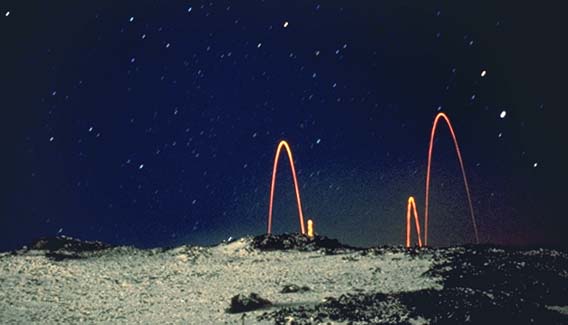
Geologists have developed a new sonification technique that translates seismic activity data into sound. Listening to the sound files, as well as creating "scores" that can be analyzed, may allow scientists to detect subtle changes that precede increased activity.
Here’s the sonification of activity at Mount Etna. Roll over, Nancarrow, and tell Ligeti the news!

Link via Acoustic Ecology.

Wednesday, August 09, 2006

Icones Lignorum


From BibliOdyssey:

Martinus Houttuyn (1720-1798) was trained in medicine but established his own printing firm in his native Holland to publish natural history books.

In 1773 the first 6 plates of 'Houtkunde'* ['A representation of inland and foreign wood'] were released as an unbound book with hand coloured prints.

Good Fucking Riddance


Even if he weren’t weltering up to his dewlap in Iraqi blood, there'd be plenty of good reasons to detest Joe Lieberman, from his aiding and abetting of Bell Curve pseudoscholar Charles Murray to his repellent exploitation of Terri Schiavo.

The official narrative is the radical left blogosphere has “lynched” a principled centrist. In reality, Lieberman is an unblushing con artist whose ugly burlesque of virtue is almost as offensive as his tireless pandering to the hard right.

Lieberman’s “concession” speech (see photo above) was a perfect demonstration of the man’s vindictiveness, and of the grueling sanctimony he consistently mistakes for gravitas. I’m very grateful to everyone who worked to deliver an historic humiliation to this monster of vanity, and I look forward to his total political annihilation. As Lieberman himself once said - in reference, of course, to someone else - "there's no prizes for second place in American politics."

Creative Visualization


Thers has alerted me to a daring new talking point on climate change, courtesy of James S. Robbins at NRO:

At the root of global-warming alarmism is a deathly fear of change. It is ironic that the Left, which calls itself progressive, is comprised of [sic] some of the most reactionary people on earth. They will come up with endless lists of all the changes that will result from temperature increases, exclusively focusing on the negative, as though change per se is something to be avoided....

So if we see global warming for the beneficial trend that it is rather than a looming threat to life and limb, none of the “solutions” being proposed by the alarmists are necessary. There is no challenge posed by a slow-rolling phenomenon like global warming that cannot be overcome; and when deserts start blooming, blizzards stop hitting, and you are enjoying the surfing at your beach house in upper Newfoundland, you won’t care what caused global warming, you’ll just thank goodness it happened.
Like Mary Graber below, Robbins is apparently a firm believer in the transforming power of creative visualization. Climate change is a “slow-rolling phenomenon,” but we can look forward to surfing Newfoundland. A warmer earth is a more comfortable earth. More rain probably means more rain forests (how could it not?). We can overcome every challenge of climate change, as long as we don't pass regulations, limit growth, misperceive biodiversity as valuable, take scientists seriously, or succumb to "alarmism."

Coastlines and ice caps, plankton and whales....all these things are ephemeral. Only the pitiless (but fair) dictates of hypercapitalism are eternal.

It's classic conservatarianism: Define a problem out of existence by turning logic and morality inside-out, and then whine about the "pessimism" of anyone who refuses to join you in Cloudcuckooland.

Adding insult to injury, Robbins - like most NRO writers - fancies himself a master of Chestertonian paradox:
[I]f the ice caps melt and we get more ocean, well that just means more habitat for whales doesn’t it?
Fuckin' A, dude...way to blow those liberals' eggshell minds!

Just in case that argument fails to impress you, Robbins links to a chart from the late denialist John L. Daly, which purportedly shows that the sea level at Tuvalu has remained stable. Daly wasn't actually a climatologist, and his amateur interpretations of climate phenomena (including the Tuvalu readings) are debunked at great length here. (But then again, perhaps that just proves that Daly was right. I mean, why would people go to so much trouble to refute him, unless they were threatened by his findings? QED!)

In his book Dominion, former Bush speechwriter Matthew Scully describes the frightening worldview of chattering husks like Robbins:
It is the same fundamentally vulgar vision of man that conservatives elsewhere so earnestly worry about....man the all-conquering consumer facing the universe with limitless entitlements and appetites to be met no matter what the costs....

My National Review colleague Jeffrey Hart, a professor at Dartmouth College, captured the attitude nicely...."It is depressing," he writes, "to hear cigar-smoking young conservatives wearing red suspenders take a reductive view of, well, everything. They seem to contemplate with equanimity a world without lions, tigers, elephants, whales. I am appalled at the philistinism that seems to smile at a future consisting of a global Hong Kong."
With that in mind, read Robbins’ ramblings on "infinitely adaptable humanity":
Some rare plant and animal species, hyper-adapted to highly specific climate conditions or micobiotic zones, are already unable to cope with the change. Many may go extinct; some already have. That’s tough, but chalk it up to bad evolutionary choices. When those rigidly specialist species bet everything on a small part of the world in hopes it would never change, they made a very bad bargain. For our part, we have air conditioners, lightweight fabrics, and sunscreen. Why infinitely adaptable humanity has to pay the price for the evolutionary shortsightedness of other life forms is beyond me.
”Infinitely adaptable”? I suppose that describes Robbins and his crowd well enough, though I’m not sure that seeing a global disaster as a triumph necessarily counts as adaptation in a strict evolutionary sense.

And honestly, if anyone's "hyper-adapted" to specific conditions it's conservatarians like Robbins, who'd sacrifice any or all of us to avoid being knocked from the pretended dignity of their worm-eaten ideological stilts. Someone really needs to explain to these overgrown children that the preservation of self-image is not the same thing as self-preservation.

Tuesday, August 08, 2006

The Properties of Winds


“Despite $28 billion program,”shrieks the San Jose Mercury News, “U.S. remains vulnerable to bioterror attack.”

Well, yes. The United States will always be vulnerable to bioterror attacks (though not as vulnerable as it will always be to natural outbreaks of disease). That's why preparedness is a better target for our money and effort than prevention.

Apart from filling and refilling the coffers of politically connected defense contractors (is there any other kind?), the main goal of our bioterror spending has apparently been to protect American politicians from blowback:

The FBI headquarters, World Bank and several other potential terrorist targets in the nation's capital have been outfitted with new germ-killing, air-purifying filters….

One bonus of these filters: Used in large enough numbers, they could save billions of dollars a year by reducing respiratory illnesses, allergies, asthma and sick building syndrome.
That’s a good point. Unfortunately, it’s exactly backwards. When you address everyday public health issues like these, you mitigate the risk and potential effects of bioterrorism, while increasing productivity and quality of life. This logic can just as easily be applied to universal healthcare, which, by conscientiously supporting early intervention and disease management, could save billions of dollars and thousands of lives, and provide an early-warning system not just for bioterror attacks, but also for emerging diseases.

By protecting your neighbor, you protect yourself; that's the basic fact that the smoke machine of conservative ideology tends to obscure, at least as it applies to the social contract (the far more abstract Domino Theory, of course, remains as compelling as ever). As I argued a while back:
[T]he quality and effectiveness of the medical care that even the poorest individual gets - especially in the case of contagious disease - is a matter of huge importance to society at large. It's not that different from firefighting; society must put out my burning house not because I'm part of some "meritocracy”…but because a conflagration at my house may well burn down everyone else's.

It's always been fashionable on the right to sneer at universal healthcare. It's interesting that the people most likely to buy "United We Stand" bumperstickers are also very likely to see themselves as standing outside the webs of interdependence and mutuality that necessarily bind worthwhile human communities. This stance is typical of people who can't face up to their own vulnerability.
I’m happy to see this point echoed in a fairly sensible new paper by the libertarian CATO Institute:
How can measures such as strengthening the public health system, which provide much broader benefits than those against terrorism, get the attention they deserve?

As Banks puts it, “If terrorists force us to redirect resources away from sensible programs and future growth in order to pursue unachievable but politically popular levels of domestic security, then they have won an important victory that mortgages our future.”
True enough. But perhaps “our” future isn’t the one that really counts. As Thomas Tusser observed in A Description of the Properties of Winds (1573),
Except wind stands as never it stood,
It is an ill wind turns none to good.
(Aerial view of Dugway Proving Ground courtesy of Polar Inertia.)

Monday, August 07, 2006

Imagine and Understand


Mary Graber, an English teacher at Clayton State University in Georgia, explains that what really upsets conservative activists about higher education is the uncanny ability of conservative activists to imagine upsetting things about higher education:

Imagine these instructions from a college professor and you will understand what we "conservative activists" object to:

"OK, class, let's look at our worldviews. What do you think of Britney Spears kissing Madonna? What does that act say about gender roles? Write a three-page paper and remember: Papers that do not display an open-mindedness will fail."
Two can play at that game. Imagine this speech from President Bush, and you'll understand why so many liberals distrust him:
"I am Jesus come back to earth. I hate fags and coloreds and poor people. That Hitler guy had the right idea, but he was too selectional. I'm gonna blow up the whole world!"
Kidding aside, I'd love to know what the learned Ms. Graber thinks of Agathon kissing Pausanias, or the antics of Proust's Mlle. Vinteuil and her friend the "practicing and professional Sapphist." Or Hart Crane.

A conscientious conservative, I suppose, would condemn them all as unnatural and inaesthetic (if you'll pardon the redundancy). And rightly so. Why squander your God-given open-mindedness on a bunch of filthy perverts, when you can use it to appreciate "alternative" theories of climatology or evolutionary biology?

Friday, August 04, 2006

Friday Nudibranch Blogging

Friday Hope Blogging


An extra-large edition this time around, to make up for last week. You may want to pack a lunch.

A majority of Americans feel Bush isn’t doing enough to protect the environment. No surprise there, of course. But I found this quote somewhat heartening:

Respondent Lisa Brutvan, 42, a real estate consultant from Atlanta who is not registered with any political party, said she voted for Bush because of his stance on terrorism. "I knew in making that decision that I was making a choice against the environment. I figured that for eight years we could survive it," she said. "But I think it's reaching a little bit more of a critical mass.

"At some point you've just got to look at things realistically and realize we're not leaving much of a legacy for our grandchildren if we don't address these issues," she said.
At least one federal judge seems to agree:
A federal judge lashed out at U.S. EPA yesterday for pursuing industry-friendly regulations at the same time it missed statutory deadlines to control toxic air pollution from small industrial plants…. Friedman's opinion includes an order placing EPA on schedule to complete 50 toxic emission regulations.
To give credit where it’s due, the EPA has pleased me greatly by calling for a ban on carbofuran:
The bug-killer, sprayed over corn, soybeans and other vegetables, was the greatest remaining chemical menace to bald eagles, migratory songbirds and other birds since the pesticide DDT was banned in the 1970s, according to the American Bird Conservancy.
In related news, a new bioreactor supposedly eliminates methyl bromide emitted during fumigation (a use which actually wasn’t included in the Montreal Protocol’s phase-out):
The technology harnesses methylotrophic bacteria, which oxidize methyl bromide to get energy. The system is designed to recapture the pesticide from the waste-gas stream created after fumigation. The proof-of-concept, 10-liter bioreactor successfully removed 100% of the methyl bromide from an air stream.
An appealing low-tech refrigerator from Africa comprises two earthen pots and a bit of sand:
Fill the space between the two with moist sand, and you have a most ingenious fridge….The water in the sand naturally migrates towards the outer pot, where it evaporates causing a temperature drop around the inner pot….

“Eggplants, for example, stayed fresh for 27 days instead of three, and tomatoes and peppers lasted for three weeks or more. African spinach, which usually spoils after a day, remained edible after 12 days in the pot-in-pot.”
A Nigerian teacher has set up production facilities; apparently, the system costs a mere forty cents.

In a story echoing my recent discussion of Taiwanese ghost money, Indian conservationists are attempting to change the way in which people celebrate the Ganesh festival, which normally contaminates bodies of water with lead- and cadmium-based paints:
Nature conservationists plan to tell devotees to bring home paper and clay idols of Ganesh during this year's festival rather than those made out of materials dangerous to the environment.
A pediatrician has come up with a remedy for malnourished children in Haiti:
The mixture, known to Haitians as "Medika Mamba," or peanut-butter medicine, is a nutrient-rich mixture of peanuts, sugar, oil, vitamins, minerals and powdered milk. It is distributed in plastic containers for families to feed their children at home and can be stored for several months. Children start to show visible signs of improvement about 1-2 weeks after receiving the peanut-butter mixture, becoming more active and growing new black hair. One course of the six-week treatment, which can be enough to renourish the child, costs under US$100.
A Japanese company wants to use the energy generated by the motion of commuters through ticket gates to power train stations:
”When combined with high-efficiency storage systems, the ticket gate generators can serve as a clean source of supplementary power for the train stations. Busy train stations (and those with large numbers of passengers willing to bounce heavily through the gates) will be able to accumulate a relatively large amount of electricity."
A school in Florida hopes to use a geothermal loop to control temperature:
The proposed system...is said to be more energy efficient than traditional heating and cooling, taking advantage of the constant temperature of groundwater. Some estimates put the cost savings at as much as half of a conventional system.
Leaders in the food industry have vowed not to buy soya grown on illegally cleared rainforest:
In a victory for consumer power, the companies say they will not deal with the four trading giants who dominate production in Brazil unless they can show they are not sourcing soya from areas being farmed illegally.
The new terminal at Boston’s Logan Airport is the first to get LEED certification:
The new technology will save the terminal almost $300,000 in electric bills and 1.7 million gallons of water a year.
And finally, a use of RFID tags I can wholeheartedly support: Attaching them to sponges and surgical instruments will make it more difficult for surgeons to leave these tools in patients’ bodies.

The world is so full of a number of things, and so on. Pruned reports on a new method of making letters appear in water:
“The device, called AMOEBA (Advanced Multiple Organized Experimental Basin), consists of 50 water wave generators encircling a cylindrical tank 1.6 meters in diameter and 30 cm deep (about the size of a backyard kiddie pool). The wave generators move up and down in controlled motions to simultaneously produce a number of cylindrical waves that act as pixels. The pixels, which measure 10 cm in diameter and 4 cm in height, are combined to form lines and shapes. AMOEBA is capable of spelling out the entire roman alphabet, as well as some simple kanji characters.


The post continues with a series of onanistic free associations involving Italianate gardens in the Atlantic, and Al-Qaeda attacking Los Angeles with a tsunami in the shape of Versailles (why not Islamic calligraphy, for heaven’s sake? Let’s be realistic!). My tastes are simpler, so I’m imagining Pepsi’s logo shimmering in the swimming-pools at the Summer Olympics.

On the other hand, the possibilities for skating rinks and frozen ponds are very interesting…I imagine one could make a nice bas-relief labyrinth for ice-skaters.

While we’re on the subject of water, have you ever wondered how drizzle sounds underwater? How about earthquakes? It’s all very interesting, but not as interesting as this mystery sound from the equatorial Pacific. Perhaps these brave explorers will discover its source.

Via Coudal, a few pictures of an abandoned city outside Taipei.


Despite (or because of) the hypermodern design, these buildings look far more decrepit and dated than most of the old buildings photographed by M.O. Hammond in the early 20th century.

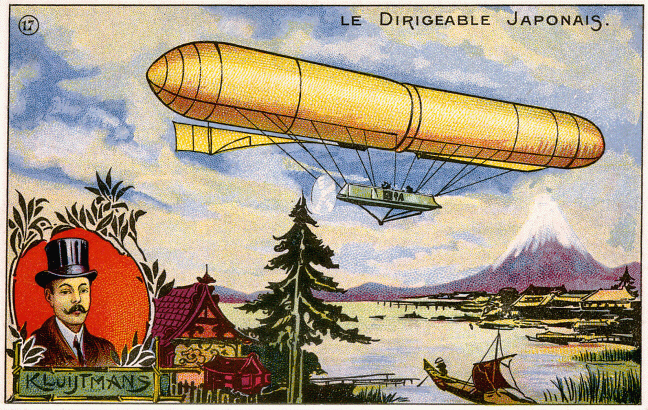
The Flying Machines of 1909 are dated, too, but in a far more agreeable way.


If nothing else, they’ll soothe your jangled nerves after you’ve toured the Museum of Frogs. Or listened to Scott Smallwood’s cicada recordings. Or learned to play the Silophone.

When you’re done with all this, the Digital Landfilll allows you to dump unwanted files: “All refuse is automatically layered into the Digital Landfill composting system.”

Thursday, August 03, 2006

Gin and Jews

Objecting to Joe "Droopy Dog" Lieberman's bad politics, dishonesty, and poor judgment? Anti-Semitism!

Objecting to the perfidious machinations of the Eternal Jew? A perfectly normal side effect of drinking alcohol!

In his August 2 column on National Review Online, John Derbyshire excused Gibson's comments because "[t]he guy was drunk, for heaven's sake. We all say and do dumb things when we are drunk."
Too true, begob. It only takes a couple of beers to get me reciting choice portions of the Protocols. Give me a few Singapore Slings, and I'm a one-man Kristallnacht.

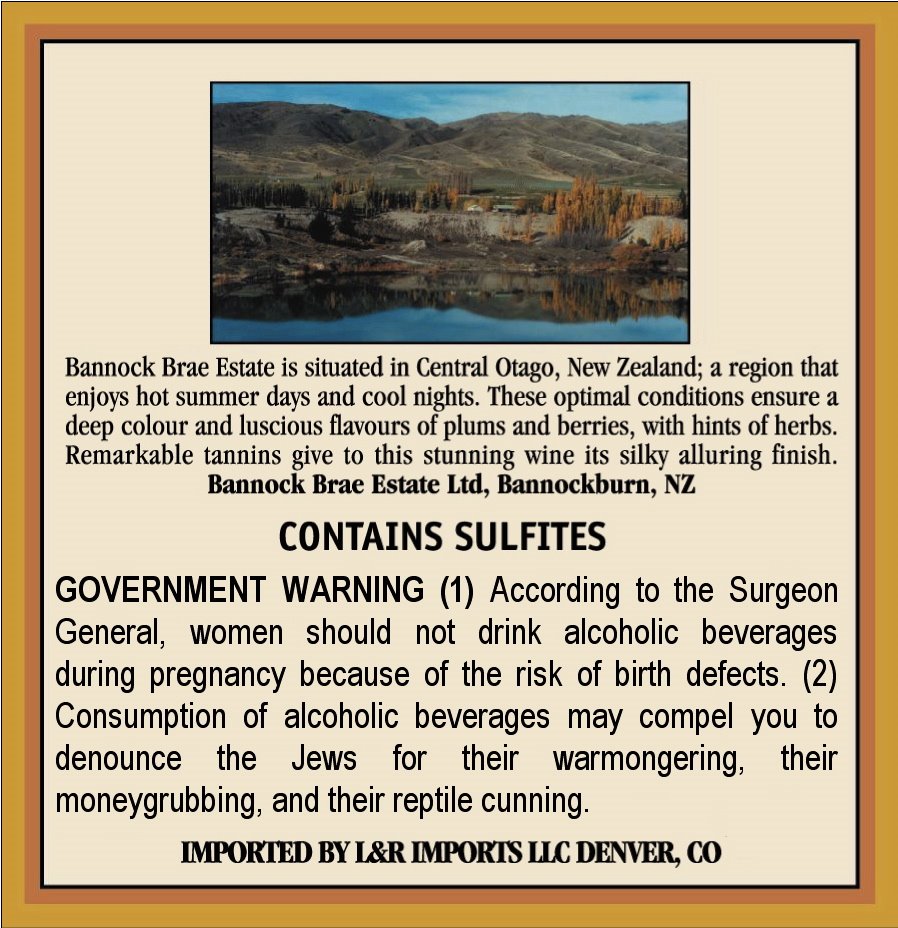
I'm not alone in that, of course. We all hate the Jews when we're drunk. That's why I believe this new Surgeon General's warning should appear on all alcoholic beverages sold within the United States:


(Thers gave me this idea in an Eschaton thread, so please address all complaints to him.)

Hard America


All things considered, Jonah Goldberg really is your best entertainment value. His latest stroke of genius is to elucidate the political differences between "dairy states" and "beef states":

When you think about it, cow-rich states dedicated to dairy seem to have more left wing politics than cow-rich states dedicated to meat production.
Where's the evidence for this? There isn't any. Goldberg has done "no research whatsoever and [is] merely going by stereotypes about cheese and steak...." In other words, he's using his patented brand of know-nothing laziness as a shield against criticism. He's just throwing some ideas out there, you see. If people like them, he can go further and fare better. If people criticize them, he can claim that he was just being funny and frolicsome. It's kind of amazing that his pals at the Corner haven't noticed this hedging strategy yet, 'cause he indulges in it pretty often.

Goldberg may have no evidence, but he's got three explanations, and each one's a winner.
First, the sorts of people who historically went into dairy production were Scandinavian socialist types while the people who went into meat production were Scotch-Irish cowboy types.
Regarding "Scandinavian socialist types," I'd direct Mr. Goldberg's attention to a book called Wisconsin Death Trip, which paints a somewhat dour picture of how the 19th-century nanny-state functioned in the environs of Prairie Du Chien. Had Goldberg lived there and then, I'll bet you dollars to donuts he would've been the very first inmate of the mental hospital at Mendota.

Before I move on to Goldberg's theory number two, I suppose I should mention that both dairy and beef farmers have been and continue to be recipients of government subsidies and other taxpayer-funded handouts.
Two: Perhaps dairy regulation occurred a lot earlier than meat regulation. This generated a culture of state-intervention and therefore a politics to match (or vice versa).
It didn't, and it'd actually be pretty weird if it had. Slaughterhouses have always posed a much greater public nuisance and health hazard than dairies, and have accordingly been the subject of more public complaint.

State regulation of cattle goes all the way back to the colonies. However, the first Federal Meat Inspection Act was passed in 1906, replacing a relatively toothless law passed in 1891; the National Cattlemen's Beef Association says that the 1906 Act was "welcomed by cattlemen," and that the Association "successfully lobbied for the inspectors to be paid by the federal government."

Go figure, eh Jonah?
There's also a more metaphorical - i.e. b.s. - theory: dairy is nurturing. It's about sustainability. Dairy farmers can afford to fall in love with their cows. Making cows into steak, handburger and wallets requires more tough-mindedness. Dairy is soft America. Meat is hard America. Or Something Like That.
Hard versus soft...it's amazing how often ideas are accepted or rejected not on their virtues, but according to their imagined position on this vague continuum. At any rate, Goldberg's unblushing invocation of "hard America" provides further evidence that conservative ideology is a sort of patent medicine designed to improve the self-confidence of psychosexual cripples.

Some might argue that sustainability is tough-minded, inasmuch as it requires discipline, careful attention to detail, and occasional acts of self-denial. But Goldberg doesn't see it like that. To him, being "hard" means vacuously catering to and coddling himself, while getting a vicarious thrill - felt mainly in the sweaty creases of the perineum - from the thought of the big boys working the bolt gun down at the slaughterhouse. Moderation and gluttony have somehow switched places in the conservative moral firmament, and the result has been a flock of Goldbergs: a gaggle of pudgy, self-satisfied, willfully ignorant layabouts with the attention span of a squirrel.

Incidentally, Goldberg doesn't realize that cattle ranchers generally didn't kill their animals. Instead, they sent them to meatpackers:
Stockyards provided the accumulation points for cattle coming in on the rail cars. Cattle were not fed as in today’s definitions, but rather sorted and distributed out to packers. There were no feeder or stocker cattle, and heifers were never slaughtered.
Chicago, despite its legendary status as "hog butcher to the world," seems to be comparatively progressive nowadays. Maybe the fact that meatpacking plants were an important breeding-ground for unionism had something to do with it.

And of course, dairy ranchers routinely slaughtered cattle. Still do, in fact.

All the same...outside of being completely ill-informed, and finding absurdities plausible simply because they crept into his empty skull to die, Goldberg's really hit on something.

Praising With Faint Condemnation


A new article in the Cavalier Daily notes that climate-change denier Patrick J. Michaels is facing a bit of scrutiny over the generous funding his consulting firm received from the Intermountain Rural Electric Association (IREA).

In a memo sent out to electrical co-operative members on July 17, Lewandowski wrote "we decided to support Dr. Patrick Michaels and his group (New Hope Environmental Services, Inc). Dr. Michaels has been supported by electric co-operatives in the past and also receives financial support from other sources."
This isn’t exactly a shock. Michaels has been propped up by polluters for years. What the article fails to mention is that the IREA initially paid Michaels without the knowledge or consent of its members.
"Intermountain is a rural electric cooperative," Binz said. "The customers are member-owners. Stan Lewandowski is basically spending other people's money."
The article also doesn't mention that Lewandowski’s letter included a “fact sheet” on climate change that blames “the influences of plate tectonics” for rising temperatures. But it does give this bizarre man plenty of room to kick up his heels:
"Where do we come about that somehow money that comes from the environmental groups is somehow sacred money and that's okay to support climatological research; and other money is not okay for that?" he said. "That's not the American way."
The author goes on to prettify Michaels’ work as a “consultant” and, more disturbingly, his status as a scientist:
According to Environmental Science department chair Joseph Zieman, Michaels has published material in peer-review journals that has generally taken a "middle-of-the-road" view on global warming….

Zieman also said he supports Michaels in his consulting work as well as in holding opinions on global warming that are outside the mainstream.

"Faculty members, as long as they are no [sic] manipulating data, are completely protected by academic freedom," Zieman said.
Well, Michaels cut off his study of satellite climate data at 1996. That certainly sounds like manipulation to me.

And as Tim Lambert also reports, a paper that Michaels claimed disproved global warming contained a fairly serious error. Michaels announced that the paper in question had survived “four years of one of the most rigorous peer reviews ever.” Unfortunately, not one of the magi who came to adore this miraculous offspring of Michaels and Ross McKitrick noticed that it confused degrees with radians, which meant that all its numbers were wrong.

Sourcewatch has more:
Dr. Tom Wigley, lead author of parts of the report of the Intergovernmental Panel on Climate Change and one of the world's leading climate scientists, was quoted in the book "The Heat is On" (Gelbspan, 1998, Perseus Publishing): "Michaels' statements on [the subject of computer models] are a catalog of misrepresentation and misinterpretation… Many of the supposedly factual statements made in Michaels' testimony are either inaccurate or are seriously misleading.”
The evidence that Michaels is incompetent, dishonest, or both is pretty goddamn overwhelming. Implying even tentatively that he's some sort of principled, respectable dissenter is indefensible, to my mind. His credibility should be taken off life support and allowed to die a natural death.

Should be, but won't be:
It seems that [notorious climate skeptic Pat] Michaels called [CNN Friday's Peter] Dykstra to complain that the network doesn't do enough to bring out the side of those who question the thesis that human industrial and transportation activity is warming the globe. Dykstra politely disagreed, but he was curious. So he took the time to look up all of the network's pieces on the topic.

The expert CNN quoted most? Dr. Patrick Michaels. By a factor of two.

Wednesday, August 02, 2006

Ooze and Sharp Edges


A sprawling landfill site in Matamoros, Mexico contains countless bags of medical waste:

Lime green trash bags are a common sight and deadly hazard. The discarded sacks are typically filled with hospital medical waste, and they’re everywhere. They hold used saline bags, glass vials, plastic syringes, bloody gauze, boxes and bloodied bandages. The waste arrives mixed in with the rest of the garbage, burned, buried and forgotten.
Predictably, the Matamoros site is home to a population of scavengers, many of whom are young children and teens:
His hands are covered in scars, evidence of five years spent digging through this refuse that is layered with unknown medical waste, ooze and sharp edges, including discarded syringes. He is a cut away from an infection, one sharp needle away from death.

The teenager shook his head when asked if he believes his job is dangerous. He doesn’t really worry about the bloody bandages and other hazardous waste scattered about.
Like other Mexican border towns, Matamoros is a popular destination for Americans seeking illicit thrills. Thousands of college students visit each spring, lured by the promise of cheap alcohol and sex. In the past, it's also been a primary crossing point for sex-slavery rings in which young Mexican girls are offered passage to the United States, and then forced to work off the debt (a complex system of fines and interest charges usually ensures that the debt can't actually be discharged).

Under these circumstances, diseases like AIDS and hepatitis are a serious concern. The presence of infectious medical wastes in the landfill makes matters considerably worse; prostitution is as predictable a response to poverty as scavenging for glass and metal, and there's undoubtedly a certain amount of overlap between the two professions.

While maquiladoras have exponentially increased the waste disposal problems in Matamoros, and attracted staggering numbers of desperately poor immigrants from all over Mexico and Central America, NAFTA hasn't brought about a corresponding growth in infrastructure improvements, housing, or public health. On the bright side, the NIMH is currently conducting a study into the feasibility of "changing sexual risk behaviors in Mexican female sex workers":
Border cities often have a thriving sex trade industry, and some are considered “sexual tourist” destinations. FSWs in these border cities, however, often do not know how to practice safe sex.
Meanwhile, a site called World Sex Guide presents consumers' experiences of prostitution in Matamoros:
I took a cab to where the cab driver said some ladies could be found. There were maybe five women on the street. All of them were ugly - either old, fat, or both. Being in a bad condition of drunk and horney, I played devil's advocate and choose one. $30 and a bad screw later, I was on my way home. Including the $20 cab fare, I spent $50 for a bad experience.
The poor man. It's just not fair, is it?

Incidentally, the mosquito-thronged waste tires in the Matamoros landfill have contributed to the emergence of dengue fever and dengue hemorrhagic fever on both sides of the border. Also, scavengers routinely set fire to the landfill in order to uncover metal and glass; this spews evil-smelling smoke and toxic particles all over Brownsville and the surrounding farmland (some fires burn for months at a time). Far more disturbing, though, is the amazingly high incidence of such neural tube defects as anencephaly in Matamoros/Brownsville.

When you hear people shrieking about the need for a wall along the border, bear in mind that it won't keep corporatism's bountiful harvest of disease and pollution out of the United States.
“In the public health department, there are no borders,” said Josue Ramírez, public health director for the Brownsville Health Department.
Strict, humane labor and environmental regulations would be a far more practical solution to both problems, and to illegal immigration. Unfortunately, that'd cost American corporations and defense contractors a great deal of money. They'd much prefer to conduct business as usual, and let taxpayers unwittingly cover the horrific hidden costs of their "affordable" consumer goods.

A Small Adjustment


Robert M. Jeffers objects to what he calls the Hegelian tendencies of George W. Bush:

Forces are in play in his imagined Middle East; not people, not men and women with histories and cultures and governments, people with families and desires and appetites and needs. Simply "forces." The world is much easier to understand when you reduce it to simple, empty concepts which can mean whatever you want them to mean.
RMJ contrasts this with the attention of Jesus to the individual; where Bush sees “forces,” God’s eye is on the sparrow.

I'm reminded of the epilogue from David Stacton’s odd and remarkable novel The Judges of the Secret Court (1960), which deals with the lives of Edwin and John Wilkes Booth:
It was Julia Ward Howe who once asked Charles Sumner if he had heard of young Booth yet.

“Why no, Madam,” said Sumner. “I long since ceased to take any interest in individuals.”

“You have made great progress, sir,” Julia told him. “God has not yet gone so far – at least according to the last accounts.”
Still, it seems to me that Bush's "simple, empty concepts" are well within the mainstream of what we ordinarily call religion. The forces of Good and Evil are at war, we’re told, and if innocent individuals “with families and desires and appetites and needs” fall victim to the friendly fire of the righteous, so be it. Death is only a dream, and God will know His own.

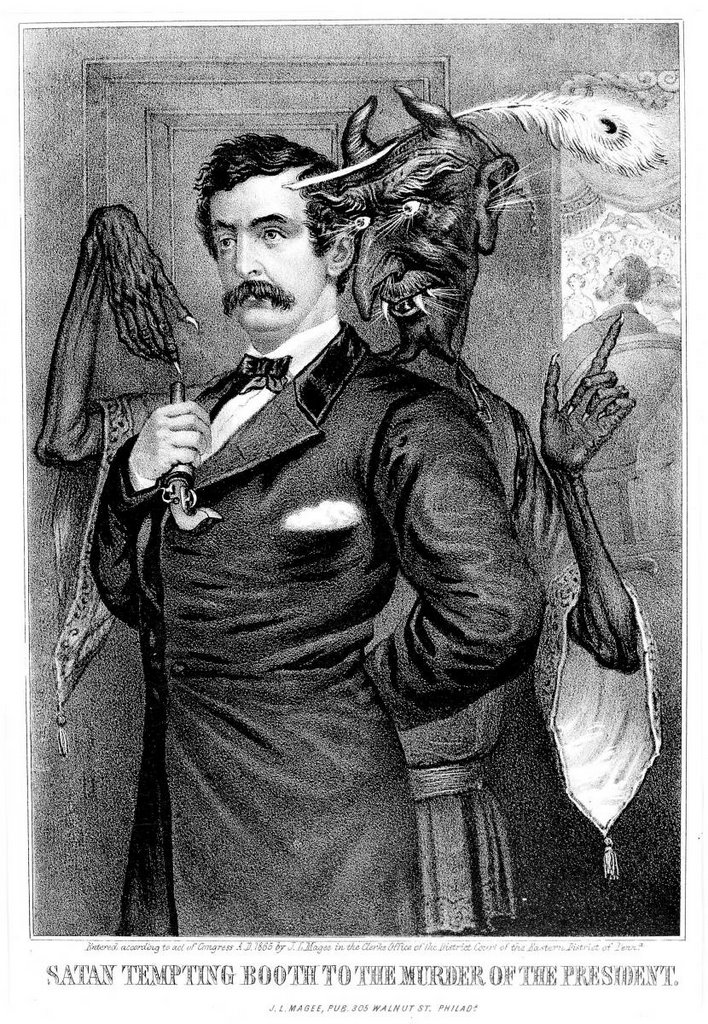
This is a problem with human beings per se. We tend to see great economic, political, biological, or spiritual forces at work everywhere, and people as their expendable puppets. In the cartoon above, Satan tempts John Wilkes Booth to kill Abraham Lincoln. Apparently, the artist felt that Booth couldn't have devised a specious, self-aggrandizing justification for murder without supernatural help.

RMJ goes on to make an important point:
The language of rights is a slippery one. It sounds like an absolute, something that must get acknowledged and can never be removed or taken away. Yet even the right to "life, liberty, and the pursuit of happiness" can be taken from you by the State of Texas; Governor Bush sometimes made quite sure of that.
This frightening ability to grant and revoke rights is at the center of Simone Weil’s elevation of obligations over rights (which can be summed up by paraphrasing Philip K. Dick: Obligation is that which, when you stop believing in it, doesn’t go away).

This begs the question of what one feels one’s obligations to be, which is an interesting – and not at all pleasant - thing to ponder while sitting in the United States and looking at pictures like these. What’s more important: The right of these people not to be killed? Or our obligation not to allow them to be killed?

Considering where the path of obligation may lead, it’s no wonder that we generally prefer the language of rights. It lets us appeal to the consciences of others, instead of our own. It lets us tell tyrants to stop themselves (from a comparatively safe distance, in most cases), instead of obliging us to do whatever’s necessary to stop them.

But what is necessary? A Jewish tradition says that the Messiah will make “a small adjustment” to the world in order to redeem it. Most assassins have held to a crude secular form of that idea. Exterminate a politician or two, the logic goes, and a bright new day will dawn for everyone (except their victims, and their supporters, and anyone who doubts the value of retaliatory or preventative killing).

None of it works, of course. Like the delusion of capital punishment, the idea that you can effectively punish murderers is based on a tendency to ignore the consequences of violence in favor of something called “closure” (which doesn’t actually exist outside of bad art, but is increasingly becoming a synonym for “justice”). To quote Stacton once more:
It is the rest of us who have to go on living with what they did, with what life has done, with what the world does, with what has been done to us.

Tuesday, August 01, 2006

Things Worth Reading


David Roberts - Grist's best and most thoughtful writer, in my opinion - considers whether it's wise to "rebrand" environmentalism as yet another form of hip, self-absorbed consumerism, and comes down on the side of the angels:

I have no objection to short-term tactical considerations, appealing to people's base interests. But we should never stop trying to convince people that they've been lied to about what they are and what they can be. The ties of place and family and community are not annoyances to be escaped when finances permit. They are the very stuff of being human.
Also at Grist, John McGrath notes the serious problems with carbon sequestration, and uses them to smash the cornucopian halfwit Marc Jaccard (author of Sustainable Fossil Fuels) into his constituent atoms:
While he [Jaccard] disdains the idea of a (perhaps) more expensive, (perhaps) less efficient renewable-energy future because it would require rebuilding the entire energy infrastructure of western civilization, he neglects the fact that his ideas do the exact same thing. Modern industry is not built to capture and sequester CO2, and in large part it simply cannot be. Moreover, the policies that would make oil and coal cleaner and more efficient are being fought tooth and nail by the very industries Jaccard is championing....

Or to put it more bluntly: Our society is currently reaping the consequences of our fossil fuel addiction, flopping around on a bathroom floor with a syringe in our arm and a dirty spoon nearby. And Jaccard thinks all we need is a mop.
In reality, of course, our fossil fuel addiction calls for a mop and plenty of thermobaric weapons:
As with the SMAW-NE, the new thermobaric grenade has received very little publicity in spite of its effectiveness. (The Russians also sell a multi-shot grenade launcher with thermobaric rounds for urban combat.)
Read the whole thing at Defense Tech, keeping in mind the relaxed screening techniques currently favored by our military recruiters.

BLDGBLOG reports on the "biological invasion" of Antarctica:
[W]e do the migratory work of other species for them. We take them with us. Importations of even the smallest microbe can sufficiently alter an ecological niche, opening it up to further changes – then compounding over time into whole new landscapes. What would happen naturally is accelerated: a thousand years in a decade.

It shouldn't surprise us, then, to learn that strange things are afoot in Antarctica.
The Seattle Times describes a different type of biological invasion, stemming from the fact that it's often cheaper to fly to another country for medical treatment than to get it in the United States.
"The hospitals have a monopoly; they don't care, because where else are patients going to go?" said Bonnie Blackley, benefits director. "Well, we are going to go to India."
As long as the fossil fuels hold out, anyway.

Preaching the Cross


Just got in from another vacation, in case you were wondering. Thought you'd like this picture of someone I met on my trip.

It was very nice not to read about politics for a few days, and nicer still not to write about it. I don't think I need to apologize for failing to write my usual gloomy posts while I was busy guzzling high-octane tropical drinks in Los Angeles, but I will do my best to make up for the lack of nudibranchs and hope on Friday.

Tuesday, July 25, 2006

A Visit to Aerotropolis


Studies detailing the rough outline of a poison circle around airports could just as well define the boundaries of John Kasarda's aerotropolis, in which sprawling terminals will form the ugly, toxic heart of the community's "central business district."

Fast Company writer Greg Lindsay's defense of this scheme - which is increasingly popular in Asia - is a little miracle of concision:

To the jaundiced American eye, such a project might appear to be the terminal metastasis of the sprawl represented by O'Hare, LAX, or JFK. But to dismiss it as the product of Asia's infatuation with all things mega would be to miss the carefully calibrated machinery underneath.
Because, you see, if the underlying machinery of a project is carefully calibrated, then there's clearly no way it could be a product of infatuation, or an example of terminal metastasis.

Or something. Anyway, they're doing it over there, so we'd better do it over here.

There's a bit more to the argument than that, of course. Unfortunately, Kasarda's rhetoric is long on what Lindsay calls "Olympian pronouncements" and short on coherence:
[T]he three essential rules of real estate have changed from 'location, location, location' to 'accessibility, accessibility, accessibility.'
I would've thought that location and accessibility were intimately, if not indissolubly, linked. But this is a New World, and I'll gladly admit that some of its subtleties are beyond me.

That said, some of them are beyond Kasarda, too:
He sheepishly concedes that his visions of monstrous highways and multimodal cargo hubs would make Jane Jacobs--the late patron saint of human-scale cities--toss and turn in her grave. But Kasarda has moved beyond the comfy, retro dictates of the New Urbanists. He isn't concerned with "the way we live now" but with the naked realities of how we do business now.
"Now" being the operative word. The problem is, how we do business now may not be viable even ten years down the road, as Dr. Colin Campbell explains:
Demand for other oil products will make the attainment of 11%, let alone 30%, of crude oil production as jet fuel impossible….An exponential growth rate in passenger traffic of 4.5% and in freight traffic of 5.9% (in accordance with Airbus forecasts) would require an amount of jet fuel impossible to procure.
That's on the one hand. On the other is our innate disdain for "comfy, retro dictates." These are soft, limp, drooping things, after all, while multimodal cargo hubs are hard, vigorous, and thrusting. This sort of rhetoric has been falsely associated with a realistic worldview for so long that it now serves as a stand-in for actual realism. Calling New Urbanism "comfy" allows the cognoscenti to ignore not just that particular school of urban planning, but also the underlying crises it hopes - however inadequately - to address.

Thus, we’re supposed to forget that the airline industry is more vulnerable to fuel prices than other transportation sectors, which makes it a very unlikely engine for long-term economic development. We're also supposed to forget that the impatience of those online consumers whom Kasarda (rightly, for once) calls “spoiled” won’t survive an era of $100-a-barrel oil. Kasarda likes to quote D’Arcy Thompson on the tension between growth and form, but conveniently ignores the fact that both these things require an ongoing, affordable source of energy.

Still, you can't let facts stand in the way of progress. Airports must expand, and cities must grow around them according to whatever logistical and aesthetic demands are made by the gods of intermodal efficiency and brand management, respectively. In case there's any doubt on that last point, Kasarda explains how essential branding is to an aerotropolis:
There needs to be a branding of the area, which will require gateway entrances and basically the type of architecture and landscape design that will let people know they're going into the aerotropolis and not just any other area….
I figure the noise, the lines, and the security guards will tip them off. Failing that, I'd suggest an arch reading Globalisierung Macht Frei.

Any sense of community pride in Aerotropolis will presumably center on its "seamless" catering to the needs of passengers and cargo, and I imagine its schools will be tolerably good at turning students who are neither too deafened nor too asthmatic into model workers. Meanwhile, David Brooks and Paul Virilio, in their own inimitable ways, can exclaim anew over speed's conquest of space. Everyone wins! Or at least, everyone who counts.

As we build branded cities around airports and fill them with dispirited, harried, sickly, underpaid workers, we create a perfect target – and breeding-ground - for terrorism. It seems logical that an aerotropolis would need (or will get) more security than an ordinary city, and that a fair number of its security measures would center on residents and workers. What restrictive covenants might apply to prospective residents of an aerotropolis? What sort of screening will they have to put up with, and what sort of surveillance? Will security forces be public or private? (More important, will they have quotas to fill?)

Whatever the answers to these questions may be, I think it’s safe to say that the combined costs of security, surveillance, infrastructure improvements, and – inevitably - antimissile technology will make it incredibly expensive to put our eggs in the flimsy basket of “airport-centric development.” And that, unfortunately, is precisely why such projects are likely to go forward; they have the potential to make venal people very, very rich whether they ever function properly or not. Kasarda and his supporters like to pose as visionaries who offer us the thrill of progress. In reality, their schemes boil down to the age-old strategy of squandering public goods to reap private benefits.

(Illustration by A.C. Radebaugh, from an online exhibition evocatively titled The Future We Were Promised.)