Monday, March 27, 2006

Pointless Acts of Violent Rage

If you have a recently vacated stable that needs to be bolted shut, Michael O'Hanlon's new column - in which he explains how to prevent a civil war in Iraq - suggests that he's the man for the job.

Administration officials have been right in recent weeks to argue that there is no large-scale civil war underway in Iraq. As long as the Iraqi political leadership remains generally united in trying to calm the situation, and as long as sectarian violence remains more sporadic than strategic (with no systematic ethnic cleansing, for example), true civil war remains a threat rather than a reality.
It's strange that O'Hanlon thinks Iraqi political leadership is "generally united," considering that one of his first recommendations for stopping a civil war is for Iraqis "to form a coalition government."

To be fair, it's not a bad idea. I wonder why no one else has thought of it?

O'Hanlon also notes that most Iraqi security forces are "dominated by one group or another." As you can see, there's very little that he doesn't know about this troubled part of the world.

So how will we know when "true civil war" is looming? O'Hanlon offers a handy checklist. I suggest you print it out, and keep it in your wallet for easy reference:
If civil war begins in Iraq, it will probably consist of increasingly active vigilante justice -- as well as random, pointless acts of violent rage -- by Iraq's powerful militias. They will attack defenseless mosques, homes of important figures from other ethnic and religious groups, and defenseless citizens.
Something to watch out for, definitely.

Sarcasm aside, I'd argue that we can do without any more of O'Hanlon's "expert" analysis of the situation in Iraq. He was an arrogant advocate for invasion, a premature triumphalist once the war started, and a trivializer of its tragedies as the situation deteriorated:
As bad as things are now, and as slow as the going currently appears, things are not that bad. And as tragic as deaths and injuries to coalition military personnel, U.N. officials, and top Iraqi leaders have been, the fact also remains that total American losses in Iraq to date -- just over 300 as of this writing -- are still less than in Desert Shield/Storm in 1990-91.
O'Hanlon's inaccuracy and poor judgment are irritating enough, God knows. But some of his opinions are simply incoherent. Check out these erratic thoughts on the capture of Saddam:
[I]t is quite likely that taking Saddam out of the picture will have important effects on the ongoing war....In this light, it is hard to understand or defend the comment of presidential candidate Howard Dean Monday that Saddam's capture did not make America safer; even opponents of the war, who have a reasonable case, should recognize that at this point eliminating Saddam from the picture improves our prospects for success in Iraq considerably. Admittedly, Saddam probably did not play a major role in orchestrating attacks on coalition forces. But he may have had some part.
I have more respect for the people who simply called Dean a traitor or a lunatic than for O'Hanlon's brand of labyrinthine, faux-rational, "centrist" equivocation.

Like a number of other liberal hawks, O'Hanlon doesn't understand that his current criticism of the war is meaningless. Bush isn't interested in his advice, or his theories. What Bush wanted from him was bootlicking support for the invasion, and O'Hanlon gave it to him in spades. That was the ultimate test of O'Hanlon's morality and geopolitical acumen, and he failed it. That being the case, he'd do himself - and the families of the people his glib warmongering helped to kill - a great service by shutting the fuck up.

Paging Jim Brady!

Sadly, No has done a fair and thorough job of assessing possible replacements for disgraced conservative blogger Ben Domenech.

But I think the job should - nay, must - go to this provocative new talent discovered by Overheard in New York:

Old woman: "Free"? Nothing's free around here! That's what's wrong with you immigrants, always looking for something for free!

Businessman lady: I said "sweet", not "free".

Old woman: I know what you meant!

Friday, March 24, 2006

Friday Nudibranch Blogging


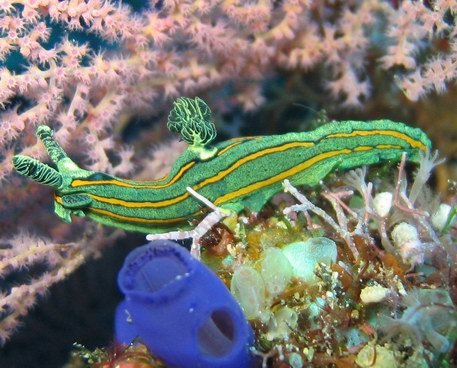
Here's an unidentified nudibranch...some form of Tambja, apparently. Translucent and glowing, they ooze up from the ground and float through solid walls, wriggling countless tentacles and snapping their jaws.

Too busy again this week for hope blogging, which is extremely labor-intensive. Should be getting back to normal very soon, though.

Stages of Grieving

Denial:

The charges of plagarism are false, meant to bring down a good and honest man. The presented facts to prove plagarism are specious -- products of shoddy work.
Anger:
The bitterness, despondancy, and hopelessness of their movement can now only manifest itself as hate. Pure hate, prejudicial attacks, and rampant accusations are their message. Their platform incubated at the safe havens of Daily Kos, MyDD, and Atrios. Thousands of satellite blogs and message boards anxiously awaiting a dispatch from this "Axis of Idiocy", and faithfully linking and emailing without a modicum of sanity checking.
Bargaining:
Assume, for a moment, that the plagiarism charge is true. For the sake of argument, assume that. Now, having accepted this, what are we left with?
1. It is the sole critique of Domenech by the left with any objective merit.

2. It does not have much merit, as the profferred examples are:
-- Old, dating wholly from Domenech's teen years.
-- Confined wholly to movie reviews.
Depression:
The charges of plagiarism are serious business, especially the one in NRO. It may be happening at this very writing, but a complete and timely response is needed by the co-founder of this site, answering fully every charge made. I count myself a supporter of Ben Domenech, but the credibility of this site and the Redstate project is at risk.
Acceptance:
I've looked at the evidence, and though I don't like what it tells me, I won't close my eyes to it: Domenech is guilty, and the worst part of it all is the fact that he has demonstrated serial tendencies - this isn't an isolated deal. The only honorable response in this situation is to remove Domenech from the masthead/editorship of RedState. Can any other conceivable option be entertained for a plagiarist? Obviously he should still be allowed to post or write diaries like any other member, but I would be deeply hesitant to promote to the front page, given that it would inevitably appear to be a tacit endorsement.

Thursday, March 23, 2006

Pregnant With Possible Significance

Over at the Weekly Standard, Christopher Levenick picks up the world like a snow globe, and turns it thoughtfully in his crabbed hands:

It is by now a commonplace that the state of Europe hovers between dire and grave. Sclerotic economies, plummeting birthrates, and moribund militaries all appear symptomatic of imminent collapse. Exacerbating its condition is the widespread decline of the continent's ancestral faith.
I'm not sure how the bit about "moribund militaries" would fit into this equation, even if it were strictly true.

But never mind about that. Levenick is here to tell you that reports of Europe's demise are possibly premature, because - and I wish I could draw out this moment of sweet suspense indefinitely - Italians have a new interest in monasticism!
[E]ven more pregnant with possible significance is Italy's sudden surge in new monastic vocations. A recent conference organized by the Vicariate of Rome and the Unione Superiore Maggiori D'Italia revealed that in the last year, no fewer than 550 women entered cloistered convents--up from 350 two years earlier.
A mass movement, indeed. And really, what better cure could there be for moribund militaries and plummeting birthrates than a modest rise in the population of nunneries?
Italy's spike in new monastic vocations may be nothing more than a statistical outlier. But nobody should be altogether dismayed if in fact it foreshadows something deeper. Monasticism seems to prosper in moments of great tumult and confusion. One may fear with Gibbon that its revival suggests another long, dark night of the European soul. One may, of course, equally hope with Benedict that its resurgence portends for the continent a new and glorious dawn.
Is that forthright enough for you? "Nobody should be altogether dismayed" if monasticism turns out to be "something deeper" than a "statistical outler"...like, for instance, "another long, dark night of the European soul."

Or, to put it another way: Splunge.

Friday, March 17, 2006

Friday Nudibranch Blogging


People often ask me how big nudibranchs are. They vary, but this one is typical.

Absolutely swamped in work this week. Back to regular posting on Monday, probably.

Tuesday, March 14, 2006

Ephemeral Cities


The new issue of Polar Inertia is out, which is wonderful news for fans of ephemeral cities (aren't they all?), polar ice stations, and Hong Kong noodle shops.

Speaking of ephemeral cities, don't miss this virtual helicopter tour of the Hayward Fault. Or the Digital Imaging Project Index of Art Historical Sites.

Or Thailand Tsunami Then and Now. Or these photos by Florian Maier-Aichen. Or Texas Bird's Eye Views (link via Coudal).

Special Interest Terrorism

An article entitled U.S. terror hunt targets animal activists starts out on a note of perfect falsehood:

Kevin Kjonaas is an unlikely casualty of George W. Bush's war against terror.

No one, including the U.S. government attorneys who just finished prosecuting him for so-called animal enterprise terrorism, says that the 28-year-old Minnesota native killed anyone — or even hurt anyone.
Kjonaas - whose crime was running a Website critical of animal experimentation - is not an "unlikely casualty." People like him, who inconvenience or slander large industries, are a primary target of the "War on Terror," and always have been:
"This is just the starting gun," says David Martosko, research director of the Center for Consumer Freedom, an organization funded by the U.S. restaurant industry and a fierce opponent of animal rights.

He says the government should move against more mainstream organizations like People for the Ethical Treatment of Animals or the Humane Society of the United States, which he calls "the farm teams for the eco-terror problem."
And why not? It's not like the feds have anything better to do:
FBI spokeswoman Cathy Milhoan says there have never been any deaths or injuries in the U.S. attributable to animal rights or environmental terrorism.

By comparison, radical right-wingers killed 168 people in the 1995 Oklahoma City bombing. Since then, according to a Southern Poverty Law Center report, police have uncovered 60 more right-wing plots, including plans to assassinate judges, bomb synagogues and destroy mosques.

In 2000, the head of Pittsburgh's tiny Free Market Party killed five and critically wounded a sixth. Three years later, a neo-Nazi videotaped himself firebombing a synagogue.

Yet in spite of this, as the Alabama-based law centre points out, the U.S. government has decided the radical right presents little or no threat. And the FBI says illegal activities of the extreme right have been eclipsed by the "special interest terrorism" of the animal rights and environmental movements.
The real enemy in the "War on Terror" is anyone who calls for accountability and transparency in industry or government. It's no surprise that under our "CEO president," federal law enforcement is becoming a goon squad for corporatism.

Of course, there's so much wastefulness and inefficiency in government that privatization is probably a much better long-term option for maintaining "order":
Maj. Pete Tufaro scanned the fenced lot packed with hundreds of stark white trailers soon to be inhabited by Hurricane Katrina evacuees. Shaking his head, he predicted the cramped quarters would ignite fights, hide criminals and become an incubator for crime, posing another test for his cash-strapped sheriff's department, which furloughed 206 of its 390 officers after the storm.

Tufaro thinks the parish has the solution: DynCorp International LLC, the Texas company that provided personal security to Afghan President Hamid Karzai and is one of the largest security contractors in Iraq.

Friday, March 10, 2006

Friday Nudibranch Blogging


This is Hypselodoris obscura, whose evocation of "the antartick oriency of a western aurore or acronick rising of the most radiant constellation of the firmament" may well lead to "the ineffable extasie of an overmastered apprehension," and induce a state of swoon "without the appearance of any other life than what by the most refined wits of theological speculators is conceived to be exercised by the purest parts of the separated entelechies of blessed saints in their sublimest conversations with the celestial hierarchies."

So watch your step.

Friday Hope Blogging

While Kristin Gerencher sits and broods over the apotropaic consumption of the "worried well," yet another study demonstrates that organic farming is better for everyone than conventional farming:

Writing in the March 6 online edition of the Proceedings of the National Academy of Sciences (PNAS) , Stanford University graduate student Sasha Kramer and her colleagues found that fertilizing apple trees with synthetic chemicals produced more adverse environmental effects than feeding them with organic manure or alfalfa.
And in Indiana, farmers have realized a host of benefits from no-till farming, which "leaves crop residue in the field from harvest through planting":
The residue reduces soil erosion by water and wind. Sediment runoff from farm fields, construction sites and other bare land is the nation's leading water pollutant...."You get a blanket (of crop residue) on top of the soil that keeps the wind from picking the soil up and blowing it around, and the roots from last year also hold the soil," Hotmire said. "Cost-wise, no-till is not as expensive, because you're not running equipment over the ground as many times."

In addition to being less expensive, "no-till has improved our yields because it is better for the soil," said Randolph County farmer David Jennings, who grows corn and beans on 1,500 acres with his father. No-till farming also reduces the emission of greenhouse gas.
Speaking of which, Volvo is switching a second assembly plant to 100% renewable energy. Also, from Treehugger comes word of a strange new adaptation of the Stirling engine, which produces hydrogen instead of electricity:
The CR5 is a stack of rings made of a reactive ferrite material, consisting of iron oxide mixed with a metal oxide such as cobalt, magnesium, or nickel oxide. Every other ring rotates in opposite directions. Concentrated solar heat is reflected through a small hole onto one side of the stack of rings. The side of the rings in the sunlit area is hot, while the other side is relatively cold. As the rotating rings pass each other in between these regions, the hot rings heat up the cooler rings, and the colder rings cool down the hot rings. This arrangement results in a conservation of heat entering the system, limiting the energy input required from the sunlight.

Steam runs by the rings on the cooler side causing a chemical reaction to take place, allowing the ferrite material to grab oxygen out of the water, leaving the hydrogen. The hydrogen is then pumped out and compressed for use.
Will it really work? Who knows? Who cares? All I know is, I love Stirling engines!

The deranged sprawl advocate and con artist Gale Norton is resigning from the Department of the Interior, possibly as the result of her implication in the Abramoff scandal. This means that the Endangered Species Act has one less implacable foe in government. Republicans, of course, hate the ESA because it works, as demonstrated by the ongoing comeback of the gray wolf. As Grist reports,
New wolf numbers released this afternoon from U.S. Fish and Wildlife: Idaho, Montana, and Wyoming now host an estimated 1,020 wolves, a stunning 21 percent increase in just a single year. Since reintroduction in the mid-1990s, gray wolf numbers have grown at an astonishing pace, faster even than the most optimistic prognostications.
Here's another comeback story, this time about wetlands in Arizona:
What has impressed city officials is how rapidly the area went back to nature....Dozens if not hundreds of species find homes in the cottonwood, willow and mesquite trees, the bulrushes and reeds in the ponds and on the water. Dozens of these are water birds: ducks, geese, kingfishers, rails, ibises and spoonbills. Others are raptors, including vultures, hawks, owls and ospreys. Finally, you will find the desert natives, sparrows, woodpeckers and hummingbirds, even roadrunners.
In medical news, there are three interesting developments in the battle against antibiotic resistance. In one approach, scientists are modifying gram-negative bacteria to make them susceptible to existing drugs:
After their genetic modifications, E. coli was killed with just a fraction of the antibiotic dose typically needed. It was 512 times more susceptible to Rifampin, 256 times more vulnerable to Novobiocin, and eight times more susceptible to Bacitracin, suggesting doses could be dramatically cut and still be effective....
Another approach is photodynamic therapy, which exploits the absorption of light-sensitive drugs by target organisms. The drugs are activated with a laser, killing the organism without affecting neighboring cells:
Researchers found that the bacteria S. mutans, as well as fungal organisms of the genus Candida, cultured from HIV patients, were highly susceptible to killing with minimal doses of PDT, both in laboratory dishes and on biofilms grown on denture material....

"PDT may provide an adjunct to current antibiotic treatment or an alternative where antibiotics no longer are working. This may be vital for patients undergoing cancer therapy, HIV patients who demonstrate resistance to antibiotics and the elderly with persistent oral infections."
Last, researchers have synthesized the antiobiotic nisin:
Scientists have made nisin, a natural antibiotic used for more than 40 years to preserve food, in a test tube for the first time using nature's toolbox. They also identified the structure of the enzyme that makes nisin and gives it its unique biological power.
In somewhat related news, researchers are hoping to replace mosquito populations with a breed that will not transmit dengue fever:
Researchers have successfully created a genetically engineered mosquito that shows a high level of resistance against the most prevalent type of dengue fever virus, providing a powerful weapon against a disease that infects 50 million people each year.
This world is adorned in diverse ways, decorated with rare ornaments. For instance, Chemistry in Art is a virtual exhibition of artwork based on chemistry. The following photo shows an environmental art installation by Brigitte Hitschler, which uses natural chemical reactions occurring at a potash slagheap to power a field of light-emitting diodes.


The rest of the artists are worth a look, too. But for sheer pornographic pleasure, it's hard to beat A Small Collection of Books on Colour. Here's a plate from Thought Forms (1905), by Annie Besant and C.W. Leadbeater:


Recommended soundtrack: Bizarre Features of Saturn's Radio Emissions.

Wednesday, March 08, 2006

Just Cause, or Just 'Cause?

Last night, my pal Eli asked me to take a stab at deconstructing this column by the ever-appalling Richard Cohen, and I can't help but comply.

Cohen kicks things off with this charming anecdote:

Back behind my high school one day, we all assembled to watch a fistfight. To my immense pleasure, a bully was being bested by his victim. Then the bully's friend stepped in and ended matters with a swift kick to the other guy's midsection. It was an unfair ending to what was supposed to be a fair fight, but it taught me a valuable lesson: You treat your friends differently than you do your enemies.
I bet Cohen would find this wisdom-tale less satisfying if he knew just how much it reveals about him, and the industry in which he works. This story about a naive little boy who, in the course of getting a vicarious thrill from violence, suddenly realizes that might makes right, is the closest thing to honesty I've ever seen from him.

"We all assembled to watch a fistfight," Cohen says. Did this group—in which our young hero felt the initial, quasi-sexual stirrings of the abject toadyism that would define his adult life—enforce the "code of the schoolyard" by chasing the interloper away, or beating him up? Apparently not. As Cohen tells it, they did nothing to help the kid who was standing up to a bully—fighting for them, in a sense, against a shared enemy. In fact, at least one of them—initials R.C.—took away the lesson that standing up to bullies can be dangerous, and seemingly vowed never to run the risk of getting a boot in his own midsection.

Not surprisingly, Cohen insists that the accommodation his own defective nature has made to brutality comprises some self-evident spiritual axiom for the rest of us.
This elemental principle of life, love and other matters seems utterly lost on so many critics of George Bush's agreement to provide India with civilian nuclear technology. In doing so, we are told, he has done something truly awful -- established a double standard. Well, duh -- yes. India is our friend and Iran, just to pick an example, is not.
Wittingly or not, he's basically espousing a dumbed-down version of Carl Schmitt's "friend/enemy distinction." Here's Schmitt:
The political enemy need not be morally evil or aesthetically ugly; he need not appear as an economic competitor, and it may even be advantageous to engage with him in business transaction. But he is, nevertheless, the other, the stranger; and it is sufficient for his nature that he is, in a specially intense way, existentially something different and alien, so that in the extreme case conflicts with him are always possible.
The problem with that is...well, there are lots of problems with that. For one thing, the belief that a given group of people is "existentially something different and alien" is not necessarily rational, let alone accurate. Worse, it's often predicated not on outward difference, but on inward similarity (e.g., in the case of conservative closet cases who oppose gay rights).

Also, Schmitt dismisses religious injunctions like "love thy enemies" as inapplicable to the sphere of politics, while allowing findings of "existential difference" to be based on irrational religious hatreds that rely just as obviously on some ineffable world beyond the political.

But even in this daft, morally bankrupt formulation, Schmitt understands something Cohen doesn't: Conflicts are always possible between "friends," and the potential for conflict "can neither be decided by a previously determined general norm nor by the judgment of a disinterested and therefore neutral third party." By contrast, Cohen simply makes empty pronouncements like "No one worries about India or Israel making the technology available to terrorists." For Cohen, friends and enemies are immutable, despite the ease with which people like Osama bin Laden and Saddam Hussein and Manuel Noriega have traveled from one category to the other.
Why should the United States look the other way at Israel's bomb and go nuts over Iran's effort to get one? The answer ought to be clear: Because Israel has not threatened to blow Iran off the map....
I guess Cohen has never heard the phrase Samson Option. Or stumbled upon Haaretz defense editor Zeev Schiff's 1998 complaint that "too many senior Israeli officials have taken to issuing threatening statements vis-a-vis Iraq and Iran."

But never mind all that. It's time to climb into our protective gear, and approach the poisonous core of Cohen's argument:
The "double standard" accusation has a schoolyard quality to it. Why a boycott of Cuba and not of China? Because you can with one and not with the other. Why attack Saddam Hussein and not all the other vile dictators? Because you do what you can.
It seems to me that Cohen's responses have as much of the "schoolyard quality" as the accusations that provoked them. Come to think of it, they have a good deal more. His response to these perfectly legitimate questions is just 'cause. Why boycott Cuba? Just 'cause! Why attack Saddam? Just 'cause! Why invade Panama? Just 'cause!

The real lesson of the schoolyard fight Cohen watched so avidly is that public passivity and cowardice let injustice and corruption thrive. For five years, Cohen and his ilk have straddled the fence, nodding knowingly as every single person who challenged BushCo's abuse of power got "a swift kick to the midsection." Why should they care? After all, the victims of the administration's bullying brought their troubles on themselves. They chose to be the administration's enemies, instead of its friends. They chose to feel a boot in the gut, rather than on the tongue. What can you do with people like that? They're just not rational.

Monday, March 06, 2006

Hitting the Pipe

Always John Derbyshire seeks the truth, and always he finds it. While lesser minds puzzle over what went wrong in Iraq, Derbyshire effortlessly anatomizes his own dead hopes, and fingers their assassin:

US policymakers, and GWB especially, have breathed deep of the opium-smoke of multiculturalism, and so believe that...the real causes of Iraqi unrest can be smoothed away with some sweet talk and a couple of PowerPoint presentations.

The multi-culti cult has not finished its work yet. It will wreak much more damage in the world, and to America's interests, before it expires at last.
The West is declining! The world's in flames! Roll over, Spengler, and tell Francis Parker Yockey the news!

What a remarkable world Derbyshire inhabits. This war - which was inexpertly planned, dishonestly proposed, illegally launched, and immorally defended by the self-proclaimed transcendental moralists of the Conservatarian power elite - is a disaster because George W. Bush turns out to be an adherent of the multiculturalist heresy. It turns out that the biggest problem with the authoritarian cult of personality surrounding Bush is that it was too easygoing, too yielding, too tolerant, too willing to indulge the president's opioid dreams of Whitmanesque oneness with the eternal Other. Now, too late, the Right finds that it has nourished a rainbow-striped serpent at its wizened, hairy bosom.

You know the denouement. "The rain descended, and the floods came, and the winds blew; and they rushed upon that house, and it fell; and great was the ruin of it." And yet, Derbyshire finds his little consolations where he can, as thus:
The one that really impresses me is the Lego tribute to Brokeback Mountain.

...though I am glad the little Lego people don't come anatomically correct. Really, really glad.

This Public Address


This Public Address is a beautifully designed blog dedicated to the history and semiotics of photography. It offers intelligent discussion of Walter Benjamin and Herman Melville, as well as marginal figures like John Plumbe. Outside of sending me a bottle from Cadenhead's Chairmans Stock, or overthrowing the government, there's really not much more the author could do to curry my favor.

Go and have a very leisurely look, is my advice.

Koufax 2005: The Thrill of Defeat

The Koufax Awards have rolled around again, and lots of terrific blogs are in the running. I'm grateful to have been nominated in three categories: Best Writing, Most Deserving of Wider Recognition, and Best Commenter.

I could explain at length why I don't deserve to win, but why bother? My work speaks for itself.

Here, then, are my voting recommendations. Bear in mind that these are primaries; the winners will be chosen from a list of finalists, so vote your conscience!

Best Blog (Non-Professional): Eschaton.
Best Blog (Professional): Orcinus.
Best Blog Community: WorldChanging.
Best Writing: Echidne.
Best New Blog: Stayin' Alive.
Most Deserving of Wider Recognition: Adventus.
Best Single Issue Blog: Arms Control Wonk.
Best Expert Blog Effect Measure.
Best Group Blog: WhirledView.
Best State or Local Blog: Red State Rabble.
Best Series: Birds In the News by Grrl Scientist.
Most Humorous Blog: Metacomments.
Best Commenter(s): Thers at Eschaton.
Everyone should vote - there are cash prizes this year! - and if you have a buck or two to spare, you might consider donating it to Wampum, which hosts the contest (and is a great blog in its own right).

Friday, March 03, 2006

Friday Nudibranch Blogging


This is Miamara magnifica, "far down in the inverted Heaven, the duplicate blooming of the hills."

Friday Hope Blogging

Bush's poll numbers in freefall? I'll drink to that with a tankard of ale from Anderson Valley Brewing Company, which is using a huge solar array to manufacture its line of microbrews.

Lunar power is on the march, as well. In New York, at least one Gristedes will be partially powered by East River tides, thanks to six underwater turbines. That'd never work in Arizona, unfortunatly, because that state banned all turbines in 1994 on the basis of a misconstrued Bible verse. But that doesn't mean they're completely behind the times. In fact, Republican commissioners have voted to require utilities to switch over to renewable energy:

This could provide support for up to 2,000 MW of solar, which is more, on a per-capita basis, then California's groundbreaking $3.2 billion, 3,000 MW solar initiative passed earlier this year.
Did I mention that they're Republicans? 'Cause they are.

It's been a rough few years for conventional wisdom, all things considered. Triple Pundit reports that microfinancing - which makes small loans to people who are treated like plague-rats by banks and traditional lenders - is becoming an increasingly popular investment choice. One thing it's demonstrating is that the poor, by and large, are more honest and reliable than our titans of industry:
It turns out that poor rural women are better credit risks than many companies, meaning that default rates are low. Accion reports a historical repayment rate of 97 per cent. No Accion or Calvert investors have lost money to date.
While we're on the subject of irresponsibility among the corporate elite, did you know that 1.3 million Americans suffer injury every year because the glossolaliac names of prescription drugs are sometimes too similar to one another? To solve the problem, a software firm has snapped up a program previously thought to be useless:
PPC looked at the problem and then, based on a tip from a professor at the University of Maryland, turned to Dr. Greg Kondrak, a professor in the University of Alberta Department of Computing Science.

"During my PhD research, I wrote a program called ALINE for identifying similar-sounding words in the world's languages. The program incorporates techniques developed in linguistics and bioinformatics," Kondrak said. "At the time some people criticized it because they felt it wouldn't ever have a practical application."
I always enjoy stories about useless things that end up coming in handy. Speaking of which, a wildflower called cuphea has some interesting properties:
The plant's seeds contain novel fatty acids along with lauric acid, which is used as a wetting and foaming agent in soaps, detergents, shampoos, toothpaste and even airplane fuel....

Cuphea could reduce U.S. reliance on imported tropical oils like palm and coconut. It could also cut dependency on some petrochemicals and give American farmers a new crop to rotate with corn.
Last and very definitely least, who among us does not love ephemeral folk art? If ice palaces, butter sculptures, and furniture made out of oranges are too outre for you, you can soothe your fevered brow with these vintage patent drawings of equally ephemeral diners, gas stations, and novelty buildings. Or you could go directly to A Catechism of Familiar Things, neither passing "Go" nor collecting $200, and rejoice in these glad tidings:
Vapor is water, combined with a still greater quantity of caloric,—that is, an imponderable and subtile form of matter, which causes the sensation of heat; and which, driving asunder the particles of the water, renders it aëriform.
If I had my way, this lulling, singsong compendium of the world's knowledge would be set to music of some sort...the Stridulation Sounds of Black Fire Ants in Different Situations, preferably.

Methunderestimated


Congress is glutinous with self-approbation after passing yet another bill that'll allegedly curb meth production.

The U.S. Senate on Thursday approved groundbreaking legislation designed to curb the production of crystal methamphetamine, a potent stimulant now consumed by 1.4 million Americans from Oregon to the Carolinas. The Combat Methamphetamine Epidemic Act will impose nationwide controls on cold remedies that contain pseudoephedrine, meth's essential ingredient, and dramatically expand U.S. authority over global trade in the chemicals.

"This is the most important meth bill that's ever been passed by the United States Congress," said Rep. Mark Souder, R-Ind., chairman of the House subcommittee overseeing drug policy.
Though I agree that meth labs are a scourge and ought to be wiped out, I don't know if 1.4 million users really constitites an "epidemic." Interestingly, 1.4 million also happens to be the number of Americans who were arrested for drunk driving in 2004. Who were arrested, mind you; as the CDC notes,
That’s less than one percent of the 159 million self-reported episodes of alcohol–impaired driving among U.S. adults each year.
Alcohol was a factor in 16,694 traffic deaths in 2004, which is 39% of the total traffic deaths in that year. Meth has a way to go before it matches that body count. And of course, alcohol kills people in other ways than car accidents.

Regulating cold medicine to this extent simply isn't worthwhile, especially when one considers how anti-meth laws can be used to harass innocent people. More to the point, meth cookers can easily get ephedrine and pseudoephedrine from ephedra itself, which grows all over the desert West like...well, a weed. One study estimates that using loose ephedra in meth production would cost $1000 per kilo, compared to $48,000 using cold capsules. Those are outdated figures, given ephedra's changed legal status since 1995. But the point remains: there are other options for meth labs.

Maybe we'd better start a pre-emptive program of aerial spraying, like the one we've pursued in Colombia to such excellent effect. We'd just have to hope that ephedra doesn't develop herbicide resistance.

There's an eerie parallel to the "War on Terror" here. Irrational, hyperactive government response has a disproportionate effect on the innocent, while causing the guilty to adopt new tactics. The government response to the new tactics is, once again, irrational and hyperactive. And as this deranged game of Whack-A-Mole progresses, it does far more damage to civil society than to the criminal element. The implication of this is that we're effectively allowing criminals and terrorists to determine what kind of society we live in. At which point, the extent to which authoritarianism needs criminality becomes disturbingly obvious. Truly, if it didn't exist, they'd have to invent it.

Thursday, March 02, 2006

The Microscopic Sublime


This image is from a startling collection of photos of bacterial growth in petri dishes, which you can find at Pruned.

If you're seduced by "the plenitude of their smallness," you can go here and here for more. No electric shocks will be given.

Wednesday, March 01, 2006

Empty Spaces

Marc Herold has written a long, heartbreaking piece on Afghanistan:

Four years after the U.S.-led attack on Afghanistan, the true meaning of the U.S occupation is revealing itself. Afghanistan represents merely a space that is to be kept empty….The only populated centers of any real concern are a few islands of grotesque capitalist imaginary reality -- foremost Kabul -- needed to project the image of an existing central government, an image further promoted by Karzai's frequent international junkets.
This photo shows children in Kabul collecting garbage for resale. It was taken in March of 2004. Herold explains:
Even in Kabul, the island of Westernization and the epicenter of imaginary reality, garbage piles up (generating foul odor and undoubtedly contributing to disease) as the city is only able to remove 40 percent of the daily waste produced.
On the occasion of his surprise visit to Kabul, Bush said:
It's such a thrill to come to a country which is dedicating itself to the dignity of every person that lives here....We are enthralled when we see an entrepreneurial class grow up where people are able to work and realize their dreams.
Scout Prime reports from New Orleans:
To look from the outside of these homes it may not look that bad but wait til you get inside. It's utter ruin. The walls and ceilings are worthless. Everything must be gutted out. Possessions left in the home were destroyed. Clothing just falls apart when you touch it. Dirt and dried mud are everywhere. You can see the water lines on walls and windows. You can not live in these homes. There are a number of FEMA trailers in front of homes but not so for most. I ask where are the rest of these people? They say they just don't know. There is much not known here.

On January 13, Bush said:
If folks around the country are looking for a great place to have a convention, or a great place to visit, I'd suggest coming here to the great, to New Orleans.
Riverbend describes the current situation in Iraq:
The Iraqi government is pretending dismay, but it's doing nothing to curb the violence and the bloodshed beyond a curfew. And where are the Americans in all of this? They are sitting back and letting things happen - sometimes flying a helicopter here or there - but generally not getting involved.

I’m reading, and hearing, about the possibility of civil war. The possibility. Yet I’m sitting here wondering if this is actually what civil war is like. Has it become a reality? Will we look back at this in one year, two years… ten… and say, “It began in February 2006…”? It is like a nightmare in that you don’t realise it’s a nightmare while having it - only later, after waking up with your heart throbbing, and your eyes searching the dark for a pinpoint of light, do you realise it was a nightmare…
Yesterday, Bush said:
"I don't buy your premise that there's going to be a civil war." He said he had spoken to leaders of all Iraqi sects and "I heard loud and clear that they understand that they're going to choose unification, and we're going to help them do so."

What's In It For Me?

Back in January, I complained about Kristin Gerencher's bizarre unwillingness to investigate - let alone concede - the social and environmental benefits of organic farming.

She's at it again this month. People are willing to pay a premium price for organic food, she sniffs, despite lacking evidence that it confers personal health benefits.

First off, that's what happens in the marketplace. People will cheerfully pay premium prices for products that confer status, a sense of security, or imaginary benefits of just about any other kind. It's one of the primary drivers of our economy - and of technological and social change, for better or worse - and I'm getting very, very weary of priggish writers on organic food who pretend not to know it.

The entire issue, to Gerencher, is individual health. If it can't be demonstrated that organic food will improve one's own health (or one's family's), then there's no intelligent reason to buy it. The larger questions about pesticide application, pesticide run-off, antibiotic resistance, and land use are of no concern to her whatsoever.

Once again, she calls organic buyers hypochondriacs:

Much of the sales gain appears to be driven by the worried well, an educated, mostly healthy group with ample disposable income.
American business and government thrive on irrational worries, of course. And most businesses would be overjoyed to have "an educated, mostly healthy group with ample disposable income" buying their products. But as usual, the ordinary workings of the Free Market must be placed under a moralistic magnifying-glass when it leads consumers to buy organic food as opposed to, say, home security systems, or bath salts from the Dead Sea.
The limited presence of pesticide residues in Americans' food isn't a big risk to human health and shouldn't guide buying decisions, said Fergus Clydesdale, head of the food science department at University of Massachusetts at Amherst and a functional-foods expert with the Institute of Food Technologists, an independent scientific organization.
As it happens, this "independent" group's corporate sponsors have included the Coca-Cola Company, Monsanto, and Archer Daniels Midland.

Another fine job, Kristin!

In unrelated news, the Wall Street Journal notes:
Doctors are increasingly diagnosing multiple sclerosis in children and teens. Some research indicates that MS may be related to an environmental trigger early in life.