Tuesday, January 09, 2007

Yet Another Attack On Industry


A new study has found that research financed by the food industry tends to deliver results favorable to that industry:

Of 24 studies of soft drinks, milk and juices financed by the industry, 21 had results favorable or neutral to the industry, and 3 were unfavorable, according to the research led by Dr. David S. Ludwig, director of the Optimal Weight for Life Program at Children’s Hospital Boston and an associate professor at the Harvard Medical School.
However, as Susan Neely of the American Beverage Association points out, the results are untrustworthy because the research was conducted by dirty fucking hippies who hate science:
"This is yet another attack on industry by activists who demonstrate their own biases in their review by looking only at the funding source and not judging the research on its merits," says a statement by Susan Neely, president of the American Beverage Association. "The science is what matters - nothing else."
Which just goes to show you that, as Pierre Bourdieu says in Science of Science and Reflexivity, "the definition of what is at stake in the scientific struggle is one of the things at stake in the scientific struggle.”

Neely's not being entirely fair, in that she fails to consider the possibility that these researchers are suffering from an acute psychosis that prevents them from conducting the sort of objective study favored by the members of the American Beverage Association.

If that's what's producing these skewed results, the researchers should probably be dosed with antipsychotics and made to start from scratch. Fortunately, the choice of medication is clear. Earlier this year, research funded by Eli Lilly showed that in five studies, its antipsychotic drug Zyprexa outperformed Janssen's Risperdal, while Jannsen-funded studies showed that Risperdal beat Zyprexa only three out of four times. Thus, unless Jannsen shells out for research that delivers more impressive results, Zyprexa will continue to be the drug of choice for treating Fallacious Activist Guile Syndrome (FAGS).

But even if Dr. Ludwig's study were accurate, the fact remains that 3 dissenting studies out of 24 represents a remarkable degree of scientific autonomy, and shows how far we've come since 2004:
Researchers have found that 100% of industry-sponsored studies recently presented at the annual scientific meeting of a medical professional society reported findings that support product use. The study, by Drs Thomas Finucane and Chad Boult (Johns Hopkins School of Medicine, Baltimore, MD), appears in the December 1, 2004 American Journal of Medicine.

"The overwhelming nature of this finding was a little surprising," Finucane told rheumawire. "But then again, it would be surprising if the results didn't favor the product. On reflection, it makes sense."

Accentuate the Negative


This photo is by Vera Lutter.

Using room-sized cameras, Lutter often inhabits the camera during the exposure which can last hours, days or even weeks.
Via Moon River.

Jumping to Conclusions


You’ve probably heard about the mysterious odor in New York City, which is similar to the methyl mercaptan with which natural gas is odorized.

At Whirled View, CKR considers the possibility that the government - or a terrorist group - is conducting a vulnerability test to ascertain the reach of a biological or chemical agent. We know that the government has resumed open-air vulnerability testing in NYC (albeit with odorless agents), so her theory isn't entirely farfetched.

And that's just what's wrong with it, frankly. Someone has to come up with an entirely farfetched theory, and it might as well be me.

Methyl mercaptan occurs naturally in natural gas fields. Suppose the smell in NYC had something to do with this?

According to U.S. maritime industry sources, tanker captains are reporting an increase in onboard alarms from hazard sensors designed to detect hydrocarbon gas leaks and, specifically, methane leaks. However, the leaks are not emanating from cargo holds or pump rooms but from continental shelves venting increasing amounts of trapped methane into the atmosphere. With rising ocean temperatures, methane is increasingly escaping from deep ocean floors. Methane is also 21 more times capable of trapping heat in the atmosphere than carbon dioxide.

In fact, one of the major sources for increased methane venting is the Hudson Submarine Canyon, which extends into the Atlantic 400 miles from the New York-New Jersey harbor.
(Link via Peak Energy.)

To be fair, underwater methane venting probably has nothing at all to do with the smell in NYC. But what’s the point of having a blog if you can’t indulge in a bit of ill-informed, irresponsible speculation from time to time?

Meanwhile, the spoilsports at Newsday take the easy way out, and blame New Jersey:
"We think it emanates somewhere between Secaucus and Jersey City," said Charles Sturcken, a spokesman for the New York City Department of Environmental Protection….

[New Jersey Environmental Protection Commissioner Lisa Jackson] bristled upon hearing that New York officials said they believed the smell came from New Jersey. "It looks an awful lot like jumping to conclusions," she said.

Poisonous Attitudes


At Phi Beta Cons, Mark Bauerlein finds fault with an article by Rutgers professor Barbara Foley, who says:

As one who in fact suspects that it is primarily liberals, rather than "the right," who are paving the way to a possible U.S. fascism, I include myself among those who yearn to bypass [David] Horowitz and confront what I consider to be the greater danger posed by mainstream political discourse, as articulated—and put into practice—by Republicans and Democrats alike. But we cannot so readily ignore Horowitz and other ideologues of the far right. For it is crucial to recognize the role that they play in defining and extending the political spectrum. Their assertions and proposals function as trial balloons that, even when brought to earth, turn out to have introduced various reactionary ideas into the realm of accepted political debate.
This is a rather poor piece of writing, and Bauerlein is right to complain that Foley doesn’t explain how liberals are “paving the way to a possible U.S. fascism.”

But Bauerlein’s much more concerned by her attack on David Horowitz, who’s admirable because he’s right even – or especially – when he’s wrong:
Some people have said that Horowitz exaggerates the extent of liberal/progressive indoctrination on campus, and in some instances they're right….But Horowitz does have a way of exposing poisonous attitudes on campus, if only by his provocative, in-your-face manner.
Sure. And Gene Ray has a way of exposing the blinkered corruption of the scientific establishment, if only by the sheer force of his personality.

Bauerlein is shocked that Foley would dare to accuse Horowitz of being part of “the growing racist movement within the United States.” But she actually makes a good case, both by quoting Horowitz on the alleged moral failings of the black underclass, and by pointing out that he published articles by the white supremacist James Lubinskas in FrontPage. (Lubinskas is a former assistant editor of American Renaissance, an omphalos of “polite” racism that bills itself as a “journal of race, immigration, and the decline of civility.”) [emphasis added]

Apparently, it’s irresponsible to accuse liberals of paving the way to fascism without explaining oneself...but perfectly reasonable to defend Horowitz against the charge of racism without acknowledging – let alone rebutting – the evidence for that charge. Bauerlein simply accuses Foley of “character assassination,” and presents her as illustrative of the American intellectual's “disconnection of [sic] real public affairs.”

And this, mind you, is the sort of extra-fancy-grade thinking to which higher education must learn to conform.

Saturday, January 06, 2007

Spockomania!


At Online Blogintegrity, ¡El Gato Negro! has posted what will probably be the last (for now) guest post from Spocko, who's just about to go live with a new - and, we hope, SLAPP-proof - blog. Read it, and reflect on the fact that although KSFO is owned by one of the largest corporations on earth, and broadcasts over an area comprising roughly seven million people, one brave person has managed to hold them accountable for their vile, dangerous, un-American rhetoric.

Solidarity with Spocko should be the default position across the political spectrum. Conservative and libertarian bloggers who fancy themselves media critics and citizen journalists are made vulnerable by legal attacks like ABC/Disney's, and ought to oppose them on principle.

For those on the Left, the situation is more elemental. Getting involved in this fight isn't a choice; you already are involved. The hosts on KSFO are talking about killing you, along with the politicians who are supposed to represent your interests and protect your rights. And they're not talking about it as some painful duty, either, though God knows that would be bad enough. They're talking about it as a pleasure, to be drawn out and savored.

It seems unthinkable that talk-show rhetoric could really inspire Americans to murder each other. Unfortunately, unthinkability is precisely what makes the unthinkable possible. These things can happen, and have. And they will again, unless our society somehow becomes sane enough to realize that it's far more obscene to call for someone's death than to use words like "fuck," and starts recognizing people like Melanie Morgan as uncivilized, unpatriotic thugs.

Anyway, Mike Stark has written a terrific post that includes a list of KSFO's sponsors, and explains how to contact them effectively.

Spocko's audio clips are still posted at OBI, and Ripley continues to work on more media. In the meantime, mirror sites for the audio are springing up everywhere. If you'd like to host the clips on your site, Mike's post addresses some of the legal issues.

Also, if you'd like to send the video at the top to a friend, click the "share" button at the lower right.

Monday should be a very interesting day for all concerned...

UPDATE: Disney responds!

UPDATE II: Spocko is back!

UPDATE III: Jesus' General writes a letter to Disney president Robert A. Iger.

Friday, January 05, 2007

Friday Nudibranch Blogging


Here's Hypselodoris infucata, in "a sea
uniform like tapestry;

here, a fig-tree; there, a face;
there, a dragon circling space --

designating here, a bower;
there, a pointed passion-flower."

(Photo by Jun Imamoto.)

Friday Hope Blogging


The "Wise Use" movement has spent the last couple of decades arguing that every American has a God-given right - if not a duty - to mow down the wilderness in off-road vehicles. Which makes this story both droll and heartening:

Snowmobile use in Yellowstone National Park -- long a bone of contention between aficionados of motorized snowsleds and environmentalists -- has taken an inexplicable plunge, according to a story last week in the Star-Tribune of Casper, Wyo.

The story, widely distributed this week by the Coalition of National Park Service Retirees, says snowmobiles entering Yellowstone have dropped from a peak of 60,000 per season in the 1990s to 10,000 by the winter of 2004-05.
If you liked that, you’ll love this:
Associate Professor Michael King of the University of Rochester Biomedical Engineering Department has invented a device that filters the blood for cancer and stem cells. When he captures cancer cells, he kills them. When he captures stem cells, he harvests them for later use in tissue engineering, bone marrow transplants, and other applications that treat human disease and improve health.
Furthermore, environmentalists and hunters are working together to shut down captive elk ranches:
The unlikely bedfellows of animal-rights and hunting groups again are taking a collective run at closing Oregon's captive elk-ranching industry over fears the exotic herds threaten wild elk populations….

"We'd like to see them out of business entirely because the threat to wildlife is so high," says Jan Wilson, a Eugene attorney and member of the coalition, which includes the Humane Society of the United States as well as the Oregon Hunters Association and several preservation groups.
Perhaps Der Kulturkampf is running out of steam. (Or methyl bromide, or whatever it runs on.)

Three men in Florida have launched a nonprofit called the Green Armada Foundation in order to keep coastal waterways clean:
The boat travels to local bridges and causeways and anchors in full view of passers-by. Maksimowicz and his crew, wearing plastic boots and gloves, pick up litter one piece at a time and haul it away.

They say they collected eight tons of litter in two months.
They're looking for sponsors, and hoping to to go statewide. If you're inclined, you can help them out by clicking here.

Professor Bunyan Bryant, of the University of Michigan, is putting his money where his mouth is on environmental issues:
Bryant, 71, believes in his work so strongly that he announced this fall that he will donate $100,000 over the next five years to the university to teach more students about environmental justice issues.

With a goal of raising $14 million in endowments, Bryant hopes to create a center and fund a chairmanship and number of scholarships devoted to the study of environmental justice issues.
And Rorschach is impressed with the OpenCourseWare movement:
By the end of this year, the contents of all 1,800 courses taught at one of the world's most prestigious universities will be available online to anyone in the world, anywhere in the world. Learners won't have to register for the classes, and everyone is accepted.

The cost? It's all free of charge.
Business Week has a nice story on microinsurance in Mexico:
Just as Mexico's microfinance lenders have carved out a lucrative niche making tiny loans to some of the country's smallest entrepreneurs, a handful of insurers are proving that it can be profitable to sell life insurance to the country's working poor and lower-middle class.

"The issue isn't that the population doesn't have the economic capacity, disposable income, or an insurance culture, rather we as insurance companies need to adapt to their means," said Alfredo Honsberg, chief executive of insurance company Seguros Azteca, in an interview.
In a pleasing display of sanity, a German engineer has decided not to convert a British power plant to run on rainforest-sourced palm oil:
The decision by RWE power to scrap the project at its Littlebrook plant in Dartford, Kent, which was seen as a test case for palm oil as an alternative energy source, comes after it was unable to secure sufficient supplies without risking damage to tropical rainforest.
A new sucker-footed bat has been discovered:
Scientists have discovered a new species of bat that has large flat adhesive organs, or suckers, attached to its thumbs and hind feet. This is a remarkable find because the new bat belongs to a Family of bats endemic to Madagascar--and one that was previously considered to include only one rare species.
Uganda is experimenting with BTI, which is a comparatively safe mosquito-control agent produced by the soil bacterium Bacillus thuringiensis israelensis:
The drug which is promoted by Xenorex, a Canada-based organisation, will be sprayed outdoors in mosquito breeding places like water bodies and footmarks, while DDT will be used indoors, according to the Ministry of Health.
Speaking of Canada, Port Moody, BC banned the use of pesticides on private land a year ago. No reports yet of people living in caves, eating their pets, or seeking medical advice from bloodletters.

A bill introduced in the Kentucky legislature would make it mandatory for young girls to be vaccinated against the virus that causes cervical cancer. The usual people are making the usual objections, which you can be quite certain will backfire.

If we must have nuclear plants, we may as well make them safer and more efficient:
By reconfiguring nuclear-fuel pellets into "doughnuts", scientists from the Massachusetts Institute of Technology (MIT) have found a way to boost the amount of energy that nuclear reactors produce by 50%. The new design also helps diminish the chance of meltdown by slashing the temperature at which reactors must be operated, and it renders the spent fuel more proliferation-resistant.
A British satellite navigation system allows drivers to pick the most fuel-efficient route:
Where existing devices find the most direct or fastest route between two points, the new system plots the most fuel-efficient route by checking roads for traffic lights, junctions, speed limits and the tendency for traffic jams. Early tests suggest that taking more eco-friendly routes cut motorists' average fuel usage by 8.2%.
I’m not sure about this idea for everyday motorists, but it could be very handy for truck lines and delivery services. It’s interesting, at any rate.

Speaking as someone who hasn’t bought a new piece of clothing in about 25 years, I enjoyed this article on Americans who’ve vowed not to buy anything new in 2007:
The two-principle Compact - named loosely after the Mayflower Compact and referring to living for the greater good - challenges participants to first, forego the purchase of new products, and, second, to get what they need by borrowing, bartering or buying used.
I was pleased to learn of the discovery of two telescopes made of rolled paper and ground glass, which date to the early 1600s. But it pales in comparison with this description of the electrical diablerie served forth in 1884 by William J. Hammer of Newark, NJ (link via Things):
The ceiling was found to be covered with luminous stars, arranged to represent the principal constellations in the heavens - while comets, moons, etc., shone beautifully in the dark. By placing one's head on the pillow, the gas, fifteen feet away, would be extinguished and the phosphorescent stars on the ceiling would shine forth weirdly, and a phosphorescent moon rose from behind a cloud over the mantel and slowly describing a huge arch disappeared behind a bank of phosphorescent clouds on the other side of the room….
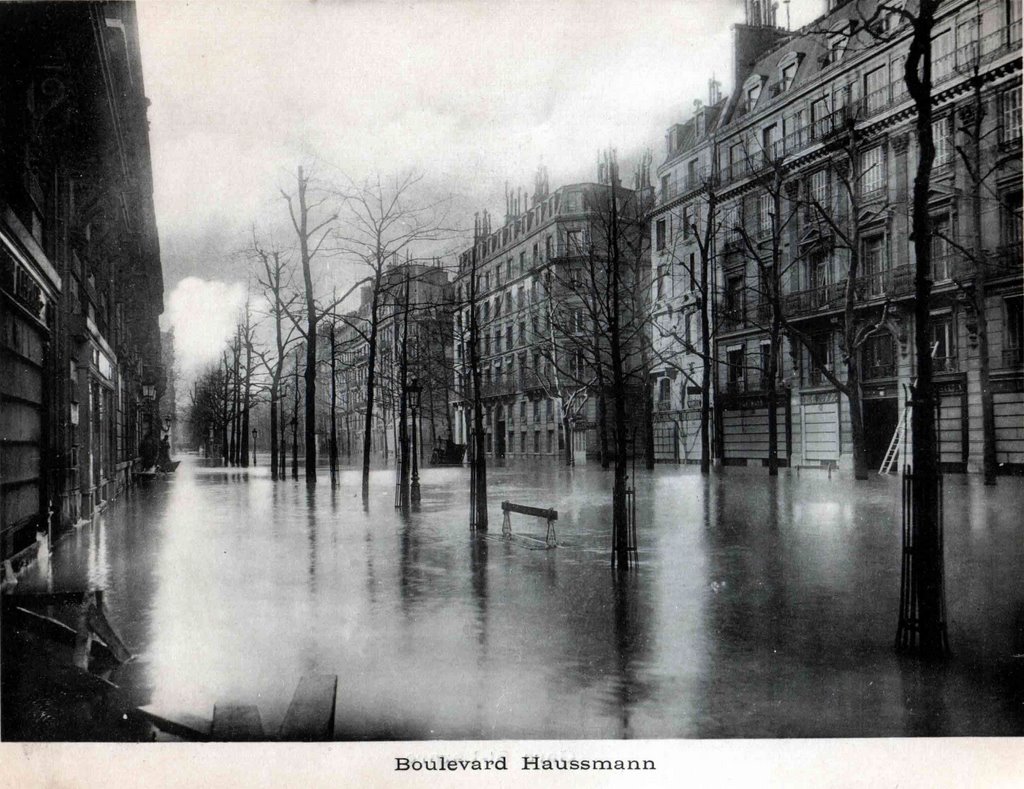
Also via Things comes an unbelievably beautiful gallery of photos of Paris during the flood of 1910.


This reminds me of Alain Resnais’ apocryphal book of photographs of locations used in the films of Louis Feuillade, which I’ve been hunting after for twenty years (along with the equally apocryphal English translation of Kircher’s Musurgia Universalis, whence comes the illustration at the top of this post). If you have a spare copy of either book, or information about whether or not they actually exist, I hope you’ll send it along, even though I can’t give you anything but love.

Speaking of Feuillade, whatever happened to the Chronophone discs made by Cyclophone for his 1909 film Les Heures? I have no idea, but my attempt to answer the question led me to a bumper crop of phonographic sites and sound archives.

The Flexible Records Project compiles labels from 1930s acetates and metal discs. Lots of gorgeous stuff, as thus:


And thus:


Little Wonder Records is another gorgeous site; it also features sound clips. Or you can visit Australian Collectors of Mechanical Musical Instruments, and listen to a variety of early gramphones and phonographs.

The Marr Sound Archives has couple of great online exhibitions: The Voices And Music Of World War I, and Musicians Local No. 627 and the Mutual Musicians Foundation.

The Internet Chinese Music Archive is…well, pretty much what it sounds like. It’ll take you a while to work your way through it. When you’re done, you can tackle the Judaica Sound Archives . Or the Berea College Appalachian Sound Archives, which offers “fiddle and banjo tunes; ballads and songs; Old Regular Baptist singing and preaching; folktales and legends; and oral history.”

If that’s too much for you, you can focus exclusively on the nyckelharpa, courtesy of The American Nyckelharpa Association.

Then again, it’s possible you’re not interested in any of this stuff. In which case, you may proceed directly to Seedtime and Harvest, a film from the Hampshire Record Office.

UPDATE: Spocko Speaks!

Thursday, January 04, 2007

We Interrupt This Program...


My pal Spocko has been doing a tremendous job of documenting the grotesque eliminationist rhetoric spouted by Melanie Morgan and Lee Rogers on San Francisco’s wingnut flagship KSFO. His approach has been perfectly reasonable, and perfectly legal: He gathers verbatim statements from these lunatics, and then contacts KSFO advertisers and asks them whether the statements reflect their brand identity.

A number of advertisers evidently feel that they don't, and have pulled their spots. As a result, Spocko has been subject to harassment and threats from KSFO’s management, and from ABC/Disney, of which KSFO is an affiliate.

Now, they’ve managed to shut his blog down, on the grounds that the audio clips Spocko posted are an infringement of copyright. It’s absurd, of course; Spocko’s use of the clips clearly falls under the Fair Use Doctrine. The station’s actions are just as vindictive, cowardly, dangerous, and stupid as the rhetoric of its hosts, and just as incapable of withstanding public scrutiny.

Accordingly, links to the audio clips have been posted at Online Blogintegrity. If it gets shut down, I think it’s safe to say that they’ll be moved to another one. In the meantime, as ¡El Gato Negro! says, “Listen to them for jourself, then, por favor, post them far and wide.”

The ABC/Disney lawyers who’ve come after Spocko are doing so because they think the benefits will outweigh the costs. Negative PR can change their calculations very quickly. So tell your friends, contact KSFO’s advertisers (politely!), and if you have a blog, spread the word.

Spocko’s also being threatened - and rightly so - by Interrobang:

[I]f he doesn't get a PayPal account so we can all start putting up links to it so we can contribute to his legal defense fund, he's going to get yelled at.
I believe I speak for all of us when I say that this is no idle threat.

(Talk-radio whirligig by William Ross.)

UPDATE: Echidne discusses Hal Turner's recent call for the assassination of U.S. politicians. In the WND story to which she links, Turner, who previously singled out federal judge Joan Lefkow as "worthy of being killed," says that "his comments are 'uttered in a context which does not lend itself to imminent lawlessness,' do not constitute a 'true threat,' and could be considered 'political hyperbole.'

Ms. Lefkow, I imagine, might feel differently.

ALSO: More on Spocko from Thers, Elroon, Juan Cole, and David (Austin TX). And many others.

The Way We Really Are


Debra J. Saunders complains that the media are making it difficult for her to bask in the warm afterglow of Saddam's execution:

Within hours of Saddam Hussein's hanging, the drumbeat began -- as cable-news sages pronounced that the Iraqi scourge's execution will not improve the situation in Iraq….These days, the first rule of war coverage is that nothing -- not even military victory -- will improve Iraq's prospects.
She has a point. We've generally been unwilling to let conservatives savor any of the hundred-odd “turning points” that they announce in the course of an average year. Why are we always harshing their buzz? Why are we forever dashing the Cup of Joy from the lips of these well-meaning people, whose wisdom is - as Ramesh Ponnaru points out - proven by their gimlet-eyed attention to the problem of “unintended consequences”?

I mean, besides the fact that they’re a pack of ineducable halfwit chatterboxes who’ve been consistently wrong about everything. Saunders and her ilk could do worse than to ponder that old AA motto, Your best thinking got you here.

Meanwhile, the appalling Georgie Anne Geyer applies her analytical skills to the orphic conundrum of Saddam’s execution:
“So what WAS the strange execution of Saddam Hussein, in the chill pre-dawn of an Iraqi morning last Saturday in Baghdad? What exactly did it mean?”
I think you’ll find her answer intriguing. Before she gets to it, though, she informs us that the Bush administration had hoped Saddam's trial would establish an Outpost of Progress, by showing that “Western legal practices could be implanted in the unrelenting sands of Iraq.”

Next, she lauds the Nuremberg trials for being internationalized, and bemoans the fact that the International Criminal Court “was too liberal for the radical-right Bush administration and its neocon supporters, there was no death penalty, and things moved much too slowly.”

She also clucks that Saddam got his “early advanced weaponry” from East Germany, neatly sidestepping the question of where he got his later advanced weaponry. This is the preamble to her account of his hanging, which she felt offered “none of the dignified lessons that the United States had hoped for” when it spurned the ICC for being socialistic bedwetters.

Part of the problem with the hanging was that the camerawork was so unprofessional:
[I]t was recorded not by Iraqi or Arab television, not by American or BBC television, and not by some neutral [!] cinematographer designated by the Iraqi government, but by someone who happened to be in the room with a cell phone camera! Has human history ever been so cursed?
No, never. Or at least, not since I got eyestrain from trying to watch scrambled porn in a Montreal hotel room.

Remember all that stuff about BushCo’s “radical-right” reasons for avoiding the ICC? Well, forget it. On reflection, Geyer decides that the United States “eschewed the idea of an international court for valid reasons.” But then again, maybe it didn’t:
All of this is, in great part, the result of our going it alone in Iraq, without the kinds of substantive allies that we had in World War II [like the UK, Georgie?] and the international structures we were then building.
So what does Saddam’s execution mean? Why, it means that that those confounded Iraqi chappies are nothing but a pack of uncivilized brutes, that’s what:
[L]ast weekend, as tired America was trying to start a new year, Old Iraq pushed in on us, saying, Hey, remember us? This is the way we really are. Did you think you could change us so quickly?
Ingrates, that's what they are. We free them from a brutal dictator, rebuild their infrastructure, give them plenty of electricity and clean water, reduce their unemployment rate, kowtow to their silly superstitions about strip-searching women, scrupulously avoid unnecessary violence, and - most important - completely abolish torture and indefinite detention. And this is how they repay us.

Almost makes you wonder why we bother, sometimes.

The Domain of Hippies


The Los Angeles Times marvels at the current popularity of solar power:

Once the domain of hippies, whose off-the-grid escape doubled as an anti-establishment rebuke, renewable energy is now a pillar of California politics.
Back in the good old days, you see, the United States had a safe, sensible, cost-effective, farsighted energy policy. Then, the hippies came along and started trying to "stick it to the Man" with outlandish ideas like solar collectors and wind power. But now, solar power has become fashionable, and all sorts of pathetic dropouts are cashing in!

[Cue the Byrds playing "Turn, Turn, Turn," so that we can more wistfully contemplate Life's Little Ironies.]

Today's solar power advocates may not dress in varicolored rags, or stink from fifteen feet away, or prattle about astrology while they scratch earnestly at the pubic lice they caught from "balling" Janis Joplin, but don't let that fool you: they're still part of the freak scene:
Curly-haired and soft-spoken, Gerber today looks the part of a steady engineer in his pressed khakis and checkered button-down shirt, four pens aligned in his front pocket. But he remains at heart a zealot, committed to renewable energy down to the solar watch on his wrist.
See, that's what troubles me. I like the idea of renewable power...but why can't its advocates be more measured and sensible, like Charles and David Koch?

The author notes that the first solar water heater was patented in 1891, and that 30 percent of the homes in Pasadena, CA had solar water heating by 1897. He doesn't mention that the first solar-heated office was built in Albuquerque in 1956, by Frank Bridgers, and remains in operation today.

So far as I know, the influence of marijuana, free love, and "acid rock" on these technological milestones was minimal. It may even be that the counterculture's desire to "rebuke" the establishment with solar power was less important, on the whole, than the establishment's desire to marginalize solar power by linking it irrevocably in the public mind with dirty fucking hippies. As Frank Bridgers' daughter says:
If a fairly average or middle income homeowner...if they don't have the feeling inside their gut that "people like me" install solar systems, it will never become widespread.
That feeling was precisely what the past few decades of hippie-baiting helped to forestall, thanks in large part to the deep pockets of oil and gas companies who'd grown fat off taxpayer subsidies.

But these minor details can't be allowed to spoil the clean, elegant lines of the LAT story. We're not to consider the influence of petrodollars on the public portrayal of solar power, any more than we're to question the seriousness of our journalists' witless obsession with what Thers calls "infantile identity politics." The important thing is that solar power and hippies go together like BBQ and beer. While it may be worthwhile to talk about how public perceptions are changing - even as you're reinforcing them - it's profitless to examine how and why they formed.

Trade Secrets


A judge has ruled that Christine Jennings, who's been vying with Republican Vern Buchanan for Katherine Harris's seat, has no right to see the source code for the electronic voting machines on which the election relied.

Circuit Judge William Gary ruled that Jennings' arguments about the possibility of lost votes were "conjecture," and didn't warrant overriding the trade secrets of the voting machine company.
The ballots in this race showed an alarming 13-percent undervote. The voting machine manufacturer, Election Systems & Software (ESS), blames the problem on "bad ballot design." Sounds a bit like conjecture, doesn't it?

Here's the actual ruling, which I find fairly bloodcurdling:
For this Court to grant Plaintiffs' motions would require this Court to find that it is reasonably necessary for the Plaintiffs to have access to the trade secrets of Defendant, Election Systems & Software, Inc., based on nothing more than speculation and conjecture, and would result in destroying or at least gutting the protections afforded those who own the trade secrets.
The "speculation and conjecture" in this case revolves around the stark physical fact of 18,000 missing votes, a fact for which there are a small number of possible explanations. It may be that electronic fraud or malfunction is the least likely of these, but then again, the other possibilities are not as serious. I think electronic voting should be done away with entirely, but at the very least, the companies that win these lucrative contracts should forfeit any right to trade-secret protection.

A lot of people think we should have open-source machines. I'd prefer them to proprietary systems, of course, but when you consider the amount of misinformation and confusion that's been sown over the expert analysis of...well, climate change data, for instance, it's not all that reassuring to imagine election results hinging on a disputation over the finer points of audit log encryption in C++.

In other news, Bruce Schneier alerts us to some problems at Ciber, Inc.:
A laboratory that has tested most of the nation's electronic voting systems has been temporarily barred from approving new machines after federal officials found that it was not following its quality-control procedures and could not document that it was conducting all the required tests.
The Pima County Democratic Party Committee on Electronic and Computerized Vote Counting Procedures and Safeguards notes:
CIBER, Inc. donated $25,000 to the Republican National Committee in 2000 and $23,000 to the Allard Victory Committee in support of Republican Wayne Allard's successful run for the U.S. Senate in Colorado in 2002. CIBER's president and CEO, Mac Slingerland, has donated over $17,000 to Republican causes in the last three election cycles.

Tuesday, January 02, 2007

The Innate Psychology of Women


What makes women so goddamn picky about the people they're willing to have sex with, even though it seems eminently reasonable that they should toss it up to anyone who wants it?

A study by Dustin Penn of the Konrad Lorenz Institute for Ethology in Austria and Ken Smith of the University of Utah offers some tantalizing hints, so long as you don't mind the fact that it's based on data pertaining to Mormon couples who got married between 1860 and 1895.

When it comes to humans, women are naturally thought to suffer fitness costs from reproduction, given the stresses of pregnancy, childbirth and breast-feeding, but evidence for whether men do has been mixed and controversial....

Penn and Smith found that having more children was linked with decreased survival for both parents, although this effect was more pronounced in women. After age 50 the number of offspring had no effect on the likelihood that fathers would die, but continued to have an impact on the mortality of mothers. This difference in cost between men and women fits with evolutionary explanations for the observation that women tend to be choosier than men when selecting mates.
That's not quite clear, since at least one of the traditional criteria for female "choosiness" (reproductive vim and vigor) seems in this case to result not only in early mortality for the mother, but a poor prognosis for her offspring:
[T]he more offspring parents had, the less likely each child was to survive to reproductive age.
I'd say that the conclusions one can draw about Womanhood from the matrimonial hazards of 19th-century Mormonism are limited at best. Nonetheless, Smith and Penn suggest that their findings "shed light on the evolution of menopause...which humans experience but chimps and many other species do not." (Click here for research on menopause in guppies, and here for information on factors potentially affecting menopause in nonhuman primates, including diet and lifespan).

As you can see, it's all very...rigorous:
"One of the other problems we've been trying to explain in human reproduction is why women all over the world have been having fewer children whenever they get access to contraception or more education," says Dr. Penn.
One might do better to study why women so often tend not to get access to these things, which is really a far more interesting question, and possibly even has some bearing on the problem that's worrying Dr. Penn.

Earlier today, I took issue with Amanda's claim that "animals are not different from us in any major way." This research is a good example of how overlooking little instances of human exceptionalism like culture, law, religion, and education complicates the "objective" study of our throbbing biological urges:
"If women bear a higher cost for reproduction than men, then this might help explain why, when they get control over their reproduction, they would have fewer children."
I find it odd that people are looking for biological theories to explain what happens when women, by some unacknowledged process, "get control over their reproduction." Perhaps we can study the puzzling flight reaction of people whose prison doors are left unlocked, while we're at it.
Intriguingly, an environment in which resources were scarce, such as that faced by preindustrial Mormons, may have placed selective pressures on the innate psychology of women that at least partly explain why birth rates are so low in modern industrialized societies.
Let me put this as politely as I can: I see no obvious reason why resource scarcity among communities in past centuries - communities that had limited access to sex education and contraception, mind you, as well as religious and social injunctions against both - should've created "selective pressures" favoring low birth rates in modern industrialized societies.

But what do I know? My brain is mostly female.

UPDATE: For those who didn't notice, the first sentence of this post was intended as a joke. It's obvious that "the stresses of pregnancy, childbirth and breast-feeding" take a greater toll on women than on men. What's less obvious is the extent to which female choice is actually permitted in a specific culture or community - most readers have heard of arranged and forced marriages, I'm sure - and the extent to which being free to choose one's mate (or let one's genes choose him) affects reproductive costs. Female parental investment sounds a bit more explanatory than it actually is, IMO.

Quite Acceptable Boundaries


New imaging techniques have allegedly pinpointed the region of the brain that allows us to imagine ourselves in the future:

"Our findings provide compelling support for the idea that memory and future thought are highly interrelated and help explain why future thought may be impossible without memories."
Speaking of which, the World Question Center recently asked Daniel Dennett what future event he felt optimistic about living to see. Imagine how surprised they must've been when he answered "the evaporation of the powerful mystique of religion."

If you're wondering how this is going to happen, or what the world will look like when it does, Dennett is happy to enlighten you:
Of course many people – perhaps a majority of people in the world – will still cling to their religion with the sort of passion that can fuel violence and other intolerant and reprehensible behavior. But the rest of the world will see this behavior for what it is, and learn to work around it until it subsides, as it surely will.
QED, motherfuckers!

If it seems like Dennett has made his work a bit lighter than it ought to be, that's probably because he feels that religious faith is a cultural phenomenon along the lines of smoking cigarettes:
Recall that only fifty years ago smoking was a high status activity and it was considered rude to ask somebody to stop smoking in one’s presence. Today we’ve learned that we shouldn’t make the mistake of trying to prohibit smoking altogether, and so we still have plenty of cigarettes and smokers, but we have certainly contained the noxious aspects within quite acceptable boundaries.
See? It's the exact same thing. In essence, fanaticism will become "uncool," as the world comes to realize that it's far preferable to dwell within "quite acceptable boundaries" per Dennett, than to believe in a god who can only be properly worshipped by overstepping - or demolishing - those boundaries.

Anticipating the reader, Dennett asks "Why am I confident that this will happen?" O ye of little faith! Obviously, you've never heard of "the asymmetry in the information explosion":
With the worldwide spread of information technology (not just the internet, but cell phones and portable radios and television), it is no longer feasible for guardians of religious traditions to protect their young from exposure to the kinds of facts (and, yes, of course, misinformation and junk of every genre) that gently, irresistibly undermine the mindsets requisite for religious fanaticism and intolerance.
Yes, thanks to the Intertubes and its handmaidens, the day is soon coming when most people won't believe stuff that isn't true anymore. Why should they, when they can simply Google the eternal verities, and download them as a podcast?

I also look forward to the day when the externalities of pornography become less worrisome. I'm thinking that the Internet could help with that, too. After all, there are lots of facts about human sexuality and women's rights online, as long as you know where to look.

I think it's fair - if not mandatory - to say that Dennett comes off here as a hypercredulous schmuck. I'm sure most of us share his holiday wish for an "avirulent" religion that exists solely to relieve suffering and poverty and injustice - one that will never be radicalized by (or collude with) state powers that have ordained suffering and poverty and injustice for a certain population, or otherwise drive its followers to "the teleological suspension of the ethical."

But some of us, unlike Dennett, can recognize this prediction as harebrained Candyland bullshit with no basis in fact or rationality. And we're accordingly troubled when it's offered up for public consumption as a "rationalist" worldview.

"Eventually," says Dennett, stroking his beard meditatively, "the truth will set us free."

Well, why not? It's always done so in the past.

(Illustration: "Christ Carrying the Cross" [1920] by Stanley Spencer.)

Saturday, December 30, 2006

Weapons of Mass Destruction


It's come to my attention that Atrios, Thers, and NYMary are trying to terrorize people with YouTube clips.

I'm in an indulgent mood tonight, so I'll let it pass...for now. However, let this serve as fair warning that I'm quite prepared to unsheathe my claws, if needs be.

Friday, December 29, 2006

Friday Nudibranch Blogging


This photo of Ceratosoma trilobatum was taken by Tanguero56; click the link to see more of his work.

Friday Hope Blogging


Peter Leyden has a prediction for 2007:

American politics is entering a transformative period that is roughly analogous to a handful of other periods in American history....What happened then, and is happening now, is that fundamental economic and social restructuring gets to the point where the old politics don’t work, particularly conservative formulas that look backward. The new world’s new challenges go unsolved, and problems build to the breaking point – then a new politics begins.
That's pretty accurate, it seems to me. I doubt the "new politics" will go quite as far in the direction of sanity or morality as I'd like, but our biggest hurdle has always been noticing - or admitting, I should say - that there's a problem. I think it's fair to say that 2006, we made some impressive progress in that regard.

I also think it’s going to be very hard to be a climate denialist in 2007, and that the collapse of this industry is going to have uncomfortable repercussions for free-market fanatics in general. These people are long overdue for the ash-heap, God knows, because…well, because they’re incredibly fucking stupid, basically. Our conservatarian overlords have held back progress for decades, largely out of ill will, but I don’t think they’re going to be able to manage it for much longer. Not because Americans are suddenly going to start hugging trees or worshipping dirt, but because we’ve reached a point where it’s become obvious even to the timid, stolid "visionaries" who make up corporate America that there’s at least as much money to be gained by solving problems as by pretending they don’t exist.

Apropos of which, the Bush administration is talking about listing the polar bear as a threatened species:
The Bush administration has decided to propose listing the polar bear as threatened under the Endangered Species Act, putting the U.S. government on record as saying that global warming could drive one of the world's most recognizable animals out of existence.
I hesitate to speculate on the logic behind this proposal, or how it might play out in terms of policy. But if it goes through, I think it’s safe to say it’ll be an epochal decision.

The same goes for Wal-Mart’s tentative plan to install solar power in stores in five states:
Wal-Mart doesn't mention a specific purchase size, but my sources tell me that the company could put solar on as many as 340 stores in the next few years. Assuming that each store utilized about 300 kilowatts of solar panels (it could be as much as 500 kilowatts), we're talking roughly 100 megawatts of solar. To put that into perspective, the solar system currently being installed at Google headquarters in California -- the largest single corporate solar installation in history -- is 1.6 MW, about 1/60th the size.
Meanwhile, the Democrats have come up with a nice way to ring in the new year:
House Democrats in the first weeks of the new Congress plan to establish a dedicated fund to promote renewable energy and conservation, using money from oil companies. 

That's only one legislative hit the oil industry is expected to take next year as a Congress run by Democrats is likely to show little sympathy to the cash-rich, high-profile business.
Let’s hope they’re serious about it, and can actually pull it off. It probably wouldn’t hurt to ask your rep to support the plan.

A new study suggests that reducing infections in intensive care units is not all that hard to do:
Hospitals will quickly slash the rate of common, costly and potentially lethal catheter-related bloodstream infections in their intensive care units (ICUs) by using cheap, low-tech, common-sense measures like hand washing, timely removal of unneeded catheters, and use of sites other than the groin to place lines when possible, according to a report from safety experts at Johns Hopkins in the Dec. 28 issue of the New England Journal of Medicine.

"There's just no reason any more not to do these relatively simple things," says Peter Pronovost, M.D., professor of medicine and medical director of Hopkins' Center for Innovation [!] in Quality Patient Care….
Amazing, eh? And remember: You heard it here first!

Wisconsin has had some luck with re-establishing the trumpeter swan:
Successful efforts to re-establish trumpeter swans in Wisconsin have resulted in a flock that last summer numbered more than 500 swans. Now these majestic, but still endangered, birds are expanding their range into the central and even southern parts of the state.
Numbers of whooping crane and ruffled grouse are also increasing.

In Washington, the Nature Conservancy sealed a deal with local farmers to flood fields for the benefit of waterfowl:
Each man has committed about 70 acres to this project, which is called Farming for Wildlife. A third of that land will be flooded with a few inches of fresh water in the spring, fall and winter. This will create shallow ponds to entice thousands of birds, some of them on their way to and from the Arctic, to stop and snack on tiny invertebrates and worms as they travel along the Pacific flyway.

The farmers see the Nature Conservancy’s willingness to pay them as an acknowledgment that they should not be expected to sacrifice their land or their living for wildlife. This approach effectively turns shorebirds into another crop to manage, instead of grounds for a lawsuit."
Also in Washington, the destruction of the Goldsborough Dam has done wonders for the salmon population:
Along the way, scientists are getting a glimpse of what can happen when a dam, albeit a small one, is demolished: As fish gradually reclaim their former habitat, Goldsborough Creek is becoming a more important source of salmon for the southern tip of Puget Sound.

Though small, this dam is a harbinger of things to come in the Northwest. Seven dams in Washington and Oregon, including two big dams on the Elwha River in Olympic National Park, are slated for demolition in the next five years.
A small village in Trinidad has managed to prevent Alcoa from siting a smelter on their farmland:
Bowing to a year of stormy protests, Prime Minister Patrick Manning said the government was scrapping plans to open an industrial park in Cap-de-Ville, in a sleepy, southeast farming region where the US$1.5 billion smelter was to have been located.
The new plan is to site the smelter offshore. But something tells me it may run into some snags:
"We have a consensus. We will protest," said Suresh Seepersad, a spokesman for the Otaheite Fishermen's Association. "As fishermen and residents of the area, we will be ready to die for this cause," he said.
Alcoa has also been obliged to shut down a polluting plant in Texas:
The consent decree stemming from the 2002 federal court lawsuit filed by Neighbors For Neighbors Inc., Environmental Defense and Public Citizen Inc. citing air pollution from Alcoa’s aging Sandow Power Plant, required Alcoa to upgrade the power plant, shut down the power plant or decommission the plant and rebuild - the option Alcoa chose....
Researchers in the UK are about to commence human testing of a universal flu vaccine. Caveat lector is my advice, but there’s no reason you can’t keep your fingers crossed. If all else fails, the town of Croydon is seeking alternative strategies for disposing of corpses:
BURIALS in unmarked graves with bio-degradable coffins may be the only way to beat pollution and a chronic lack of graveyard space in Croydon.
Southeast Asia is getting tough on wildlife poachers:
Long outgunned and outmaneuvered by smuggling gangs, the 10-member Association of Southeast Asian Nations agreed last year to form the Wildlife Enforcement Network to combat a black-market trade in plants and animals that generates $10 billion in revenue each year -- third behind illicit dealings in weapons and drugs.
Apparently, the USA has contributed $2.7 million to anti-smuggling groups. That’s good, but more would be better. In addition to being reprehensible and stupid, this trade poses a serious public health risk.

Speaking of Southeast Asia, a plant native to Ambon may be a valuable weapon against diarrhea (which, as I always feel compelled to mention, kills 1.8 million children per year):
A unique Mayo Clinic collaboration has revived the healing wisdom of Pacific Island cultures by testing a therapeutic plant extract described in a 17th century Dutch herbal text for its anti-bacterial properties. Early results show that extracts from the Atun tree effectively control bacteria that can cause diarrhea, as claimed by naturalist Georg Eberhard Rumpf, circa 1650. He documented his traditional healing methods in the book Ambonese Herbal.
Rumphius is an endlessly fascinating character, by the way, and the story of how his work was written and published is truly harrowing:
After going blind in 1670, Rumphius continued work on his six-volume manuscript with the help of others….In 1687, with the project nearing completion, the illustrations were lost in a fire. Persevering, Rumphius and his helpers first completed the book in 1690, but the ship carrying the manuscript to the Netherlands was attacked by the French and sank, forcing them to start over from a copy that had fortunately been retained. The Herbarium Amboinensis finally arrived in the Netherlands in 1696. However, "the East India Company decided that it contained so much sensitive information that it would be better not to publish it." It finally appeared in 1741, thirty-nine years after Rumphius's death.
The Ambonese Curiosity Cabinet is beautifully written and illustrated; it’s one of my favorite books of natural history.


You can get it cheap from Amazon sellers, or – sad to say – in bookstores that carry remaindered titles.

The picture at the top is titled "Solar Effect in the Clouds – Ocean" (1856). It's part of a glorious online exhibition of photographs by Gustave Le Grey. I was also very impressed, this week, with an exhibition called The Human Factor, which showcases "The Industrial Life Photograph Collection" at the Harvard Business School's Baker Library. Here's a 1934 photo of silverware being electroplated:


BibliOdyssey has made a last-minute bid for best post of the year with a collection of images of stilt walkers. Here’s an evocative sample:


Almost as remarkable as this illustration is the title of the book whence it came: Across the Great Saint Bernard: the Modes of Nature, and the Manners of Man (A.Sennett/H.Percival, 1904). That’s right up there with John Stewart’s Roll of a Tennis Ball Through the Moral World (1812).

Last, in administrative news, I've been trying to post more frequently at Injudicious Gardening, which is my online commonplace book. I've also created a blog called Dime Geography as a dumping-ground for photos I've taken while on my appointed rounds. Not much there at the moment, but I hope to do more with it in the coming year. Oh, and Abie will be glad to know that I intend to switch to the new Blogger over the weekend, which'll apparently allow me to use tags.

Saturday, December 23, 2006

Stick Figures in Peril


This photo was taken by Uh...Bob. It's part of the Stick Figures in Peril Flickr pool.

"Although affliction cometh not forth of the dust, neither doth trouble spring out of the ground; yet man is born unto trouble, as the sparks fly upward."

Friday, December 22, 2006

Friday Nudibranch Blogging


The lovers of Glossodoris cruenta are
Happy, cheerful, well-fed;
As for me, my arms are broken
Through having hugged the clouds.

(Photo by Jun Imamoto.)

Friday Hope Blogging


San Francisco and Oakland are requiring restaurants to stop using styrofoam containers:

[T]he new laws not only ban the foam but also encourage food establishments to reduce their use of all plastic in favor of materials that are biodegradable or can be composted, such as SpudWare, the trademark for cutlery made of potato-starch.
Here's hoping they'll also require restaurants to capture and use waste heat:
Take a peek inside the kitchen of any busy restaurant and you'll quickly realize there's a lot of heat being produced, and wasted. Ovens are constantly on and being opened, grills sizzle with burgers and steaks, pots boil with soups, sauces and pastas, and hot water and steam wash dishes and cutlery. Where does all that heat go? Well, it usually gets sucked up an exhaust stack and released into the air.

Meanwhile, under a separate process, natural gas is typically used to heat up municipal water and, in the winter, the fresh air coming into a restaurant through an intake vent.

"Why buy gas to heat a restaurant when thousands of dollars of that heat is sent up an exhaust stack every month?" says Jeff Martin, president of Martin Air Systems.

The Burlington entrepreneur says there's no reason for such waste – and he's proving it. For the past three years his company has retrofitted a number of restaurants around the GTA with a system that captures otherwise wasted kitchen heat and uses it to pre-heat water and restaurant air.
The batfish has apparently changed its eating habits, which is good news for coral reefs:
Scientists at the ARC Centre of Excellence for Coral Reef Studies (CoECRS) who were studying how coral reefs are lost to weed were astonished when, after removing a cage from a particularly weedy bit of reef, the rare batfishes emerged out of the blue and cleaned up most of the weed.
Most people would rather save coral reefs than parasitic flies, but the latter - amazingly enough - have their uses:
A parasitic fly may revolutionize hearing aid technology. Cornell's Chronicle reports how researchers there and elsewhere have found the Ormia ochracea fly has amazingly acute hearing, able to detect the location of a sound within two degrees. Heretofore such acuity was thought possible only in large creatures like humans, whose ears can be placed many centimeters apart, but these flies' entire bodies are smaller than the smallest hearing aids today.
The Coast Guard's plan to shoot millions of rounds of lead ammo into the Great Lakes is dead. (That'll learn 'em to go up against Interrobang.) And Boston is requiring all new large buildings to meet green building standards.

The bushmen of Botswana have won a landmark case against the Botswanan government:
Judges in Botswana ruled two-to-one that the country's government removal of thousands of bush people from their ancestral lands was illegal and unconstitutional. The government moved the bush people to another settlement, which the bush people argue was a "poverty trap"...

The ruling is seen as a wider test of whether governments can legally move people from their tribal and ancestral lands."
Inhabitat reports on FuseProject's XO computer, which is designed for technologically underprivileged children:
The device boasts a slew of streamlined features, from its Wi-Fi antenna “rabbit ears” and energy-efficient LCD to the digital writing tablet and integrated video camera. Networking capabilities allow children to connect to each other, their school, their teacher, and the Web. And if that weren’t enough, the machine runs off of power from a variety of sources- from rechargeable batteries to hand cranks, and eventually solar energy. When closed, the laptop features an integrated handle and is completely protected from dust and dirt, allowing each student to transport their laptop to and from school. Aesthetically, the XO is simple yet kid-friendly, engaging, tactile, and even anthropomorphic.
The Public Library of Science (PLoS), a nonprofit group "committed to making the world's scientific and medical literature a freely available public resource," has launched a new open-access site:
PLoS ONE will accelerate the pace of scientific research because publication is faster and more interactive than ever before. No longer need there be months of delay between submission and publication. Now there is a way to share not only the results of research but also the responses, ideas, and opinions of fellow researchers as well.
And in a rather lovely confluence of religion and reason, synagogues are using Hanukkah as a example of making the most of one's energy resources:
The central tale of the holiday involves a lamp in a liberated temple burning for eight days when the Jews had enough oil for only one day. As a result, Jews light a nine-armed candelabra, often called a hannukiah or menorah. Eight arms represent the days, and the ninth is for a symbolic candle used to light the others....

But synagogues this Hanukkah are celebrating the light-oriented holiday by launching energy audits, giving out CFL bulbs to congregants and chanting a newly written "installation prayer" for the changing of the bulbs.
Flickeur (via Coudal) is an amazing site created by Mario Klingemann, which randomly assembles "films" from images on Flickr.
Flickeur works like a looped magnetic tape where incoming images will merge with older materials and be influenced by the older recordings' magnetic memory. The virtual tape will also play and record forward and backward to create another layer of randomness. This principle will create its own sometimes very suggestive or scary story.
American Landscape and Architectural Design, 1850 – 1920 comprises 2,800 magic-lantern slides featuring “views of cities, specific buildings, parks, estates and gardens," including the Winsor McCay-esque view of San Francisco at top. Not sure how I missed this site, but I’ve been making up for lost time all week!

Vilar allows you to search a huge database of of architectural and landscape features, by century, country, and typology. If you’re looking for pictures of 16th-century French archways, this is the site for you! Unless, that is, you're bothered by high-maintenance interface and confusing navigation, in which case you should proceed directly - without passing "Go" or collecting $200 - to this gallery of postcards from the Detroit Publishing Company:

I also recommend Jim Reed's photos of "severe and unusual weather." And, via Things, this gallery of photos from the drowned village of Lago di Vagli.

Thursday, December 21, 2006

Huh?


While it's not as damning as Bill Bennett's observation that people like Al Gore are complaining about global warming while it's snowing (in the Northern hemisphere, at least), Iain Murray has detected a fairly lurid example of climate-alarmist hypocrisy:

When the Republicans controlled both houses of Congress, we heard repeatedly that Congress was blocking urgent action on global warming and that something had to be done NOW before it was too late. Now, with people who have argued that hearings on the matter were a waste of time in charge, the Pew Center on Global Climate Change simply states:
[W]e are optimistic that enactment of mandatory US climate action is plausible by 2008 and likely by 2010.
Huh? Where are the demands for action now? What can have changed to calm them down so much? It's almost as if this is merely a political issue to leverage for further electoral gain, not the crisis they've been banging on about.
One can be forgiven for assuming that "them" refers to the Pew Center on Global Climate Change, which generally takes a business-friendly, market-based approach to emissions reduction. Here's president Ellen Claussen speaking at Yale in March of 2006:
[W]e’ve seen an up-tick in Congressional interest in this issue. Granted, these proposals may not become law right away, probably not before 2008, but I believe it is only a matter of time before limits on greenhouse gas emissions are in place.
And here she is in 2004:
The United Kingdom...has set 2 goals, a near term goal of a 12.5-percent greenhouse gas emission reduction by 2012 and a longer term one for a 60-percent reduction within 50 years. The United States needs to adopt something similar....
I'm nitpicking, of course. The larger question is, if climate change alarmism truly provides effective "leverage for further electorial gain," then why on earth would these wild-eyed one-worlders ever stop "banging on about" it? You'd think they'd be emboldened to ramp up the rhetoric in hopes of bigger and better victories.

In Murray's defense, it's quite possible that he's stupid enough to be arguing in good faith. The denialists I find really disturbing are the ones who choose to present themselves to the world as blithering nitwits.

Blood and Bravery


Jack Valenti, that rather…excitable gentleman who formerly headed the Motion Picture Association of America, explains how he taught his son about the importance of military sacrifice. He took the lad to Omaha Beach, and delivered himself of this speech:

"John, I want you to know why I brought you here." He looked puzzled. I said, "I wanted you to understand that these boys, who never knew you, nonetheless gave you the greatest gift one human can give another. They gave you the gift of freedom. They bought and paid for that gift in blood and bravery. They made it possible for you and millions like you to never have to test your own courage to see how you would react when the dagger is at the nation's belly and death stares you right in the face. You owe them a debt you will never be able to repay."
You might think that this story would end with the fruit of Valenti’s loins joining the service and going boldly forth to fight the Hun. But the reality’s a bit more drab:
We never spoke about this again until one day years later, he phoned me. "Dad, last night I saw Saving Private Ryan. You were right. They never turned back, not a one. They kept coming." His voice trembled as he spoke.

Somehow, my own voice cracked a bit with gratitude. My son remembered.
In other words, Valenti went to all the trouble and expense of traveling to Normandy in order to give his kid a deeper appreciation of a Spielberg movie.

Having demonstrated these bona fides, Valenti asks, "Does the next generation value the sacrifice of war?"

I guess we'll have to wait and see how choked up they get during Live Free or Die Hard.

Incidentally, John Valenti had a brief career as an actor. His most notable accomplishment was playing his father in the film Path to War, which was about the Johnson administration’s decision to escalate the Vietnam War.

The Best and the Brightest


In a mid-year budget review, Australia’s treasurer announces that his drought-stricken country’s economy will thrive next year, as long as it rains:

The new spending included $300 million for projects which Mr Costello refused to reveal, and more than $1 billion for drought relief. He warned that this figure would balloon if the drought continued.
Canada’s public safety minister has been instructed to remove comments from his website that made fun of the science behind global warming:
The controversy coincides with new signals from Prime Minister Stephen Harper that the government plans to boost its environmental policies and overall plan to fight climate change and air pollution. Harper has spent the past few days insisting in a series of interviews he believes it's time to act to stop global warming because of mounting evidence that the climate is changing.
Meanwhile, two of India’s islands seem to be missing:
Official records list 102 islands in Indian Territory, but scientists examining satellite imagery now say two have disappeared and a dozen more could go under. The Sunderbans are a natural buffer shielding millions from storms and tidal waves whipped up in the Bay of Bengal.
In the South Pacific, the Carteret Islands are facing the same fate:
“We have no cars and no factories and no aeroplanes,” says Bernard Tubin, a leader on the island of Piul. “We are the victims of this greenhouse-gas emission and we are totally innocent. America sends someone to the Moon, wars are being fought and millions are being spent on warheads and ammunition. So why is it that Russia and the US and Japan and Australia cannot do anything to help us?”
In China, officials have been colluding with mine bosses to overlook safety violations:
Investigations of the deadliest mine accidents last year found that many were due to the failure of officials to enforce safety standards, Li said. He said some took bribes or illegally owned shares in mines they were supposed to regulate.
And in South Korea, official have been colluding with developers to falsify water-safety reports:
Water quality test labs and underground water developers stand accused of conspiring to fake test results and providing polluted water to 1,410 nurseries and schools nationwide.
In India, children’s toys are manufactured with scrap plastic containing high levels of lead and cadmium:
India does not have any enforceable standards for lead, cadmium and other toxic materials in toys and hitherto soft PVC toys have not been investigated as one of the possible sources of these metals’ exposure to children. These soft toys, the study says, account for 35 per cent of the total production of India’s toys.
U.S. policies ostensibly intended to help family farms are helping to destroy them:
[O]wners of large farms receive the largest share of government subsidies. They often use the money to acquire more land, pushing aside small and medium-size farms as well as young farmers starting out.
Furthermore, the FDA intends to close laboratories charged with protecting the public against intentional and accidental food contamination:
The U.S. Food and Drug Administration is planning to close as many as half of its laboratories across the country, despite pending appropriation increases to expand this lab network to fight bio-terrorist attacks on our food supplies, according to documents released today by Public Employees for Environmental Responsibility (PEER).
In other news, shocking new photos indicate another Miss USA contestant may be a drunken whore. The question now raging is whether America can stand the strain of ongoing suggestive behavior among its sexually commodified young women.

Also, President Bush would like you to go shopping more.

Wednesday, December 20, 2006

Stabbed in the Back!


As you can see, PZ Myers has let the cat out of the bag.

Granted, he didn't plot the sparse matrices of Levinasian/Derridean Otherness, or situate this inscription properly on the Body Without Organs, but the damage is done.

Obviously, we're going to have to move to Plan B (and I'm not talking about the drug we use to murder babies and encourage worry-free sexual experimentation among teenagers).

In the meantime, let's hope Comrade Myers is working diligently on his self-criticism.

Tuesday, December 19, 2006

The Flea's Waltz


From the anti-Parnassus of his padded cell at WND headquarters, Bob Unruh is proposing that “separation of church and state” should be reinterpreted to mean that federal courts can't rule on cases relating to the separation of church and state. This is in support of a bit of grandstanding by the Louisiana state legislature, which recently issued this toothless challenge to federal lawmakers:

Whereas, the Louisiana Legislature recognizes that this is the season to give gifts and be charitable and an integral part of the season is the inclusion and acknowledgment of Jesus Christ, therefore, be it resolved that the Legislature of Louisiana memorializes the Congress of the United States to adopt the Constitution Restoration Act, thereby reducing the caseload of our federal courts by removing from their jurisdiction any and all cases involving the acknowledgment of God as the sovereign source of law, liberty, or government as authorized by Article III, Section 2, of the United States Constitution.
Aficionados of nightmare illogic, preening pharisaism, and low-grade delirium may want to read the full document. Here’s my favorite part:
WHEREAS, Chief Justice Rehnquist in the Texas case referred to the duplicity of the United States Supreme Court in telling local governments in America that they may not display the Ten Commandments in public buildings in their communities while at the same time allowing these same Ten Commandments to be presented on these specific places on the building housing the United States Supreme Court stating, "Since 1935, Moses has stood holding two tablets that reveal portions of the Ten Commandments written in Hebrew, among other lawgivers in the south frieze.
The “other lawgivers” on the south frieze include heathens like Confucius, Solon, and Draco, all of whom are wailing in Hell as we speak. And the north frieze includes – wait for it – the archfiend Mohammed. If any state courthouses want to follow the Supreme Court’s lead in this regard, it's no skin off my nose.

Most of Unruh's article simply transcribes a somniloquy by retired judge Darrell White, which climaxes in this rapturous kerygma:
"Wouldn't it be like God for Hillary Clinton to grab onto this and say, 'I can get some mileage out of this,' or have Obama whatever-his-name-is say, 'I'm going to do this,'" White told WND.
Yes, that’s just what we're missing in this country: a truly bipartisan commitment to idolatry, cynicism, narcissism, and faux-spiritual busywork. (Well, that and a return to sensible names for colored folk, like "Rufus Rastus Johnson Brown.")

Now, let's put aside all this foolishness, and consider the delicate science of flea-training, as set forth by a nineteenth-century adept:
They are placed in a reversed position to each other - one looking one way, the other another way. Thus tied, they are placed in a sort of arena on the top of the musical box; at one end of the box sits an orchestra composed of fleas, each tied to its seat, and having the resemblance of some musical instrument tied on the foremost of their legs.

The box is made to play, the exhibitor touches each of the musicians with a bit of stick, and they all begin waving their hands about, as performing an elaborate piece of music. The fleas tied to the gold paper feel the jarring of the box below them, and begin to run round and round as fast as their little legs will carry them.

This is called the Flea's Waltz.

My Appointed Rounds


Arms Control Wonk demolishes the DSB Task Force report on nuclear capabilities, and erects a veritable palace of snark in its place:

Concerned citizens should be aware, the authors warn, of “an entrenched set of views held by an influential segment of the U.S. population” ... crazy views like …
  • smaller, less alert forces would be good;
  • US emphasis on nuclear weapons might encourage proliferation;
  • nonproliferation is more important than deterrence after the end of the Cold War;
  • nuclear weapons should only be used to deter other nuclear threats; and
  • that new nuclear weapons might just generally be a bad idea.
At WhirledView, Cheryl Rofer dissects the “existential threat” of nuclear terrorism:
Al-Qaeda and similar organizations have the motivation, but they have so far not managed to motivate weapons designers, experienced or incipient. Some may be disaffected, but those who have worked on nuclear weapons understand well the gravity of their special knowledge. Those who have this kind of expertise outside the weapons community are able to hold good jobs, integrated into their societies. There are always a small number of criminals and sociopaths, and recent unhappiness at the weapons labs suggests that some susceptible people might be turned. Recruitment would have to be underground, through contacts that al-Qaeda probably doesn’t have.
Effect Measure discusses the death sentence in the case of the Tripoli Six:
Science and justice have been on trial in Libya and both have lost. Today a Libyan court again condemned five Bulgarian nurses and a Palestinian doctor to death by firing squad after a retrial widely seen as unfair because it excluded exculpatory scientific evidence….
If I were to say that this Libyan court comprises subhuman vermin who ought to be boiled in their own fat, I probably wouldn’t get many complaints from the guardians of our discourse. But when David Roberts suggests a Nuremberg-style trial for climate denialists – who also have a certain hostility to science, and a certain disregard for human life - it’s an intolerable breach of civility. Thers explains why:
To grasp the full meaning of a particular "bad" expression in a particular utterance of same, what matters is the position of the speaker within the wider linguistic marketplace, a space of competing interests and valences. Which I know sounds like dirty water being squirted from an old rubber ball. But still.

[…]

Pierre Bourdieu argues that the struggle within any specific social field is to establish the dominant definition of legitimate discourse. And he's right, motherfuckers.
Speaking of competing interests and valences, Subtopia’s discussion of “Baghdad’s guillotined real estate” includes a map that has to be seen to be believed.

And with that in mind, here’s Echidne on valuing human life:
[O]ur willingness to spend money to prevent deaths is much greater when we have some knowledge of the person or persons saved. This knowledge makes the case real and the urgency greater. A similar thing happens with those who are dying in Iraq. As long as they are just numbers the deaths don't really hit us deeply. But once we are given names and other details (an old man, a child, a pregnant woman) we become more concerned.

Though all this may be natural, it can mean bad ways of spending our prevention dollars. But then it is linked to another silly thing we humans do: Not giving much credit to those who prevented catastrophes from happening while praising and adulating those who make a mess of the prevention but manage to control the catastrophe at the last minute.
(Photo at top depicts Bolivia's North Yungas Road - one of the most dangerous roads in the world. Via Things.)