Thursday, September 07, 2006

A Ticking Time Bomb


A new study details the symbiosis between the U.S. government and terrorists:

"This public panic benefits the terrorists whose work is made easier by an overactive government response that magnifies their efforts. In an odd way this puts the government and the terrorists in league with one another," he said. "The main loser, alas, is the terrified public."
Meanwhile, Republicans continue to block legislation that would secure chemical plants, despite the fact that as Amy Smithson of the Center for Security and International Studies says, "One of the hallmarks of al-Qaida is that they will use our infrastructure against us."

This is what James Inhofe (R-OK) sneeringly refers to as the security argument. In the looking-glass world of conservatarianism, wiretapping citizens without oversight is necessary because it might prevent a devastating attack, but enforcing chemical plant security is an intolerable infringement of fundamental American liberties.

As usual, the solutions of Sensible Technocrats tend towards appeasement. For instance, here's Daniel Prieto, director of the Reform Institute's Homeland Security Center in Washington, DC:
Let's say we'd offered $3 billion in breaks to companies so that they made decisions that protected major metropolitan areas from chemical attack. That's not a substantial amount of money, compared to our military budget, but it takes care of a major threat.
True enough (as long as the threat is actually taken care of, instead of getting defined out of existence, or wallpapered over with pseudopatriotic PR boilerplate). The problem is, you shouldn't have to bribe American companies to make decisions that protect major metropolitan areas. Industries shouldn't be rewarded for clinging to shortsighted, antisocial behavior that effectively holds our cities hostage.

Joke about having a chemical weapon while you're in an airport line, and you'll find yourself in jail. Site a chemical plant in a densely populated area, and you can use it to extort "offers" from the taxpayers whose lives you're endangering. Perhaps it's unconscionably brutal of me, but my approach would be "Fix these problems immediately, or we'll revoke your corporate charter, use your assets to secure the facility, and then auction it off to your competitors."

Who could possibly oppose that idea, save for people who want the terrorists to kill us all?

Wednesday, September 06, 2006

Similia Similibus Curentur


I've always been rather skeptical about the practice and theory of mitigation banking, which aims to offset the destructive effects of paving over wetlands by creating or protecting wetlands elsewhere.

Now, a study of 12 mitigation projects in Ohio confirms that mitigation banking is fast becoming natural capitalism's version of homeopathy:

[T]he study found that the failing banks not only fell short of Ohio's more scientifically advanced wetland assessments, they also fell short -- by large margins -- of the performance standards the Army Corps of Engineers and federal EPA had set for them.
The "scientifically advanced" assessment is that there's something more to wetlands than water and dirt; unless a site performs the actual function of wetlands, it can't be considered a replacement for wetlands. The more pragmatic view is that creating a couple of glorified puddles will let you develop marshlands that were previously off-limits, while enhancing your public image as "a company that cares."

See if you can guess which side wins most of the arguments.

Not that there've been all that many arguments, given the perfectly rational self-interest of the parties involved:
President of the National Mitigation Banking Association Craig Denisoff says, "we'd like to see higher ecological standards and adaptive management but we build what we're asked to build."
Isn't it amazing how often the liberating power of the free market turns people into mere automata?

Just as the solution to the destruction of wetlands is more destruction of wetlands, the solution to the failure of mitigation banking is more mitigation banking:
To increase the odds of mitigation banks' success, most agree, the Army Corps and federal EPA need to take a more intensified watershed approach to mitigation so that wetlands remain where they are needed most. More rigorous performance standards that remain flexible enough to reflect emerging scientific knowledge should be established. And more regulators – preferably scientists who understand wetland ecology as opposed to agency bureaucrats who understand numbers – should consistently and scientifically monitor banks' status at creating wetlands.
No argument here. But the thing is, if you had these factors in place - if it were possible to put them in place, given crony capitalism's appetite for malignant growth - there'd be a lot less need for mitigation banking. This is the same Army Corps and EPA, remember, whose lax oversight contributed greatly to the problem that mitigation banks are now supposed to fix under the watchful eye of the Army Corps and EPA.

While we're waiting breathlessly for "more rigorous performance standards," I've got a "no net loss" solution to the problem of Devil's Night arson in Detroit: we let the arsonists burn down as many inner-city houses as they want, as long as they build the same amount of housing on the edge of town, using old packing crates, tarpaper, and carpet remnants.

Tuesday, September 05, 2006

Universal Wolf, Universal Prey


Hooray for accountability:

The Bush administration has declared itself immune from whistleblower protections for federal workers under the Clean Water Act, according to legal documents released today by Public Employees for Environmental Responsibility (PEER)….The opinion invoked the ancient doctrine of sovereign immunity which is based on the old English legal maxim that “The King Can Do No Wrong.” It is an absolute defense to any legal action unless the “sovereign” consents to be sued.
One might say that the whistleblower’s right to sue ends where the sovereign’s right not to be sued begins. Except that as PEER notes, "The opinion and the ruling reverse nearly two decades of precedent" regarding the government's waiver of sovereign immunity in such cases.
“The Bush administration is engineering the stealth repeal of whistleblower protections,” stated PEER General Counsel Richard Condit, who had won several of the earlier cases applying environmental whistleblower protections to federal specialists. “The use of an unpublished opinion to change official interpretations is a giant step backward to the days of the secret Star Chamber.”
BushCo's self-protective logic here is basically that of Mark Steyn and his cowardly ilk: security is infinitely more important than the law. The difference is that we’re talking about the security of corrupt officials and their polluting cronies, rather than that of the public.

Either way, though, the kind of security sought by the cowardly and corrupt is impossibly expensive; no amount of sacrifice or violence can ensure it, just as no amount of money can buy you a throne at God’s right hand. The bucket has a hole in it.

In its hostility to anything that threatens its own security, the Bush administration is like Shakespeare’s universal wolf, whose universal prey inevitably includes itself. In its attacks on the law, it attacks what little remains of what little legitimacy it had. The closer it comes to absolute power, the more it’s threatened by the specter of absolute resistance.

In other words, it’s frightened of its own shadow, which it can only destroy by destroying itself. This is a traditional apotheosis for those who, to quote Ernst Bloch, “sooner desire death than insight into their own contradictions.”

Friday, September 01, 2006

Friday Nudibranch Blogging


Ceratosoma sinuata "can change the shape of her body as she pleases, giving extraordinary appearances to her size: sometimes she will dwindle to a small, thing, shriveled object, at other times she will swell to huge proportions. At one minute she will be tall enough to reach the sky, then contract to dwarfish dimensions.

"She is believed to be able to bring down the heavens, hang up the earth, solidify springs of water, melt mountains, lift ships into the air, bring low the gods, put out the stars, and light up the underworld."

(Photo by Jun Imamoto.)

Friday Hope Blogging


A couple of weeks ago, I discussed a biomimetic building based on termite mounds. This week, the Guardian has an entire article on biomimesis. It discusses wind turbines based on sycamore seeds, and a low-energy desalinization plant based on the habits of the Namibian fog-basking beetle, which can double as an open-air theatre (the plant, not the beetle). This design has other applications, too:

The idea has been used in three commercial greenhouses in the Middle East to grow food using salt water. Seawater cools and humidifies the air in the greenhouse and sunlight distils fresh water.
Speaking of greenhouses, Tom Philpott explores the possibility of using Terry Carroll's passive-solar greenhouse design to grow vegetables year-round, which, in addition to improving the availability of local produce in winter, could help to cut food transportation costs:
Known as "passive-solar design," Carroll's work involves building greenhouses directly into south-facing hillsides. Along the rear wall -- backed by a hillside's robust insulating power -- Carroll packs steel drums filled with water. As the sun streams in by day in the winter months, those drums store heat, which is released as temperatures fall at night.

Carroll's test projects have proved that his design can support vegetable production all winter, with little or no fossil-fuel energy burned and no costly solar panels.
There are obstacles to the widespread adoption of this technique, but as Philpott notes, there's no reason to believe they can't be overcome.

Many students in the developing world can't afford textbooks, even when publishers reduce the price. Here's a logical solution:
To make education more accessible, a professor in the University of Georgia Terry College of Business is spearheading an effort to produce free online textbooks using a modified version of the Wiki software that powers the Web site Wikipedia....

Through what he's dubbed, "The Global Text Project," Watson and an international team of professors aim to create a free library of 1,000 electronic textbooks covering subjects typically encountered during the first two years of college. A prototype text is already complete, and work is underway on the first book in the series.
California has passed a landmark emissions bill. As usual, "business leaders" complain that it will cripple the economy. Not to be outdone, the CEI shrieks that California has voted "to join the Third World." These adherents of the conservative precautionary principle have predicted economic devastation more times than we've turned the corner in Iraq, but their dire scenarios have a tendency not to materialize. It's odd how the people who slavishly worship market forces seem to have absolutely no faith in American industry's ability to generate innovative ideas or adapt to changing circumstances.

Wal-Mart wants to sell each of its 100 million regular customers at least one compact fluorescent bulb. The energy (and PR) benefits are obvious, but Treehugger explains what makes this decision so remarkable:
Wal-Mart's push into swirls won't just help consumers and the environment; it will shatter a business -- its own lightbulb business, and that of every lightbulb manufacturer. Because swirls last so long, every one that's sold represents the loss of 6 or 8 or 10 incandescent bulb sales. Swirls will remake the lightbulb industry--dominated by familiar names GE, Philips, Sylvania--the way digital-music downloads have remade selling albums on CD, the way digital cameras revolutionized selling film and envelopes of snapshots. CFLs are a classic example of creative destruction.
Disposable chopsticks, by contrast, are an example of destructive creation. Japan's chopsticks come from China's forests, or what's left of them. In November, Chinese exporters imposed a 30-percent tax on importers, due in part to China's deforestation crisis. Amazingly enough, Japanese restaurants are responding by switching to reusable chopsticks, which also reduces the amount of garbage. (Japan previously ran through about 26 billion pairs of disposable chopsticks per year.) For its part, China will be able to use its wood and bamboo in more sensible ways.

Japan's Sharp Corporation, which is the world's biggest manufacturer of solar cells, sees the price of solar power generation dropping fifty percent by 2010. That'll be welcome news for Adelaide, which hopes to become Australia's first solar city:
Mr Howard said the Federal Government would provide $15 million for the trial project which would involve installing solar panels and smart electricity metres in about 1700 homes in Adelaide's northern suburbs. The trial would save about $5 million in energy costs and cut greenhouse gas emissions by 30,000 tonnes each year.
While Western cities debate solar power, Chinese nomads are embracing it:
Sitkan and her husband were called to a meeting where 100 villagers waiting for a transmission line learned of an alternative to burning coal. After government subsidies, 500 yuan - a tenth of what Sitkan makes each year selling sheep's wool and meat - buys a photovoltaic solar unit that would provide enough electricity to power a small heater, a radio, a television, or a couple of light bulbs.
Most of these nomads have never had electricity in their lives.

You can now offset the impact of your own nomadicism by making a donation when you book trips through Travelocity or Expedia. Travelocity has formed a partnership with Go Zero, which reportedly estimates that planting two trees "compensates for a trip that includes air travel, one night in a hotel and a rental car for one person." Without doing the math, that sounds pretty dubious. Still, there's nothing wrong with aiding reforestation. Expedia favors TerraPass, which uses donations to fund clean-energy projects.

Who among us does not love selective catalytic reduction?
From a remote site in the heart of Bavaria, in southern Germany, the modest Solnhofen cement plant is a model for reducing pollution. Once a dirty industrial facility, the plant has dramatically slashed lung-scarring emissions with a cutting-edge technology that converts pollutants into water vapor.
The plant reportedly reduces ozone-forming emissions by almost 70 percent, and may soon be used to reduce emissions at three disastrous cement kilns in Texas.

A marketing group called the Future Laboratory proclaims that "overconsumption is no longer a signal of success," and predicts a new age of "conspicuous abstention." I'm not particularly impressed by this sort of trendwatching triumphalism, but it's interesting to read about how they came to this conclusion.

Sixteen endangered bird species were saved from extinction in the 1990s:
Scientists say the rebounds in populations of the Norfolk Island green parrot, the Mauritius parakeet, and 14 other species show there's hope of slowing the trend toward human-caused bird extinctions.
Apropos of which, I mentioned the destruction of the dam at southern California's Bolsa Chico wetlands last week. It turns out that the wetlands - which were previously slated to be destroyed by an oceanfront development comprising thousands of homes - will increase the habitat for a number of rare birds:
The wetlands already are home to roughly 200 species of birds, including threatened ones, such as the California least tern and the light-footed clapper rail.
In other conservation news:
An article in the September 2006 issue of BioScience...provides some rare good news for conservation biologists. Authors L. J. Gorenflo and Katrina Brandon used GIS (geographic information system) technology to study some 4,000 "gap" locations worldwide identified in previous research as harboring animals vulnerable to extinction yet unprotected by conservation regulations. Gorenflo and Brandon concluded that many of the gaps, which tend to occur disproportionately in the tropics, on islands, and in mountains, are locations where conservation measures appear feasible, because they include large tracts of conservation-compatible habitat and have a sparse human population, yet are not attractive for agriculture. Most of the gap locations did not feature high levels of threat from humans.
Today is a good day in Delaware, where the state has started fining trucks and buses for extended idling; evidently, months of surging gas prices weren't sufficient to end the practice. In another victory for common sense, Del Laboratories is removing dibutyl phthalate from its cosmetics, perhaps out of fear that the spectre of genital shrinkage would detract from their allure. The company's also removing toluene and formaldehyde from its products (which means they put a total of three daggers in Alan Caruba's black heart).

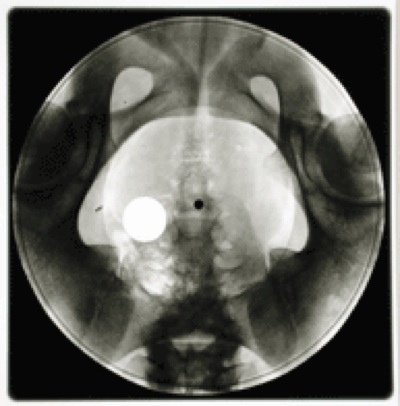
Now, let's talk about x-rays. I've been fascinated for years by Russian music bootleggers' early use of old x-ray sheets as blank discs for recording phonographs. Finally, thanks to Street Use, I can actually see some of the discs.
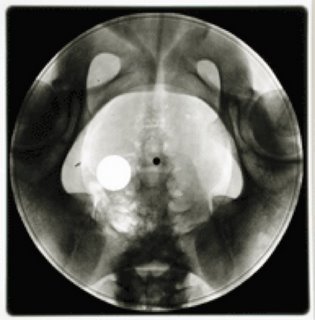
The article's brief evocation of roentgenizdat - or the "x-ray press" - is fascinating, too. (There's more here.) In an odd symmetry, by the way, x-ray technicians discovered in 2000 that "two sections cut from a vinyl long-playing record can form a spherical aberration-free refractive lens for hard X-rays." Now you know!

Click here to see that 1962 masterpiece of cineradiography, "Why did Ken set the soggy net on top of his deck?"

Back in January of 2005, I posted an unsettling "x-ray" of Betty Boop's skeleton by Michael Paulus. Now, a Korean artist has disinterred the skeletons of your favorite cartoon characters. Take off your hat, friend, for here are the mortal remains of Bugs Bunny (Lepus animatus):


X-Rays of Sword Swallowers wins this week's award for truth in advertising. It offers "the most complete set of x-rays of Sword Swallowers of the past and present." They're all here, from Petur Pokus to The Mighty Ajax. Please don't try this at home, unless you've got nothing better to do.

(Top illustration: "The Dispersal of Maple, Lime, Sycamore and Hornbeam Seeds" by Amanda Willoughby.)
Thursday, August 31, 2006

A Machine That Goes Of Itself


Bush's new budget slashes funding for the EPA's technical libraries. Accordingly, the EPA has already begun what it calls "deaccessioning procedures," despite the fact that Congress has not yet acted on the FY 2007 budget.

The U.S. Environmental Protection Agency is moving ahead this summer to shut down libraries, end public access to research materials and box up unique collections on the assumption that Congress will not reverse President Bush’s proposed budget reductions, according to agency documents released today by Public Employees for Environmental Responsibility (PEER).
I'm reminded of Philip K. Dick's Counter-Clock World, in which the purpose of the library is to subtract from the sum total of human knowledge; it gathers information only to destroy it.

We all know that Bush prattles incessantly about freedom while taking drastic steps to restrict access to information. As rational people - and I don't mean that as a compliment, necessarily - we see this as hypocritical and dishonest. Maybe it isn't, though, or at least not entirely. Freedom from responsibility can seem very attractive indeed, and knowledge does have a way of imposing responsibility. (Adam and Eve found this out the hard way, or so I'm told.) The real problem may be that Bush and his followers are pursuing a more radical type of freedom than many of us can imagine wanting, let alone having: the freedom to act in accordance with desire and nothing else.

From its disdain for the law, to its love of rhetorical and literal violence, to its apoplectic outrage over "political correctness," modern conservatism seems like a case of self-actualization gone berserk. If you harbor racist feelings, its logic goes, you should be able to express them freely, and have them accepted as legitimate (or possibly even "scientific"). If you want to nuke Mecca - as all true patriots do - why should other people's facts or knowledge or doubts stop you from doing what comes naturally?

What's important is having the freedom to be yourself (assuming, of course, that you're not gay). To thine own self be true...even, or especially, if thine own self happens to be a willfully ignorant, world-hating bully by any reasonable person's standards.

After all, who's more qualified to save Western civilization than the people who view its everyday injunctions against viciousness, violence, selfishness, and bigotry as an insufferable tyranny?

The Bush Cult offers emotional relief to conservatarian sociopaths in much the same way that the Internets offer it to racists, Aldo Nova fans, and victims of obscure diseases: it says you are not alone. It's no wonder that one of the main things conservatives utterly reject (for themselves, at least) is shame. They want to go back to a sort of Eden, it seems, where no one will realize that they're naked.

We tend to assume that these people's antisocial behavior is oriented towards conventional goals (e.g., making money), instead of being a machine that goes of itself. "Bush does X because he wants Y," or so the story goes. When you believe this, you're liable to think that if you could somehow make Bush understand that doing X is not the best way of achieving Y, he might change his mind.

But what if Bush does X for the sheer pleasure of doing X? What if his desire is simply to act, just to prove that he can?

George Will, unsurprisingly, has already embraced this pathology:
If geologists were to decide that there were only three thimbles of oil beneath area 1002 [in ANWR], there would still be something to be said for going down to get them, just to prove that this nation cannot be forever paralyzed by people wielding environmentalism as a cover for collectivism.
It's not just the money, in other words, and it's not just the oil. Perhaps it was, at one point, but what matters more is the principle that powerful people must demonstrate their power. Whether or not the demonstration makes any sense whatsoever is beside the point.

It's not much of a stretch to imagine a similar logic guiding the decision to attack Iran: it's worth doing even if the world goes up in flames, because the alternative is to let someone or something else be the "decider."

Which begs this question: How do you go about opposing a war that is made more likely by the fact that you oppose it?

I'm afraid I've strayed from the deaccessioning procedures of the EPA's technical libraries. The main issue here is that enforcement arm of the EPA uses information in the libraries to prosecute polluters; there's reasonable concern that important information may get permanently "lost" during deaccessioning, allowing lucky or well-connected criminals to go free. Another concern, which ties in somewhat with my previous ravings, is that deaccessioning is an attempt to wipe clean the EPA's institutional memory; it's the bureacratic equivalent of shock treatment.

There's money at stake here, and there are cronies to protect; these are the engines that traditionally drive politics, so perhaps there's no reason to look elsewhere for explanations. But BushCo's attacks on knowledge seem a bit too reckless, and go a bit too far beyond what's "necessary," for me to believe that it's all just a matter of corrupt pragmatism. They do these things because they want to, and to prove that they can.

Multisourced


Defense Tech has a mindbloggling article on the process by which mobile biological weapons labs became a plausible part of Saddam's alleged doomsday arsenal.

It's worth reading in full, with all the links, but the gist is that then-UNSCOM inspector Scott Ritter floated the mobile-lab idea to Ahmed Chalabi in 1998, as a possible explanation for why UNSCOM couldn't find Saddam's fabled weapons cache. Not long after, Chalabi's worthy constituent "Curveball" began prattling about BW trucks to German intelligence, who dutifully passed the information to the CIA.

In September of 2001, the United States actually created a prototype mobile lab, either as a proof of the mobile-lab concept or in order to train troops (or both):

In July 2003, there were three press reports about a truck platform that Dr. Steven Hatfill arranged to have constructed towards the end of 2001 under government contract at A.F.W. Fabrication, a metalworking plant in Frederick, Maryland. These reports describe this project as a contract to SAIC, the Science Applications International Corporation, by the Defense Threat Reduction Agency, US Department of Defense, for the US Special Forces Command at Fort Bragg, North Carolina. It was supposedly intended for use in training members of the Delta Force.
If the name Steven Hatfill sounds familiar, it's because John Ashcroft named him a person of interest in the 2001 anthrax mailings.

Here's what happened next:
The agency develops graphics drawn by a U.S. contractor based on Curveball's story and might have known of the mock-up BW lab built for SOCOM, both of which "confirms" the concept that Iraqi mobile BW labs exist, which leads to SecState Powell's speech at the UN in February 2003 and the media's echo chamber agreeing with the president that there's enough evidence to go to war against Iraq.
This, apparently, is what Colin Powell meant when he said that the information on Iraq's mobile labs had been multisourced.

Wednesday, August 30, 2006

A Reassurance and a Warning


Maggie Gallagher is upset about plummeting birth rates "in virtually every free, democratic and affluent nation on this earth," which she says is "perhaps the biggest story of our time":

As European demographer Francesco Billari has explained, at the European average of 1.5 children per woman, the population will be cut in half every 65 years. At a birthrate of 1.3 children per woman, (think Austria, Italy, Spain, as well as Greece and Japan), the population will be cut in half every 32 years.
That is to say, the replacement population will be cut in half (as long as you don't take immigration trends or fluctuations in fertility rates or any other variables into account). Mark Steyn uses similarly misleading verbiage, which I suspect is not an accident.

What's the cause? Well, Gallagher sees everything she dislikes as stemming from a rejection of traditional morality (without ever considering whether traditional morality is actually moral or, for that matter, traditional). And this issue is no exception. Gallagher's lachrymose brand of anti-feminism rejects any consideration of financial and political pressures, even though the Newsweek article she wishes to deconstruct plainly states that couples without children have "higher spending power," and that women are effectively punished for having children in many "free, democratic, and affluent" countries:
In Japan....Child care is expensive, men don't help out, and some companies strongly discourage mothers from returning to work.
In other words, some Japanese women are declining to turn themselves into baby-factories for the good of their society, because their society treats them badly.

Isn't it terrible how selfish modern women can be?

Gallagher tries to pretend that Newsweek is exalting childlessness, which isn't the case at all. Actually, the article is fairly daft and regressive in its own right, as thus:
In Japan, the trend toward postponing or not having children has given rise to an array of products like bedding supplier Kameo's Boyfriend Arm Pillow....
Makes sense to me. After all, if you don't wish or can't afford to have children, how could you possibly have a boyfriend or a husband? Newsweek also reports that these shrewish, willfully barren quasi-women present an unprecedented opportunity for businesses that cater to people with pets (because as everyone knows, people who have children don't keep pets, and vice versa).

So what makes declining fertility rates the biggest story of our time, you ask? To answer, Gallagher turns off the lights, holds a flashlight under her chin, and assumes a suitably sepulchral tone:
Death. Death of the individual, and of his or her family. Death of the nation, tribe or culture that adopts a set of beliefs, practices and institutional arrangements that fail to respect and support generativity.
Or, as Heinrich Himmler once observed, “A people of good race which has too few children has a one-way ticket to the grave.”

To be fair, I think I know just the sort of institutional arrangements she means:
U.S. business groups, including the Chamber of Commerce and National Association of Manufacturers, are pressing President Bush to scale back the Family and Medical Leave Act, the law guaranteeing workers time off to deal with illness or care for a newborn or sick family member.
Stiil, despite the United States' reluctance to ensure that new mothers get adequate vacation time, childcare, or healthcare - let alone Das Mutterkreuz - Gallagher is optimistic about the American future:
Something is different about America. Consider this both a reassurance and a warning: The future belongs to the people and peoples who dare to give themselves to love.
Or failing that, to nationalist, racist, or anti-feminist paranoia.

A Little Parable


On Monday, the Weekly Standard ran a rather silly column by Louis Wittig, which purported to uncover a secret correspondence between the overhyped movie Snakes on a Plane and the Left blogosphere. Here's the gist of it:

Snakes on a Plane doesn't contain any enduring life lessons. However, hidden like a cottonmouth in an overhead storage bin, SoaP is a little parable about why the much-hyped left-wing blogosphere has turned out to be a less potent political force than it might be.
I don't think it'd be unfair to say that this analogy is somewhat forced. Wittig's point is that things can be very popular on the Internets without resonating with society as a whole. Fair enough, but he fails to consider that there might be a difference between the hype for what he calls a "high camp" movie - one that's supposed to attract people from across the ideological spectrum - and the hype for a political movement routinely portrayed in the national media as a pathologically angry and incoherent bedfellow of "global Islamofascism."

Just as a thought experiment, let's consider that New Line Studios, which produced Snakes on a Plane, is owned by Time Warner (whose CEO, by the way, is a staunch Republican). Time Warner also owns AOL and Weblogs, Inc., along with CompuServe, Netscape, CNN, Advertising.com, Entertainment Weekly, and plenty of news stations. If you have a look at this page from AOL Entertainment News, you'll note that this subsidiary of Time Warner seems to be working very diligently to hype the product of another subsidiary of Time Warner.

Which is fine; there's no law against it. But to put it very mildly, you'd be hard-pressed to come up with a parallel promotional machine for the message of, say, Daily Kos. Wittig quotes Markos' remark that the Left blogosphere is a "buzz machine"; because New Line Cinema also has a buzz machine, the similarities are supposed to be striking. Actually, they're incommensurable.

But to paraphrase Herman Melville, stupidity 'round the world stands hand-in-hand, and one shock of recognition runs the whole circle round. Wittig's babbling was apparently more than persuasive enough for Bruce Kluger, who seems to have spent yesterday rewriting Wittig's column.
And yet, as the scrambling suits at Lamont headquarters and New Line Cinema now know, it's easy to be seduced by one's own hype, especially when that hype is preceded by a “www.”
Again, you really can't conflate the promotional resources of Lamont headquarters with those of New Line Cinema, nor can you pretend that the media representation of their respective "products" is at all comparable. No one claimed that if Snakes on a Plane had a huge opening day, it'd represent a moral victory for "Al-Qaeda types," and no one claimed that its audience amounted to a pro-terrorist fifth column.

What's even more irritating about both these articles is that Lamont basically did live up to his hype; what Wittig and Kluger represent as his "defeat" came not in the voting booth, but from Joe Lieberman's completely unpricipled, anti-democratic decision to run as an independent. The fact that the November election hasn't actually happened yet is a trivial detail to both writers, which makes their smug certainty that they represent the "responsible" media pretty goddamn offensive.

"Bloggers can just as easily get it wrong," says Kluger. He adds, "it's important to remember that the blogosphere is still in its infancy, and like any kid, it needs to be watched very carefully."

Yep. But media conglomerates, and the disingenuous hacks who write for them, are mature enough to police themselves.

Tuesday, August 29, 2006

Smoke Follows Beauty


According to the Index of Economic Freedom, which is a joint project of the Heritage Foundation and the Wall Street Journal, Hong Kong currently enjoys more economic freedom than any other country on earth.

“Economic freedom,” in their sense, exists in countries where few “bees of social virtue are buzzing in Man’s bonnet”: low tax rates on business, low wages, weak or nonexistent unions, and little or no environmental regulations will earn countries a much higher IEF rating than laws protecting the public from the social and economic effects of corporate sociopathy.

Since that's the case, it’s worth mentioning that international executives are beginning to shun Hong Kong because of its air quality:

“Up to a year ago [pollution] really hadn’t hit our pocketbook,” said Victor Fung, chairman of the government-backed Greater Pearl River Delta Business Council. “But now people are not coming to Hong Kong to take that job because their kid has asthma,” he said at a briefing.

Mr Fung’s comments follow an American Chamber of Commerce survey published this weekend that found 60 per cent of 140 senior executives polled were “very worried” about the effect pollution was having on their health. Almost 40 per cent said Hong Kong’s worsening air quality made it difficult to recruit overseas staff, while 80 per cent said they either knew someone who had left the territory, or was thinking of doing so, because of the air pollution.
You heard it here first: the freedom to breathe clean air has its partisans even in the hardheaded, practical, no-nonsense world of business. And the results of the AmCham survey are actually a bit more dramatic than this article lets on; while 60 percent of respondents said they were "very worried," only five percent said they were "not worried."

This isn’t really a new finding, either. Similar reports reached a crescendo in 2002, at which point it was generally agreed that someone really ought to do something. Accordingly, Guangdong Province and HK jointly arrived at a target for emissions caps. Sad to say, it was recently revealed that Guangdong had secretly “raised the emissions caps by as much as 158 percent.”

Who would've thought that the economic and political conflicts of interest inherent in industrial self-policing could lead to such a disappointing outcome?

Oddly enough, while the bulk of HK’s pollution comes from factories in Guangdong, tens of thousands of these factories are owned by executives who live in HK. Unlike workers in Guangdong’s "special economic zones," these businesspeople can afford to move for the sake of their children’s health. But this begs the question of where they can go; there seems to be some truth to the old saying that smoke follows beauty.

All in all, this is an excellent demonstration of the fact that the vulgar idealist theories behind the "Index of Economic Freedom" are about as rational as Hans Hörbiger’s Glazial-Kosmogonie.

(Photo by Michael Wolf, who’s quickly becoming one of my favorite photographers. Click the link to see more of his work.)

George Bush Kills His Own People


First off, let's discuss the concept of "mandatory evacuation." Here's a quote from a Washington Post article dated September 15, 2004:

The local officials said they could not order a mandatory evacuation in a city as poor as New Orleans, in which more than 100,000 residents have no cars, but they urged people to find some way to escape.
As far as I know, that statement was just as true on August 27, 2005. And telling people to leave is not the same thing as helping them to leave.

In the last few days, I've often been told that no one had any idea how bad this storm was going to be. That comes as a surprise to me; I sat up obsessively 'til 4 AM on the morning of the 29th, reading every scrap of news or gossip I could find. Everything I'd heard in the media, from the 27th on, led me to believe that New Orleans was going to be completely submerged.

Bush, of course, lied when he said that no one foresaw the levees being breached. Much proof for this has been offered by bloggers, and even by some major media. But even if that proof didn't exist, there was no good reason to consider the levees impregnable, and every reason to consider them vulnerable. Bush's statement says more about the ease and fluidity with which he can lie, even - or especially - in moral circumstances that would bring a normal human being to the breaking point, than it does about the sturdiness of New Orleans' levees.

Why didn't FEMA function properly? Because it wasn't supposed to. What Republicans like to do is infiltrate public agencies and loot them, and then run them into the ground in order to prove that government programs don't work. And that's what BushCo did to FEMA. They got rid of a competent administrator, and replaced him with people who had no experience whatsoever in disaster response (unless you count defending George W. Bush against political inconveniences).

A Scientific American article from October 2001, entitled Drowning New Orleans, explains some of the things that the Bush administration could've accomplished in Southern Louisiana over the last four years, had it comprised sane and honest people:
If Congress and President George W. Bush hear a unified call for action....Restoring coastal Louisiana would protect the country's seafood and shipping industries and its oil and natural-gas supply. It would also save America's largest wetlands, a bold environmental stroke. And without action, the million people outside New Orleans would have to relocate. The other million inside the bowl would live at the bottom of a sinking crater, surrounded by ever higher walls, trapped in a terminally ill city dependent on nonstop pumping to keep it alive.

Funding the needed science and engineering would also unearth better ways to save the country's vanishing wetlands and the world's collapsing deltas. It would improve humankind's understanding of nature's long-term processes--and the stakes of interfering, even with good intentions. And it could help governments learn how to minimize damage from rising seas, as well as from violent weather, at a time when the U.S. National Oceanic and Atmospheric Administration predicts more storms of greater intensity as a result of climate change.
There's no point asking why Bush did none of these things; we know him well enough now to know that it would be shocking if he found any of these ideas compelling enough to compete with the voluptuous pleasure of big tax cuts, and the vicarious thrill of torturing and maiming and killing Iraqis.

But why did Bush wait so long to respond? Force of habit, perhaps; he certainly displays a pattern of hiding from crises. Or maybe, as some have suggested, he was hoping that public anger would turn against Louisiana Democrats if services weren't forthcoming. To say that Bush thinks in moral terms would be insane; there's no evidence that everyday Americans have any reality to him as ends in themselves, rather than as means to his ends.

What's obvious - what no reasonable person can deny, and what even suprememly unreasonable people like Newt Gingrich understand - is that for all BushCo's talk of "homeland security," nothing has been done in the last four years to improve response time and efficiency in a disaster, whether natural or man-made. If you can't evacuate people after a hurricane - a hurricane that you watched travel towards you at twelve miles an hour - you can't evacuate them after a dirty bomb detonated with no warning. Any terrorist who is thinking of attacking us must be delighted to learn that Bush's incompetence will act as an awe-inspiring force multiplier.

It's often claimed that George W. Bush has asked for no sacrifices in this time of war. On the contrary, he's asked us to sacrifice our humanity and our compassion. He's asked us to sacrifice our privacy and freedom, and our respect for our fellow citizens. He's asked us to sacrifice every irreducible ideal - and there were few enough of them, God knows - on which this country was founded, and whatever fragile steps we've taken towards implementing them under the law. He's asked us to sacrifice any religious truth that would interfere with the dreary, mechanical pursuit of redundant wealth and false security. He's asked us to sacrifice our souls and our conscience, in exchange for his snake-oil promise that we'll never have to suffer the consequences of our own inhumanity. He's asked us to sacrifice our present for his future, and our future for his present.

Bush admits that he didn't respond appropriately to this disaster, and we know that this failure - if it was a failure, and not a policy, or a whim - killed people by the hundreds, if not thousands or tens of thousands. In a "civilized" country, Bush would've resigned in disgrace by now. In an "uncivilized" country, he and his goldbricking cronies at FEMA would be hanging by the neck from lamp-posts. But only in a soulless country - one that's turned its back, essentially, on itself - could there be any possibility of letting him remain in power.

(Originally posted on 9/3/2005.)

UPDATE: Welcome, Digby readers. I'm honored!

Monday, August 28, 2006

Your Amazing Future


Jonah Goldberg explains that when George W. Bush does bad things - like expand government bureaucracy, or run up the biggest deficit in history - it's actually a victory for liberalism:

[W]hile "Brookings types" may not like the beneficiaries of Bush's largesse, or Republican rent-seekers generally, this doesn't mean that this aspect of Bushism isn't "liberal" in an important sense. Whenever the Right moves toward big-government, this puts more slack in liberalism's leash to be for big government even more.
In other words, if Bush squanders hundreds of billions of dollars on sweetheart no-bid contracts, domestic surveillance, and disastrous wars of choice, the problem is not that his actions are illegal, nor that they undermine democracy, but that they might embolden Democrats to overspend on school-lunch programs.

Stanley Kurtz is more than willing to take that risk, if it'll lead to yet another round of giddy spending on laser-based missile defense:
A star-wars-type missile-defense system may have seemed powerless against the massive might of the old Soviet nuclear force. But against a growing nuclear power with a small arsenal, or against Islamic radicals who manage to commandeer an isolated nuclear-armed missile, an anti-missile defense could make a real difference.
And that's not the only reason Kurtz is excited about the future. With the regal insouciance of the Amazing Criswell, he reels off a list of coming triumphs for the armchair-warrior caste:
In a post-proliferation world, we are going to be raising another generation of children (probably several generations of children) marked by nerve-wracking “retention drills.” And get ready...the fallout shelter is coming back, too....

Before, and certainly after a nuclear attack (even a terrorist and/or Iranian nuclear strike on Israel or Saudi Arabia), Americans will be forced to raise a large army capable of transforming the Middle East before final Armageddon strikes.

What’s that you say? We tried that in Iraq and it didn’t work. Well, after the bomb goes off, I assure you we’re going to try it again. In fact, you’ll demand that we try it. And with your patience and political support, at that point, who knows, it just may work....

In this new world, Ned Lamont and the Daily Kos will be a distant memory.
Alright. On the down side, we're entering an era of violent instability in which nuclear weapons are likely to go off on American soil, which obliges us to invade and "transform" the Middle East preemptively, even though there's no reason to assume that'll work (given both the fever-dream illogic of the undertaking, and the fact that BushCo remains utterly incompetent).

On the positive side, rushing headlong into an unfathomable orgy of religiously charged violence will ensure that moderate liberals like Lamont and Kos have little or no influence on American foreign policy.

Everything must change, it seems, so that everything can stay the same.

Here's Kurtz's grand finale:
[W]e face two choices: preemptive war with Iran, or a nightmare world on the brink of nuclear war and nuclear terror for the foreseeable future. Anyway you slice it, the doves are doomed. Unfortunately, so may we be all.
As George W. Bush would say, I love the optimism of that picture!

I seem to remember there being two equally stark choices in the run-up to the Iraq war, too: Invade Iraq and liberate its oppressed people, or allow Saddam to build up his arsenal until he was ready to kill us all.

Kurtz's "nightmare world on the brink of nuclear war and nuclear terror" is, as some of my older readers may notice, a lot like the one we've been living in since August 29, 1949. And the nuclear dangers of our current "post-proliferation world" owe a great deal to American hawks in general and BushCo in particular.

Also, it's funny how Kurtz implies that SDI may have been "powerless" given the USSR's nuclear arsenal, and that fallout shelters were a joke. Anyone who said that in, say, 1984 would've been savaged by the conservative commentariat.

But so what? Sure, the effectiveness of these anti-doomsday strategies may've been drastically overstated for a few decades, but 9/11 changed everything! SDI and fallout shelters must now be the desiderata of all really serious people...just as "democratizing" the Middle East at gunpoint must remain a serious policy option, despite the fact that the only thing neocon intervention has done - or, quite possibly, was intended to do - is to make the situation several orders of magnitude worse.

That said, I have to admit that the commenting system at dKos is pretty irritating...

Better Than Regular


He're an admirably forthright headline from the conservatarian news outfit All Headline News:

Organic Milk No Better Than Regular But Double The Cost
Staff writer Megan Shannon goes on to claim, as promised, that organic milk is no better than regular milk, but costs twice as much:
There are four requirements milk must meet to be labeled organic. First, the cows the milk comes from cannot be injected with the bovine growth hormone used to make cows produce more milk. Second, the cows cannot be treated with anti-biotics. Third, the cows feed must be grown without the use of pesticide. And finally, cows that produce organic milk must have "access to the pasture."

Research has not yet supported that any of these requirements make the milk better for those who consume it.
Maybe that's true, and maybe it isn't. On the other hand:
A study by Danish scientists last year showed that organic milk has higher levels of vitamin E, omega 3 essential fatty acids and antioxidants. The study found that organic milk was, on average, 50 per cent higher in vitamin E than conventionally produced milk, and 75 per cent higher in beta carotene, which is converted into vitamin A in the body.
Ms. Shannon's claims are especially dishonest and irresponsible in regards to antibiotic use. Here's a terse rebuttal from the University of Guelph, Ontario:
[T]he presence of antibiotic residues in milk is very problematic, for at least three reasons. In the production of fermented milks, antibiotic residues can slow or destroy the growth of the fermentation bacteria. From a human health point of view, some people are allergic to specific antibiotics, and their presence in food consumed can have severe consequences. Also, frequent exposure to low level antibiotics can cause microorganisms to become resistant to them, through mutation, so that they are ineffective when needed to fight a human infection. For these reasons, it is extremely important that milk from cows being treated with antibiotics is withheld from the milk supply.
As it happens, millions of pounds of milk are dumped annually because they're contaminated with antibiotics and are therefore unfit for human consumption. Unfortunately, "dumped" far too often means fed to calves:
Waste or discard milk cannot be sold for human consumption, because it comes from cows treated with antibiotics for mastitis or other illnesses. Discard milk losses range from 48 to 136 pounds of milk per cow per year (Blosser, 1979). To reduce some of the economic loss, 38 percent of dairy producers feed waste milk to calves (Heinrichs et al., 1994).
Obviously, the goal of producing antibiotic-free milk is shared pretty much across the board, at least in theory. Organic dairies simply take the expedient step of avoiding antibiotics from the outset. Which, if you're allergic, or concerned about the dangers of antibiotic resistance, makes properly produced organic milk a good deal better than regular.

Sunday, August 27, 2006

Skywriting


From Earth Science Picture of the Day:

The above image composite showing a vivid lightning display over Phoenix, Arizona was captured on July 23, 2006. It's actually a digital composite of a selection of twelve out of approximately one hundred 10-second exposures, and it represents the lightning activity over a period of nearly 20 minutes.
Click the photo to see a larger image.

Friday, August 25, 2006

Friday Nudibranch Blogging


The visuriency of Hypselodoris bennetti, by ushering the tacturiency of both, makes the attrectation of each consequent to the inspection of either. Here it is that passion is active and action passive, they both being overcome by other and each the conqueror.

To speak of her hirquitalliency at the elevation of the pole of his microcosme or of his luxuriousness to erect a gnomon on her horizontal dyal, will perhaps be held by some to be expressions full of obscoeness and offensive to the purity of chaste ears; yet seeing she was to be his wife and that she could not be such without consummation of marriage, which signifieth the same thing in effect, it may be thought, as definitiones logicae verificantur in rebus, if the exerced act be lawful, that the diction which suppones it can be of no great transgression, unless you would call it a solaecisme or that vice in grammar which imports the copulating of the masculine with the feminine gender.

Friday Hope Blogging


Americans throw out about 14.4 billion coffee cups per year. Many of these cups are lined with a nonbiodegradable petrochemical. Accordingly, a company called Green Mountain Coffee Roasters has designed a cup with a corn-based liner:

Converting to the corn-based cup means Green Mountain will consume a quarter million pounds less of nonrenewable petrochemical material each year.
All well and good, but it's rather unwise to promote the use of paper cups whether they're lined with corn or not.

On the other hand, suppose those cups could be made out of stone?
ViaStone is a unique printing paper that is made with natural stone, inorganic mineral powder and trace amounts of non-toxic resins. It is designed to be used exclusively with inkjet printers. The production of Viastone is tree-free and does not require water or toxic agents. It is also biodegradable.
This weird "paper" comes from limestone, and there’s a limit to how much of that we’d want to extract at this late date. But perhaps we could coax cyanobacteria into making limestone specially for paper products.

Going back to the cup lining for a moment, I sometimes get a bit sick of hearing about all the unnecessary things that corn – a food crop, you’ll recall - is going to replace. That’s why I’m pleased to learn about vernonia, or ironweed:
Studies show that use of vernonia-derived oils has the potential to significantly offset petroleum use and related fossil-fuel emissions. In 1992, the United States consumed roughly 227 kilograms of petroleum per person to produce plastics and industrial petrochemicals; according to scientists, replacing those feedstock with vernonia oil could have reduced emissions by up to 73 million kilograms annually. In 2004, the U.S. industrial sector consumed about 5.1 million barrels of oil per day, or 23 percent of the nation’s total. The naturally epoxidized vernonia oil is also being considered for pharmaceutical uses, such as alleviating psoriasis.
Treehugger reports on a cell-phone recycler based in Michigan:
Fifteen years ago, while cell phones were still a luxury item, Michigan entrepreneur Charles Newman recognized a business opportunity in those old phones. His company, Recellular, now controls more than half of the US market for used cell phones, and in addition to keeping 75,000 phones a week out of landfills, the company provides affordable wireless communications to residents of developing countries around the world.
A company called Nanosolar has come up with an interesting way to make a photovoltaic film:
Nanosolar prints CIGS (copper-indium-gallium-selenium) onto a thin polymer using machines that look like printing presses. There is no costly silicon involved in the process, and, ultimately, a solar cell from Nanosolar will cost about one-fifth to one-tenth the cost of a standard silicon solar panel.
A judge has forbidden a commercial lumber company to clearcut within Giant Sequoia National Monument. Somewhat more surprisingly, a different judge has forbidden the construction of a new coal plant in Texas:
Plans for a huge increase in Texas' use of coal to meet rising power demands suffered a major setback Wednesday when two state administrative law judges sided with environmentalists against a permit for a new TXU plant near Waco.
And yet another judge ruled that the EPA can’t approve pesticides without consulting the U.S. Fish and Wildlife Service.
Ruling in favor of nine environmental groups, U.S. District Judge John C. Coughenor declared that the Bush administration had "plainly violated" the Endangered Species Act.
In Utah, zoning regulations may change to reflect low-water landscaping techniques. And in California, a dam was destroyed so that marshlands could be reflooded for the first time in over a century:
Environmentalists who worked for 30 years to restore the massive Bolsa Chica area cheered and sipped champagne as the salty water poured into the fragile ecosystem that had been tapped as an oil field for decades....Officials said it would take at least six hours for the ocean water to fill the 387-acre basin. The area had been separated from the ocean for 107 years.

The eight state and federal agencies involved in the project call it the largest and most ambitious restoration of coastal wetlands in the history of California, where 95 percent of saltwater marshes have been given over to development.
Meanwhile, in Asia, there’s talk of placing stringent new regulations on shrimp farms to protect mangrove swamps:
The key victims of Asia's shrimp farms are its mangrove forests, the stilt-like luxuriant root systems of which form a natural protective barrier against destructive waves, prompting many countries to plant them after the 2004 tsunami.
It turns out that bees can estimate time intervals:
In a finding that broadens our understanding of time perception in the animal kingdom, researchers have discovered that an insect pollinator, the bumble bee, can estimate the duration of time intervals. Although many insects show daily and annual rhythms of behavior, the more sophisticated ability to estimate the duration of shorter time intervals had previously been known only in humans and other vertebrates.
Speaking of bees, here’s an odd example of biomimesis:
An ingenious new mathematical procedure based on the behaviour of honey bees is delivering sweet results for industry. Researchers at Cardiff University's Manufacturing Engineering Centre (MEC) developed the procedure, or algorithm, after observing the "waggle dance" of bees foraging for nectar. The algorithm enables companies to maximise results by changing basic elements of their processes.
You’ll be glad to know that this algorithm has already improved the design of springs.

A satellite tracking device enabled researchers to follow a whale that had become entangled in a gillnet:
The satellite telemetry tag was attached Sunday and allowed the Alaska Marine Mammal Stranding Network team, led by mammal disentanglement expert Ed Lyman, to return to Juneau for rest. The team will relaunch later this week to find the 35-foot whale and attempt to free it completely from the 100 feet of fishing net.
From my standpoint, the most inspiring aspect of this story is that there’s such a thing as a "mammal disentanglement expert." I wonder if he makes house calls?

Parks do, it seems. Via Inhabitat, here’s “a mobile trailer that unfolds into an elevated park replete with a fire circle and wildflowers”:


Once you’re weary of the bucolic splendor of the portable park, you can kick up your heels (carefully!) in this miniature Moscow:


If you’re looking for a more claustrophobic form of miniaturism, you’ll want to contemplate these odd snowglobe scenes:


I recommend rounding off this tour of tiny worlds with a visit to the Prato Haggadah.

(The image at the top is from Animals Found On the Underground.)

Thursday, August 24, 2006

Present-Day Fears


Farhad Manjoo criticizes the response of architects and urban planners to the threat of terrorism:

[W]e're building structures that may last forever but are frozen around our present-day fears.
Manjoo's point is not that we shouldn't do this; he just wants it to be done tastefully. When architecture is too intimidating, or too obviously communicates fearfulness, it darkens the social and political mood of our cities. Disguise the militarization of urban space, though, and you get the best of both worlds: security, and the appearance of tranquility.

Manjoo notes that for many building owners, politicians, and architects, a more heavyhanded style of architectural defense communicates that they're very serious people who are committed to homeland security. They want citizens to be able to see at a glance that steps have been taken, and they want to intimidate, and possibly even ward off, evildoers.

Many of the world's most beloved structures are monuments to fear, of course. The Great Wall of China reflects the fears of its day, but it's no less picturesque for that. And although a chief goal of Baron Hausmann's redesign of Paris was to make it easier to exercise state power over would-be revolutionaries, it also made Paris one of the most beautiful cities on earth. Still, we usually prefer to appreciate the aesthetics of ruling-class paranoia from a safe distance (distance, after all, is the foundation of aesthetics, which is why there's such a fine line between aesthetics and evil).

Anyway, it's often pointed out that Americans are much, much more likely to be killed by drunk drivers than terrorists, and so Manjoo's article makes me wonder what an architectural or design response to this threat might look like. If we suddenly decided that we, as a society, could no longer tolerate the astonishing amount of death and bereavement that drunk drivers annually cause, how might our lives and landscape change?

For starters, we could build a tollbooth-like arrangement at all freeway onramps; you'd blow into a tube, and if your blood-alcohol level were acceptable, the gate would rise. This would result in massive traffic jams, of course. But we've all recently heard air travelers say that they'd rather wait in a longer line than be blown up by terrorists. Why shouldn't drivers feel the same way about blood-alcohol checkpoints designed for no other purpose than to protect them?

Of course, if we built such checkpoints, drunk drivers would simply take surface streets. To thwart them, we could drastically increase the number of random, roving sobriety checkpoints. But the sad fact is that some drunks would inevitably slip through the net. After all, if you see a police checkpoint several blocks ahead, you can usually take the next turn and go around it; I've done it myself.

One way to reduce this problem would be to equip each side-street with the sort of gates that block railroad tracks when a train's coming. The moment the checkpoint's in place, you could close off every exit. Again, the traffic problems would be enormous, but wouldn't you rather get home an hour or two late than be killed by some lush who was too busy bellowing along with Foghat's "Fool for the City" to notice that he was in the wrong lane?

It's all very well to build tollbooths and install gates at intersections, but it's still not foolproof. However, suppose we also made it impossible for drunks to start their cars? New car models could come with an onboard blood-alcohol tester; you'd have to blow into a tube before the engine would start.

There are loopholes here that designers would need to address. Some drunks will be able to convince sober friends or bystanders to breathe into the tube for them. For that reason, the tube should be accessible only from the driver’s seat, and a built-in camera should record each test. Weight sensors in the seat could help, too.

Of course, you could blow into a balloon before drinking, and then use it to fool the machine after your Dionysian revels. A temperature-sensitive sensor would do much to make this impractical.

More tech-savvy boozers will figure out ways to disable the computer permanently. That problem could possibly be addressed by having police officers conduct a test of the system during routine pullovers. However, we also have to worry about malfunctions; what if, in an emergency, your car "decides" that you're drunk and refuses to start? Manufacturers would have to be given blanket immunity from lawsuits, I'd imagine, or the idea would never get off the ground.

It's obvious that none of these systems is going to keep every drunk driver off the road. Remember: we have to be right 100 percent of the time, but a drunk only has to be right once. Still, the combination of placing testing booths at onramps, increasing the number and frequency of random checkpoints while blocking side-street escape routes, mandating a fraudproof onboard testing system in all new vehicles, and bringing back prohibition would all but eliminate alcohol-related auto fatalities. It's true that other substances can impair driving, but it's equally true that once a system is in place for alcohol testing, it'd be comparatively easy to adapt it to drugs like marijuana, cocaine, and heroin.

What's noteworthy here is how each "solution" causes additional problems, and exposes loopholes that must be closed if previous efforts are not to be wasted (would you rather completely scrap an expensive system, or improve it by spending a little extra money, or slightly relaxing a law?). If we were really serious about getting drunk drivers off the road, we'd have to make huge changes to street design, automotive design, and the law itself. And we'd have to make constant improvements thereafter, as criminals adapted their behavior in unforeseen ways.

On the bright side, we might achieve economies of scale in terms of other sorts of social control and surveillance. For instance, the same onramp checkpoint that tests for alcohol could test for explosive compounds, thereby identifying truck bombs.

Or vice versa, for that matter.

Wednesday, August 23, 2006

The Central Fungus Commission


In northwestern China, a fungus called facai (Flagelliform nostoc) grows on the roots of grass. In Putonghua and Cantonese, its name is a homonym for the phrase "get rich." Thanks to a semiotically daunting variant of the Doctrine of Signatures, this makes it a particularly auspicious - and expensive - dish in Hong Kong.

To get the facai, harvesters uproot the grass, which apparently takes about ten years to regrow. In the meantime, the earth where the grass formerly grew is exposed to the wind. Harvesting a pound of facai destroys roughly four acres of land. The result has been accelerated desertification, and horrendous sandstorms as far away as Beijing.

It's been illegal to harvest facai for the past six years, but starving people are nothing if not resourceful:

Groups of impoverished facai pickers, nicknamed "the central fungus commission" in a bitter word play on the all-powerful Central Military Commission in Beijing...take the bundles home to pick out the black strands and sell them on to traders.
The Western doctrine of Signatura Rerum claimed that the divinely ordained appearance of plants gave clues to their uses: a plant that looked like an ear would help with earaches.

By contrast, Chinese homonyms create an allegorical connection between things with no obvious visual or conceptual resemblance to one another. Which I suppose one could view as an example of what Walter Benjamin called “the translation of the language of things into that of man.”

But I digress. Here we have a superstition that is quite literally laying waste to the earth. The funny thing, though, is that it's primarily a superstition of the rich and educated, for whom it's essentially a luxury.

Many of the people who harvest facai live in caves or hovels; while the black market facai trade may bring in enough money to fend off starvation, it certainly hasn't made the harvesters rich. Furthermore, it's earned them the emnity of local farmers who have a very personal interest in slowing down desertification, and are willing to kill to keep what little grass remains from being uprooted.

All in all, the notion that facai is an auspicious dish is surely not widespread among harvesters. The cult of facai flourishes mainly in big cities, where it promises redundant wealth, and - more important - demonstrates it.

Beauty for Commerce


The lavish online exhibition Beauty for Commerce compiles publishers’ bindings from 1830 to 1910. It's easy and pleasant to navigate, and offers high-quality enlargements. A very nice way to spend the afternoon, especially if you're supposed to be working!

When you're done with that, have a look at the incredible archaeological photographs of Alfred Percival Maudslay:


You may also want to look at Unregulated Printing, Queensland's Built Heritage, John Ormsbee Simonds Remembered, and Character and Caricature 1608 to 1931.

Tuesday, August 22, 2006

A Profile in Courage


Georgie Anne Geyer has some startling news: Blacks and Hispanics are culturally backwards, and the only thing that stops America from embracing this vital truth is the scourge of “political correctness,” which won't allow people like her to express their opinions publicly.

[T]here is one word that underlies successful integration. But it is, most unfortunately, the word that you dare not speak. Better not even think it, in fact. At politically correct soirees, don't even let it cross your mind, because some smart aleck son-of-a-gun might just mind-read.
If you thought that the publication of the The Bell Curve inaugurated more than a decade of loud-thundering, many-throated public debate over the very issues that Geyer says can’t be discussed publicly - or that 9/11 made unhinged racial paranoia not merely respectable, but obligatory - you’re obviously as crazy as a goddamn loon. Whatever you may think you’re hearing, the plain fact is that anyone who dares to make reductive, simplistic, pseudoscientific arguments for the inferiority or dysfunctionality of black culture will immediately be stifled by liberal elitists, and will never again be given a public forum for his or her views. Ever.

Kidding aside, the pretence that it’s somehow daring to challenge “liberal orthodoxy” about race has grown very tedious, especially since it’s demonstrated daily that conservative columnists and radio hosts can say almost anything they want without doing any harm to their careers.

Public perception is not supposed to catch up with this reality, though; the political utility of wallowing in perpetual victimhood is as obvious to today's conservatives as it formerly was to demagogues on the Left.

And of course, screeching about “political correctness” allows tenth-rate intellects like Geyer to put an exciting, transgressive veneer on thoughts that are actually rudimentary and common as dirt. Like intelligent design discoverists, conservative racial theorists can pretend that even the most logical, serious, careful rebuttals of their ideas are the product of emotionalism or worse. Here's Geyer:
I speak of "culture," which of course is the matrix of social behavior and experience of both individual human beings and of societies. But when it comes to immigration, if you so much as mention the immigrant mass's cultural characteristics, you won't be able to draw a breath before you're called "racist," "xenophobe" or "bigot."
This is the sleight of hand at the center of right-leaning thinking on race. Everyone is an individual, responsible for his or her own actions; you can’t escape responsibility for your failures by saying that society is to blame. At the same time, society is to blame, and must be punished: the problems inherent in minority cultures justify discrimination. Thus, discrimination is imaginary when minorities complain about it, and justifiable when conservatives defend it. (Then, too, the effect of culture on growing minds is so powerful that we must fight to keep our children from being turned gay by the Teletubbies, but any child who can't overcome the devastating effects of poverty and racism through sheer force of character is a weakling and a simpleton.)

Geyer goes on to praise Richard Lamm, a former Colorado governor who, like the average AEI hack - and countless other dime-a-dozen representatives of this country’s real ideological elite - has dared to proclaim the Truth About Race to our generally fawning media:
Lamm politely but firmly suggests that black and Hispanic cultures fall short of Asian and Jewish cultures in fostering ambition and success not because blacks and Hispanics are not as capable or smart, but because "different cultures give different signals, and some cultures are giving out stronger performance signals than others….”

If he had two magic wands by which he could change society, "With one wand you could wipe out all racism and discrimination from the hearts and minds of white America. The other wand you could wave across the ghettos and barrios of America and infuse the inhabitants with Japanese or Jewish values, respect for learning and ambition. A Confucian or Jewish love of learning would gain minorities far more than any affirmative action laws we might pass."
Of course, we all know that it’s actually the Jews’ demonic talent for accumulating wealth that causes them to come out on top of whatever garbage heap the goyim fling them into. But let's not split hairs; all this talk about waving magic wands is wonderfully instructive, for those who are sapient enough to apprehend its intricacies.

Speaking of geniuses, Geyer goes on to call “the brilliant African-American scholar Shelby Steele” as a character witness for Lamm. Steele previously distinguished himself by arguing that “the world-wide collapse of white supremacy as a source of moral authority” has made Americans overly reticent about exterminating nonwhite extremists (along with their families and neighbors). You don’t have to be in thrall to “political correctness” to find that sentiment rather ghastly. And if you prefer to judge the idea dispassionately - viewing it solely on its merits - you may note that it’s also…well, really fucking stupid, actually.

Anyway, back to Geyer's lonely battle for truth:
[E]very country that has risen out of very low beginnings in our age, such as Singapore, Taiwan, South Korea or Tunisia, has had to deal with culture: with teaching their people to want to learn, with making children believe they can change and gain from that change….
I’m not convinced that one can profitably compare the cultural tensions and modes of education in these countries to those in the United States. But the last point Geyer makes, about creating a society in which children believe that their efforts will pay off, does actually get to the heart of the debate over the scholastic performance of different minorities. This relates to the issue of effort optimism, which I discussed at length here.

Does culture play a role in academic performance? It certainly can. Does the ideological, economic, and political structure of American society reliably lead to equal effort optimism for all minorities? You’d have to be pretty ignorant or disingenuous to think so. In any case, people like Lamm aren’t bigots because they "dare" to suggest that certain elements of certain cultures are dysfunctional. They're bigots because they pretend that white bigotry has nothing meaningful to do with the origin or continuance of these dysfunctions, and because they promote, excuse, or ignore policies that cause minority children to grow up malnourished, medically neglected, overexposed to chemicals like lead and mercury, undereducated, and otherwise endangered. The fact that they want to be patted on the back for their "bravery" in making this smug accomodation to evil adds considerable insult to injury.